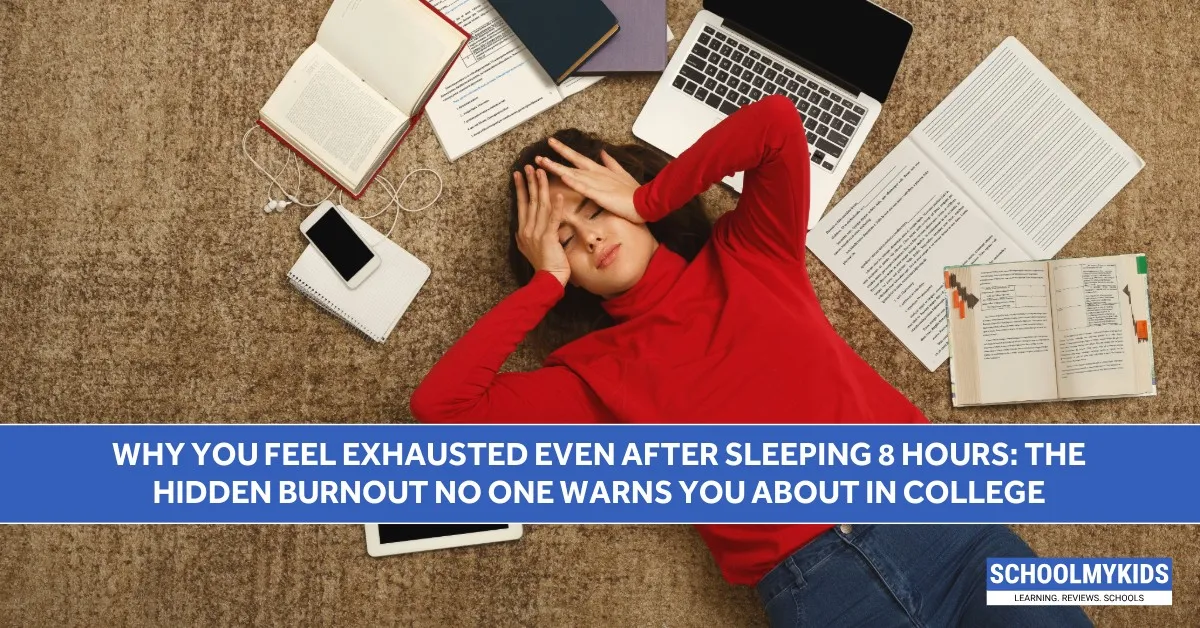
You wake up at 7 AM after sleeping for 8 full hours. Your eyes open. Your body is still heavy. The pillow looks more comfortable than facing the day ahead. You convince yourself that maybe you need another 30 minutes, but deep down, you know the problem isn’t sleep.
This is what college burnout exhaustion feels like.
It’s different from regular tiredness. It’s not about the hours you sleep. It’s about what’s happening inside your mind and body while you’re awake, and even while you’re supposedly resting.
We’ve spoken with hundreds of Indian college students across engineering colleges, medical schools, and commerce programs. Their stories are nearly identical: perfect sleep schedules, the same 8-9 hours in bed, yet waking up feeling like they haven’t slept at all. The real issue? Their brains are working overtime, even at rest.
The Problem Is Not Your Sleep, It’s Your System
When you're in college, especially in India where competition is intense and expectations are sky-high, your nervous system never actually switches off. You're juggling board exam habits (if you just transitioned from class 12), competitive entrance exam pressure, assignments that pile up unexpectedly, financial worries about your education, and the constant social comparison on college campuses.
Your sleep quality might look good on paper: 8 hours, regular timing, decent bed. But quality isn't just about quantity. Your body is running at high stress levels throughout the day. When you finally lie down, your brain is still processing the anxiety from three pending projects, the comment a professor made in class, the competitive feeling you get watching peers succeed.
These are academic burnout signs in their earliest form. It's not dramatic. It's subtle. It's the exhaustion that doesn't make sense on paper.
Why does this happen?
During high stress, your cortisol levels remain elevated. Research shows chronic stress elevates cortisol, leading to lighter sleep and reduced deep restorative phases. You might wake up multiple times without realizing it. Your deep sleep phase, where actual physical restoration happens, shortens significantly under chronic stress. So even if you're in bed for 8 hours, the restorative quality can drop notably, leaving you drained.
This is why college students who feel tired even after sleep often describe waking up feeling like they were hit by a truck.
The Burnout Pattern Nobody Talks About in College Orientation
Student wellness doesn’t start when you’re completely broken. It starts way before that, in the small decisions and patterns.
Here’s how academic stress in India evolves in most college students:
Month 1-2 of College: Excitement masks everything. You’re functional, even if you’re stressed.
Month 3-4: The initial excitement fades. Assignments stack up. Classes get harder. You start telling yourself you’ll “sleep more next week.” You don’t.
Month 5-6: You develop sleep quality college problems. You’re sleeping, but not restfully. Waking up groggy is normal now. You blame it on the weather, the heat, your mattress.
Month 7 onwards: College fatigue becomes your baseline. You don’t remember what feeling energized felt like. You drink multiple cups of tea just to function. Your social life shrinks because you’re too tired.
This is the hidden burnout no one warns you about. It doesn’t announce itself. It creeps in slowly.
Hidden Signs You’re Already in College Burnout
Check if you relate to any of these (most students do, at least three or four):
You’re scrolling your phone in bed for 20 minutes before sleep, knowing you need to wake up early, but you can’t help it. Your mind is racing.
You drink the first tea or coffee not because you want it, but because you genuinely cannot function without it.
You feel irritable or snappy with people you care about, even though you don’t mean to be.
Small things feel overwhelming. A single email from a professor sends your anxiety levels through the roof.
You’ve stopped doing things you used to enjoy (reading for pleasure, sports, hanging out with friends) because you’re “too tired.”
Your academic performance is slipping, but you’re working harder, not smarter. You’re exhausted but can’t take a break.
You catch yourself thinking about college pressures even during supposedly free time, like when you're eating or showering.
Your body feels physically tired, but your mind won’t stop. Sleep doesn’t feel refreshing anymore.
These are academic burnout signs that most college students miss until they’re completely drained.
Burnout vs. Normal College Stress: What’s the Difference?
Aspect | Normal College Fatigue | College Burnout Exhaustion |
|---|---|---|
Duration | Comes and goes with workload | Persistent, regardless of workload |
Sleep impact | Sleeping more fixes it temporarily | Sleep doesn’t restore energy |
Motivation | You feel tired but still care | You feel disconnected from your goals |
Physical symptoms | Occasional tiredness | Chronic aches, headaches, upset stomach |
How you feel about college | Manageable with stress | Dread or resentment toward studies |
Recovery time | A weekend off helps | Weeks off barely help |
The difference matters because how you treat them is completely different. College stress management works for normal stress. Burnout needs deeper intervention.
What’s Actually Draining Your Energy in College
It’s not just academics.
The comparison culture: Instagram stories of peers at internships while you're struggling with coursework. WhatsApp groups where everyone seems to be doing better. The constant, invisible competition.
Financial anxiety: Even if your family is supportive, many Indian college students carry the weight of their parents' investment. That pressure, whether spoken or not, exhausts you.
Uncertainty about the future: You’re in college, supposedly preparing for your career, but the job market is unpredictable. Companies want this skill, then that skill. Are you preparing correctly? Will you be employable? These questions drain mental energy constantly.
Unhealthy college culture: All-nighters are normalized. Working yourself to exhaustion is seen as dedication. Asking for help is seen as weakness. This culture is toxic, but it's so pervasive that students internalize it.
Sleep quality college issues: Late-night classes, early morning lectures, irregular schedules. Your circadian rhythm gets disrupted. Your body doesn't know when to wind down.
A 2025-2026 survey across Indian universities highlighted academic pressure, social comparison via social media, and family expectations as key drivers, with over 46 percent of students reporting significant anxiety symptoms.
By 2026, more Indian colleges are expanding wellness programs. They recognize that all-nighters and perfectionism harm long-term success. Early steps through campus resources make a real difference.
Practical Solutions for College Burnout, Exhaustion, and Student Wellness
These aren’t generic tips. These are actual changes that students have reported work:
Create a real stopping point for your day. Not just when you go to bed, but when you actually stop working. Most students keep their laptops open during dinner or while studying, which means their brain never actually registers “okay, work time is over.” Pick a time (say, 9 PM), and when it hits, everything shuts down. No checking assignment portals, no opening your academic email. This simple boundary helps your nervous system actually relax.
Move your body, even briefly. Not a 1-hour gym session. Even 10 minutes of walking helps reset your nervous system. Many students find that a short walk after class or before sleep dramatically improves their sleep quality and college experience.
Actually talk to someone. Not just vent to friends (though that helps), but reach out to college counselors or resources like AISA (All India Students Association) mental health initiatives, or even online therapy platforms now available to Indian students. Academic burnout signs worsen when you’re isolated.
Give yourself permission to underperform sometimes. This is counterintuitive in Indian education culture, but trying to be perfect at everything is what drives burnout. Choose 2-3 things that matter most, and let the rest be “good enough.”
Sleep is not just rest; it’s preparation. Don't oversimplify "sleep more." Instead, prepare for better sleep: reduce screen time 30 minutes before bed, keep your room cool, avoid caffeine after 3 PM. Students focusing on sleep quality pay attention to these details, not just duration.
Key Takeaways
College burnout exhaustion is different from regular tiredness. Sleep alone won’t fix it because the root cause is chronic stress and nervous system dysregulation.
Academic stress in India is particularly intense due to competitive culture, financial pressure, and high parental expectations. Recognize this without judgment.
Spotting academic burnout signs early (irritability, lack of motivation, persistent exhaustion despite adequate sleep) is crucial. They’re your body’s warning system.
College fatigue that doesn’t improve with rest requires changes to your stress level, not just your sleep schedule.
Student wellness is non-negotiable. It’s not selfish. It’s foundational to actually performing well academically.
Frequently Asked Questions About College Burnout
If I’m sleeping 8 hours but still tired, does that mean I have a sleep disorder?
Not necessarily. Most likely, your sleep quality is being affected by stress and anxiety. Medical conditions are possible, but start by addressing your stress levels and sleep hygiene first. If it persists, consult a sleep specialist.
How long does college burnout exhaustion usually take to develop?
For most students, it takes 4-6 months to become noticeable. But the underlying academic stress is building from day one. The earlier you recognize and address it, the better.
Can I recover from college burnout while still being in college?
Yes, absolutely. You don’t need to take a semester off. But you do need to make real changes: reduce your course load if possible, prioritize ruthlessly, get support, and actually rest without guilt.
What’s the difference between being a dedicated student and being burned out?
Dedication energizes you. Burnout drains you. If studying or college-related activities leave you feeling more depleted than motivated, that’s a sign of burnout.
Where can Indian students get help for college stress management?
Most Indian colleges have counseling centers on campus (though they’re often understaffed). Online platforms, student helplines, and organizations like the National Student Union also offer resources. Don’t wait until you’re completely broken to reach out.
The bottom line: You’re not lazy. You’re not weak. Your body is telling you something important. Listen to it. The exhaustion you feel even after sleeping 8 hours is your nervous system’s way of saying it needs actual rest, not just time in bed. College burnout exhaustion is real; it’s fixable, and you deserve to feel energized again.







Be the first one to comment on this story.