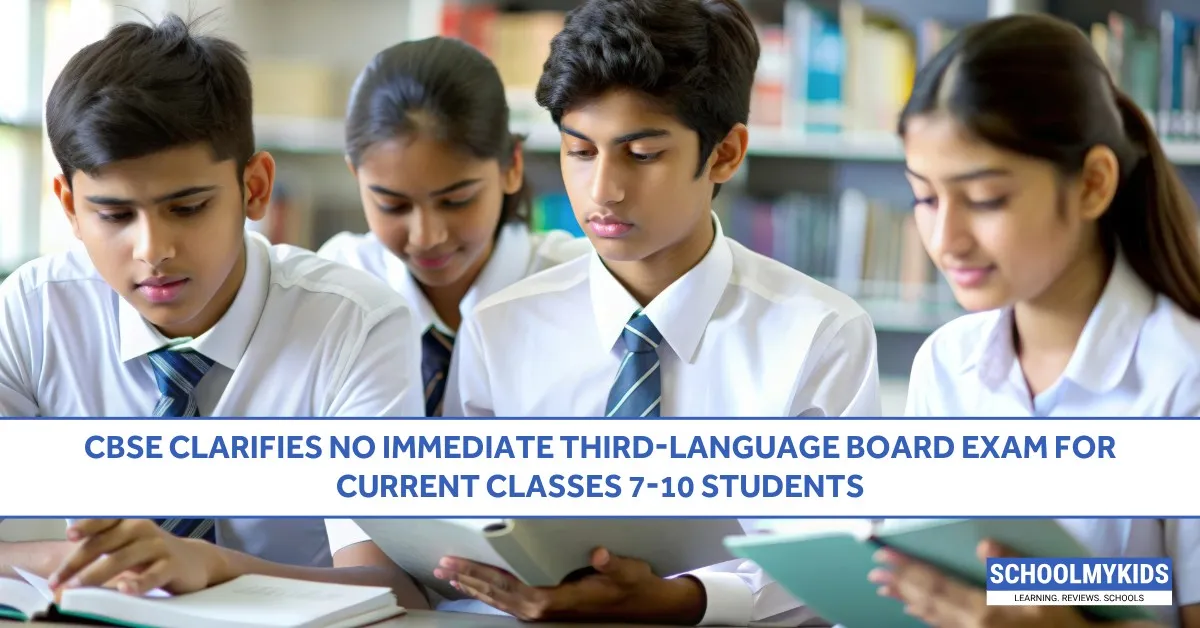
Rumors started spreading around September 2025. Parents heard through WhatsApp groups that CBSE would introduce third-language board exams. Kids in Classes 7, 8, 9, 10 would suddenly be tested on a third language. Complete panic mode.
Schools got confused. Teachers didn’t know what to prepare students for. Parents wondered whether this meant more pressure on already stressed kids. The confusion was real and widespread across the country.
Then CBSE issued key clarifications from late 2025 into 2026 with official circulars and press releases. No board examination for the third language for current students in Classes 7-10. It is not happening right now. It might happen eventually, but not for these batches. The relief was instant but left many questions unanswered.
If you’re a parent still confused about what this actually means, or a teacher implementing this in your classroom, let’s break down what CBSE actually said and what’s really going on.
Why Third-Language Got Added to CBSE Structure in the First Place
NEP 2020 reinforced the three-language formula. The idea is students should learn three languages, with at least two being native Indian languages. Sounds reasonable in theory. Implementation created chaos.
Most schools taught only two languages for Classes 7-12. Suddenly implementing three languages meant curriculum changes, teacher training, additional exams. Schools panicked. Parents freaked out. Questions piled up about timing, content, assessment methods.
CBSE tried introducing it but realized the system wasn’t ready. Teacher training incomplete. Curriculum materials didn’t exist everywhere. Assessment methods undefined. Schools couldn’t properly implement something this massive without preparation.
So they pumped the brakes. But not before confusion spread massively through parent groups and social media.
What CBSE Actually Clarified in 2025
The board issued official circulars and a press release. No board examination for the third language for students currently in Classes 7-10. These students will continue with whatever structure they are already following.
The clarification applied to both CBSE and state boards. This wasn’t just one state decision. It was a broader acceptance that the system wasn’t ready nationwide.
More specifically, current Class 7, 8, 9, 10 students won’t face third-language board exams during their remaining years in these classes. They can complete their schooling under the current two-language system.
But notice the word “immediate.” This doesn’t mean never. It means not right now. The government still intends to implement a three-language structure eventually. Just not for current batches.
Colleges and universities won’t suddenly demand third-language qualifications either. Admissions policies aren’t changing immediately. Students won’t face a disadvantage because they didn’t study a third language formally.
What Actually Changed and What Stayed Same
The third language study is becoming required from Class 9 in 2026-27 but remains without board exam pressure for current batches. If your child wants to learn a third language, they can. Many schools offer it as an additional subject. Learning it is possible. Taking a board exam in it is what got relaxed.
CBSE still recommends a three-language structure for future students. The policy didn’t reverse. Just the timeline was extended. Class 11-12 students might still face it eventually, though dates aren’t finalized.
Schools with resources continue offering third-language instruction informally. Teachers conduct extra classes. Students interested learn the language. But it won’t count as a board exam subject right now.
Board exams for current Classes 7-10 remain limited to languages their schools are already teaching. No additional subject suddenly appearing on question papers.
Internal school assessments might still include third-language components if schools want. It’s just that the board can’t mandate it immediately. Schools have flexibility about how much to formally assess it.
Why the Delay Actually Makes Sense
Implementation requires serious groundwork. Teachers need training in whatever third languages are chosen. Curriculum needs to be developed to match students’ needs. Textbooks need writing and publishing. Assessment frameworks need creating.
Doing this hastily would’ve created disaster. Students unprepared for exams. Teachers confused. Marks potentially unfair because standards weren’t established. Better to delay and prepare properly than rush and mess it up.
Schools also needed time to figure out logistics. How do you teach multiple third languages to different students in the same class? Timetabling becomes a nightmare. Teacher availability becomes an issue. Resources get stretched.
Colleges needed time to adjust admissions requirements. If suddenly a third language became mandatory, universities needed to adapt their expectations. That process takes time.
The delay gave everyone breathing room to actually prepare. By delaying for current batches, future batches can have proper implementation instead of improvised chaos. This phased approach also supports ongoing teacher training and curriculum development across schools.
When Third-Language Board Exams Might Actually Happen
Timeline remains unclear, honestly. Official announcements suggest it could be introduced for Class 11-12 students eventually. But exact year isn’t confirmed.
Official guidelines indicate a gradual rollout with clearer details for future transitions, though no fixed board exam dates are confirmed yet.
The government wants to phase it in gradually. Not suddenly forcing every school to implement everything at once. Gradual phase-in makes more sense logistically.
Different states might implement at different times. CBSE might move forward while some state boards take more time. Regional variations likely.
When it actually happens, there will probably be a long notice period. Schools get announced the change at least a year in advance. Teachers get training. Curriculum gets ready. Then it rolls out.
How This Affects Your Child Right Now
If your child is currently in Class 7, 8, 9, or 10, they do not need to worry about a third-language board exam. Their board exam structure is not changing. They can complete their schooling with whatever languages they are already studying, with internal assessments where required.
If your child wants to learn a third language, they can. It’s still encouraged. Just not mandatory through board exams immediately.
Schools might still pressure students to learn a third language even without board exams. Some schools think it’s important for development. That’s a school decision, not a board mandate.
Colleges won’t penalize students for not having a third-language qualification. Admissions criteria unchanged.
For Class 11-12 students, the timeline is still unclear. By the time they reach Class 11, the situation might be clearer. More information will come out.
Real Questions Parents Are Actually Asking
If my child doesn’t learn a third language now, will they be disadvantaged later?
Not significantly for the immediate future. Colleges don’t require it yet. The job market doesn’t demand it universally. Learning it helps but isn’t absolutely necessary right now.
Should I enroll my child in third-language classes in school anyway?
If the school offers and your child is interested, sure. Learning languages is generally good. Just don’t stress if they don’t because exams aren’t mandatory yet.
Will colleges eventually demand third-language qualification?
Possibly, but not immediately. If they do eventually, there will be a transition period where they don’t require it from students who didn’t study it.
Are state boards also delaying third-language exams like CBSE?
Most are, yes. The confusion was nationwide, so most boards took a similar stance. Check your specific state board’s announcement though.
What if my child’s school doesn’t offer third language?
No problem right now. It’s optional. Your child can survive without it for Classes 7-10. If it becomes mandatory later, there will be options.
Can my child switch third languages if they don’t like their current choice?
Usually yes within school’s policies. Switching mid-year sometimes happens; end of year happens more easily. Check your school’s specific rules.
What This Means For Long-Term Language Learning
Three-language structure still makes sense educationally. Knowing multiple languages helps cognitive development and career prospects. The policy remains sound. Just the timing changed. Research shows multilingualism supports benefits such as enhanced executive function, better problem-solving, and potentially delaying cognitive decline by 4 to 5 years on average.
Students should view third-language learning as beneficial, not burdensome. Learning to communicate in different languages has real value beyond exams.
For students genuinely interested in languages, more options exist outside board exams. Online courses, community classes, family support. Third-language learning doesn’t depend only on school.
Eventually, when board exams do come, students who learned voluntarily will be ahead. Those who wait for mandatory structure will need to rush later.
Comparison: Previous Plan vs. Current Reality
Aspect | Original Plan | Current Situation 2026 |
|---|---|---|
Third-language for Class 7-10 | Immediate implementation with board exams | No board exam; internal assessments for transitional batches |
Student requirement | Mandatory | Optional |
Board exam status | Added to question papers | Not part of CBSE Board exams; school internal only |
School flexibility | Limited | High |
Timeline | ASAP | Phased from 2026-27 with transitions |
Teacher training | Rushed | Ongoing and planned |
Curriculum status | Incomplete | Still being developed |
Student stress | Increased | Reduced |
Implementation quality | Poor if rushed | Better with proper prep |
Key Takeaways
CBSE clarified that current Class 7-10 students will not face third-language board exams immediately.
The policy didn’t reverse. It’s delayed. Three-language structure still planned for the future.
Third language remains optional for current students. Learning it is encouraged but not mandated.
Colleges won’t penalize students for not having third-language qualifications right now.
Teachers and schools got breathing room to prepare properly for eventual implementation.
When third-language does come to board exams, it will likely be better structured than if rushed.
Students interested in learning a third language can do so through school or external resources.
State boards mostly aligned with CBSE’s clarification. Check your specific board’s announcement, though.
Future Class 11-12 students might face third-language exams eventually but the timeline remains unclear.
Current batches won’t face sudden curriculum changes or additional exam pressure.
Children with special needs receive appropriate relaxations as per relevant guidelines.
Parents should review their specific school and state board updates for smooth implementation.







Be the first one to comment on this story.