The Direct Answer: What The Law Actually Says
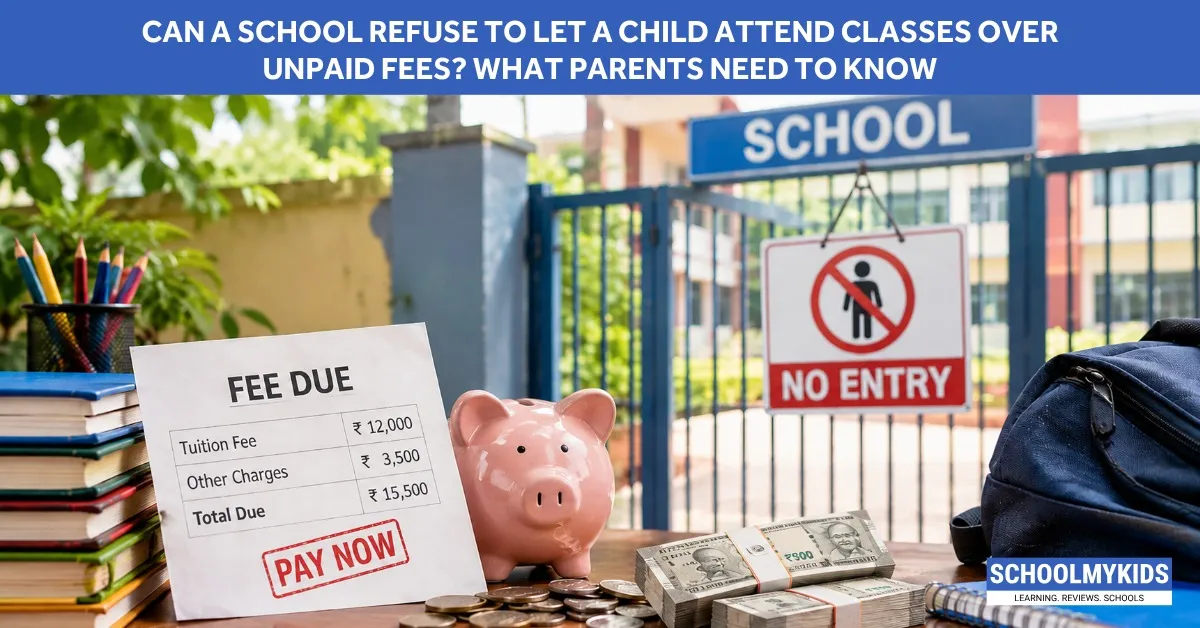
No. A school cannot refuse to let your child attend classes because of unpaid fees. Not in the middle of the academic year. Not even if the fees are significantly overdue.
Multiple court rulings confirm this. The National Human Rights Commission. State High Courts. The Bombay High Court in 2026. All agree on the same thing. Education is a right. Fees are a separate issue.
The right to education cannot be suspended for non-payment of fees.
What Actually Happened In Courts
Supreme Court April 2026:
The Supreme Court ruled that when the government allots a child to a school under the RTE Act, the school must admit that child immediately. No delays. No conditions. The case was Lucknow Public School, Eldico v. State of Uttar Pradesh (2026 INSC 422, decided 28 April 2026). The school tried to refuse admission citing eligibility questions. The Supreme Court said that is not allowed. Once the state forwards the name, the school is bound to grant admission.
NHRC February 2026:
The National Human Rights Commission held that schools cannot withhold CBSE board exam admit cards over unpaid or disputed fees. In a February 2026 intervention involving Apeejay School, Saket, the Commission called the denial of already-issued admit cards “per se illegal”. It said fee disputes cannot be used to stop students from appearing in Class 10 and 12 board exams.
Madras High Court Ruling (2024):
The Madras High Court ruled that schools cannot mention unpaid fees on transfer certificates. Why? Because it stigmatizes the child. It’s “socio-economic stigmatisation.” The court said this violates Section 17 of the RTE Act, which prohibits mental harassment of children.
What Schools Actually Cannot Do: The Legal Restrictions
Prevent Classroom Attendance Mid-Session:
Even if fees are unpaid, a school cannot stop your child from coming to class. Not for a day. Not for a week. Not mid-session.
Why? Because attendance and fees are two separate legal issues. You can dispute the fee. But that dispute doesn’t pause your child’s right to learn.
Delhi High Court (2023) and the Bombay High Court (February 2026) have both held that a child cannot be stopped from attending classes or expelled mid-session solely for unpaid fees during elementary education.
Withhold Admit Cards:
Schools often threaten this. “Pay fees or no exam card.” Courts have ruled this is “per se illegal.” Admit cards are issued by the board (CBSE, state board, etc.), not by the school. The school is just holding it temporarily. They cannot use it as leverage.
Prevent Board Exam Attendance:
Schools have tried barring students from exams over fee disputes. Courts consistently reject this. Education is a fundamental right. Exams at Class 10 and 12 are too important to be suspended for fee disputes.
Mark Your Child As Absent:
A school cannot mark your child absent if they’re actually attending classes. Even with unpaid fees. If the child shows up, they’re present.
Mention Non-Payment In Transfer Certificates:
Schools sometimes put “fees unpaid” on TCs to punish families. Courts have said this is harassment. It’s punitive. It affects the child when trying to get into another school. Not allowed.
What Schools CAN Actually Do: Their Legal Rights
Schools do have legitimate options. They’re just limited.
Refuse Re-Admission The Next Year:
A school can tell you they won’t admit your child into the next class if fees from the current year remain unpaid. This is their right. But they must inform you in writing well in advance. And they have to follow proper procedures.
Take Legal Action For Dues:
Schools can file cases to recover outstanding fees. They can approach consumer courts. They can hire recovery agents. These are legitimate ways to collect dues.
Use EMI Or Payment Plan:
Instead of refusing to let your child study, schools can offer EMI (Equated Monthly Installment) options. Flexible payment plans. This way, fees get paid without disrupting education.
Ask For a Guarantor:
For EWS (Economically Weaker Section) students or those with payment issues, schools can ask for a guarantor. Someone responsible for the fees. This protects the school without blocking education.
Important Distinction for Elementary Classes (Age 6-14)
Under the RTE Act, children in Classes 1 to 8 enjoy stronger protection. Bombay High Court in February 2026 set aside the expulsion of a Class 7 student solely for unpaid fees, holding that such action violates Section 16 of the RTE Act before the child completes elementary education. Schools may still recover dues through legal means, but they cannot remove the child mid-stream.
What the Law Does Not Stop Schools From Doing
Schools retain the right to recover outstanding fees through civil courts or consumer forums. They can also refuse re-admission for the next academic year if previous dues remain unpaid, provided they give written notice and follow their own rules and state education regulations.
Why Schools Still Try This: The Reality
Despite court rulings, schools still try to block classes over fees. Why?
Some do it out of desperation. The school has cash flow problems. They need fees to pay staff. So they pressure families.
Some do it because they don’t know the law. Especially in smaller cities. They think it’s a normal practice.
Some do it to pressure families into paying. They figure fear will work. “If your child misses class, you’ll pay quickly.”
None of these reasons are legal. But they still happen.
What You Should Actually Do: If This Happens
If your school refuses to let your child attend class over unpaid fees:
Document Everything:
Write down the date. Time. Who said what. Get it in writing if possible. If the principal tells you in person, send an email afterward: “Just to confirm, you said my child cannot attend classes until fees are paid.”
Respond In Writing:
Send a letter to the principal citing:
Section 17 of the RTE Act
The NHRC order on withholding admit cards (February 2026)
The Madras High Court ruling on transfer certificates (2024)
Delhi High Court (2023) and Bombay High Court (February 2026) rulings on mid-session attendance and expulsion
Keep a copy for yourself.
Escalate to the District Education Officer:
If the school doesn’t budge, write to the District Deputy Director of Education. Include your documentation. This is official. Schools take these complaints seriously.
Contact The NHRC:
The National Human Rights Commission accepts complaints about education rights violations. This is serious. Schools know about it.
Consult A Lawyer:
Education lawyers exist. Many offer free consultations. A cease-and-desist letter from a lawyer sometimes works faster than anything else.
The RTE Act: What It Actually Protects
The Right of Children to Free and Compulsory Education Act, 2009 guarantees:
Free education to children age 6-14
Schools cannot demand payment for textbooks, uniforms, transport, or other costs during this age
25% of seats in private unaided schools go to EWS children (fees paid by government)
Schools cannot discriminate based on caste, religion, or economic status
Schools cannot harass or intimidate children
Section 17 specifically says schools cannot inflict mental harassment. Courts have treated actions that stigmatise or block a child’s education over fees as falling under this prohibition.
The Reality In Government Schools
Government schools should not charge fees at all for Class 1-8. Education is supposed to be free.
Yet some government schools still collect “optional” fees. Building fund. Sports fee. Technology fee. All supposedly optional but practically mandatory.
Even these fees cannot be a reason to refuse class attendance. The law is the same.
What About EWS Students: Special Protection
If your child is admitted under the EWS quota, the government pays the fees directly to the school.
Sometimes the government delays payments. Parents then get blamed for “unpaid fees” that they never owed.
If this happens, it’s the school’s problem. The government is responsible. The school cannot take it out on the child.
Document that the school is EWS-allocated. Keep proof that the government is responsible for fees. Use this if there’s ever a dispute.
The Student’s Perspective: Why This Matters
Imagine being a student. You’re worried about studies. You come to school. The teacher says, “You can’t be in class.” Your parents are fighting about fees. You feel ashamed. You fall behind.
This damages children emotionally and academically. Courts understand this. That’s why they’ve ruled consistently against it.
Your child’s education matters more than fee collection. That’s the law.
Key Takeaways
Schools cannot refuse class attendance mid-session for unpaid fees (Delhi High Court 2023, Bombay High Court February 2026)
Withholding admit cards and preventing board exam attendance over fees is illegal (NHRC February 2026 and High Court rulings)
Schools can refuse re-admission next year if fees are unpaid (must inform in writing)
Schools can take legal action to collect fees (legitimate option)
Mentioning non-payment on transfer certificates is harassment (Madras High Court 2024)
Mental harassment related to fees violates RTE Section 17
Document everything if the school tries to prevent attendance
Moving Forward
If your school is blocking your child’s attendance over fees, you have legal recourse. The law is on your side.
Schools need fees. But they need to collect them properly. Not by blocking children’s education.
If your school is doing this, fight back. Send the letter. Escalate the complaint. Talk to a lawyer.
Your child’s right to education cannot be suspended. Period.
Sources
Lucknow Public School, Eldico v. State of Uttar Pradesh, 2026 INSC 422 (Supreme Court, 28 April 2026)
NHRC intervention in Apeejay School, Saket matter (February 2026)
State of Tamil Nadu v. All India Private Schools Legal Protection Society (Madras High Court, July 2024)
Delhi High Court order on mid-session attendance and board exams (January 2023)
Bombay High Court, Nagpur Bench (February 2026) on expulsion of Class 7 student for unpaid fees






Be the first one to comment on this story.