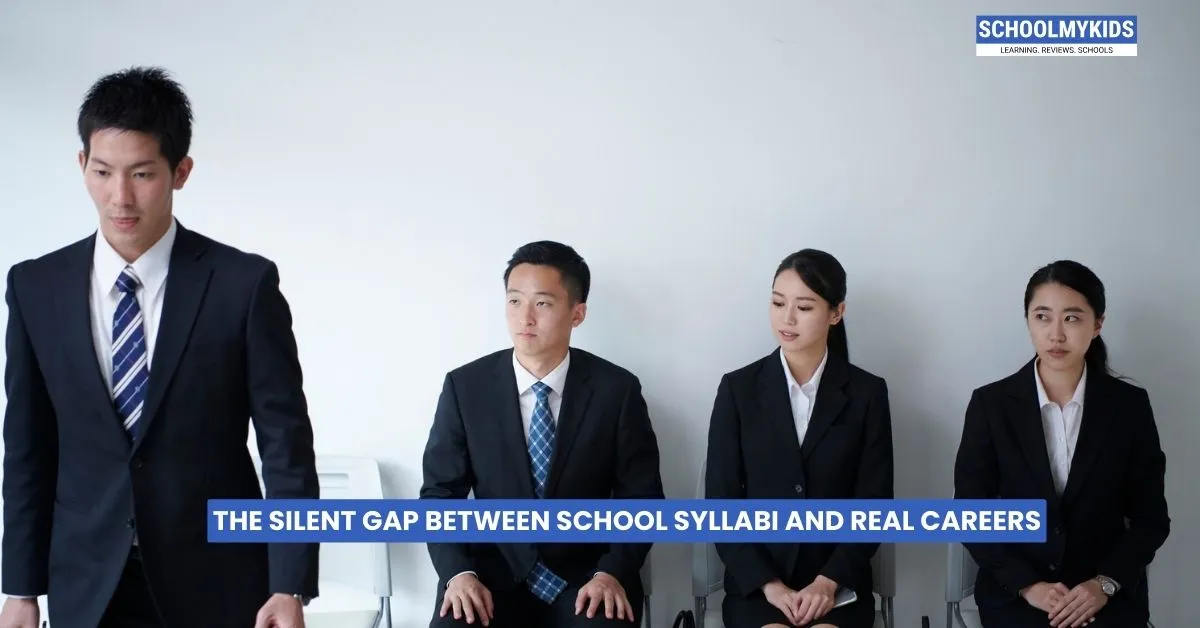
We grow up with a very clear roadmap: go to school, get good grades, get a degree, and land a great job. It sounds like a perfect equation. Input→Output. But for millions of graduates every year, stepping out of the university gates and into the corporate world feels less like a smooth transition and more like falling off a cliff.
You might have memorized the Periodic Table or mastered the dates of the French Revolution, but suddenly you are asked to "manage stakeholder expectations" or "pivot a strategy," and you realize—none of this was in the syllabus.
This disconnect is what experts call the Skills Gap, but let's call it what it really is: the silent gap between what we are taught and what we actually need to do.
The Theory vs. Practice Dilemma
The first major crack in the foundation is the heavy reliance on theory over practice.
The "Swimming Textbook" Analogy
Imagine you want to learn how to swim. In a typical school setting, you would spend three years studying the hydrodynamics of water, the history of the breaststroke, and the chemical composition of chlorine. You would pass a written exam with flying colors. But the moment you are thrown into a pool, you sink.
Schools are excellent at teaching you about things, but careers require you to do things.
The obsolescence of Static Knowledge
Textbooks take years to write, edit, print, and distribute. By the time a computer science student opens a textbook on "Modern Web Development," the technology might already be outdated. Industries move at the speed of light; syllabi move at the speed of bureaucracy.
In a real career, the ability to learn new tools quickly is far more valuable than the specific tools you learned in college.
The "Soft Skills" Void
If you look at a typical report card, you see rows for Math, Science, English, and History. What you don't see are grades for "Conflict Resolution," "Email Etiquette," or "Resilience."
Yet, when you talk to hiring managers, these are the traits they are desperate for.
Communication is Currency
In school, "collaboration" often means a group project where one person does all the work and everyone gets the same grade. In the workplace, collaboration is the lifeline of survival. You need to explain complex ideas to people who don't understand your field. You need to persuade a boss to give you a budget. You need to deliver bad news without burning bridges.
Most students graduate without ever sending a professional email or conducting a difficult negotiation, yet these are daily tasks in almost every career path.
Emotional Intelligence (EQ)
In an academic setting, your success is largely solitary. If you study hard, you get an A. It doesn't matter if you are grumpy or difficult to work with.
In a career, you can be the smartest person in the room, but if you lack Emotional Intelligence (EQ)—the ability to understand your own emotions and those of others—you will hit a ceiling. Schools rarely teach us how to handle the pressure of a deadline without snapping at a colleague or how to accept feedback without taking it personally.
The Linear Path vs. The Jungle Gym
Perhaps the biggest lie the syllabus tells us is that progress is linear.
The "Ladder" Mindset
School trains us to think in ladders: First grade leads to second grade, which leads to third grade. It’s a straight line up. Naturally, we expect careers to work the same way: Junior Executive → Senior Executive → Manager.
The Reality of Squiggly Careers
Real careers are rarely straight lines. They look more like a jungle gym. You might move sideways to learn a new skill, take a step back to join a better industry, or completely change fields in your 30s.
Because schools don't prepare students for this ambiguity, many young professionals feel like failures the moment their path deviates from the "plan." They haven't been taught how to pivot or how to view a lateral move as a growth opportunity.
How to Bridge the Gap Yourself
So, the system is imperfect. Does that mean you are doomed? Absolutely not. It just means you have to take ownership of your education beyond the classroom.
Be a "T-Shaped" Learner
A "T-Shaped" person has deep knowledge in one area (the vertical bar of the T) and a broad range of general skills (the horizontal bar).
- The Vertical (School):
- The Horizontal (Self-Taught):
Don't wait for a professor to assign a book on leadership. Read it yourself. Don't wait for a class on Excel. Watch a tutorial tonight.
Seek Internships and Mentorships
There is no substitute for being in the room where it happens. Internships aren't just about getting coffee; they are espionage missions. You are there to observe: How do people talk in meetings? How do they handle a crisis?
Find a mentor—someone who is doing what you want to do—and ask them, "What is the one thing you wish you knew when you started?" Their answer will likely be more valuable than an entire semester of lectures.
Conclusion: The Syllabus is a Map, Not the Territory
The gap between school and work is real, but it isn't insurmountable. Education provides you with the foundation—the vocabulary and the basic concepts. But building the house is up to you.
Key Takeaways:
- Value adaptability over memorization.
- Invest in your soft skills.
- Don't expect a straight line.
Remember, your degree gets your foot in the door, but your curiosity, attitude, and willingness to learn are what will open it wide.






Be the first one to comment on this story.