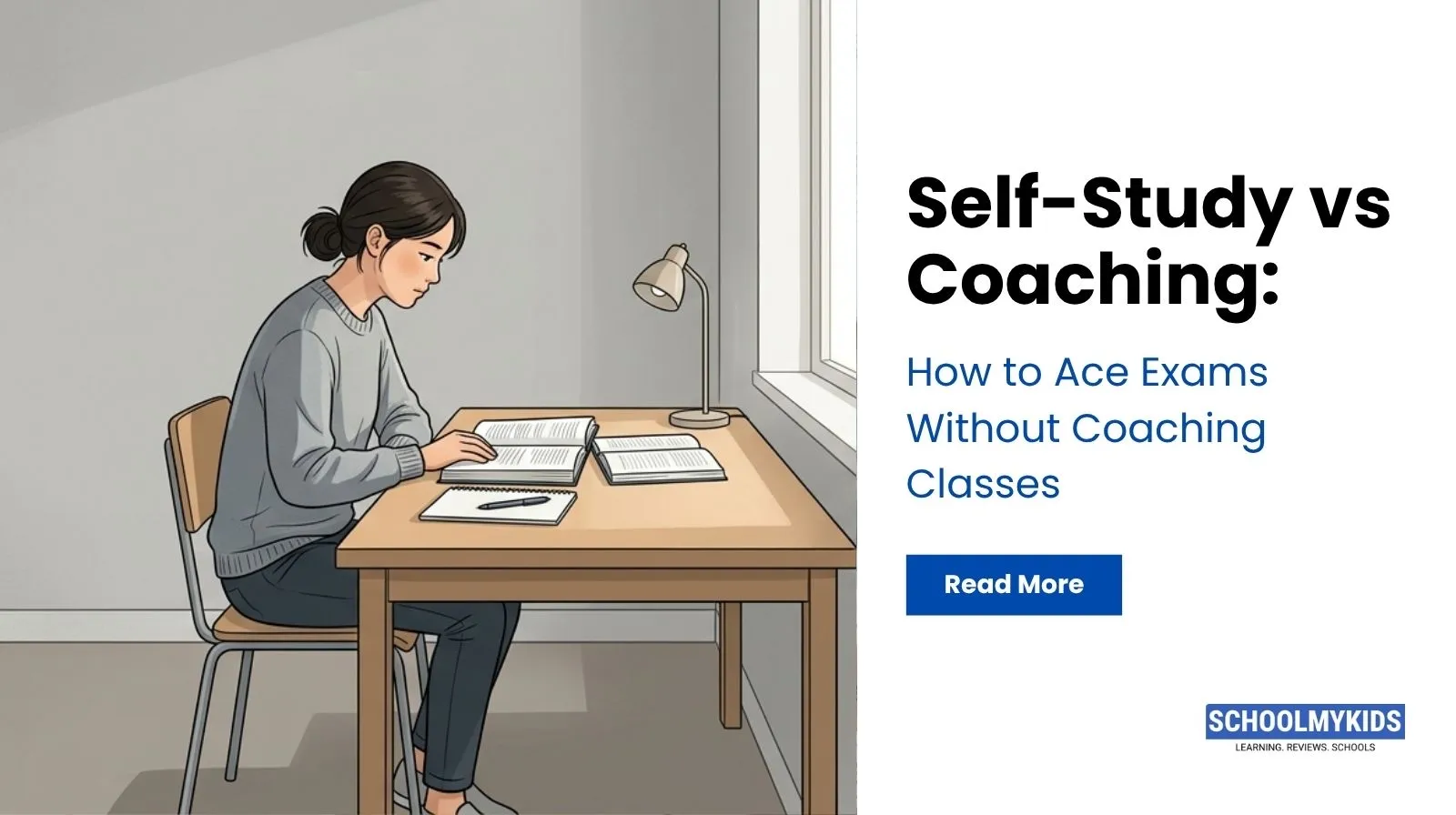
Every year, millions of Indian families face the same crossroads: enroll in coaching classes or trust the power of self-study? With CBSE Class 10 board exams drawing approximately 26.6 lakh students annually and the combined Class 10 and 12 figure nearing 46 lakhs alongside hundreds of thousands of JEE and NEET aspirants, the pressure to make the "right" choice has never felt heavier.
Here is the truth no one tells you upfront: your results are not decided by whether you attend coaching. They are decided by what you do in the hours you study alone. This guide breaks down how to study without coaching, build a self-study timetable that actually works, and crack even the most competitive exams from the comfort of your own home.
The Coaching Culture in India: Where Does It Stand in 2026?
India's education ecosystem has long been dominated by coaching institutes. But something has shifted significantly in the past three to four years. The rise of free and affordable digital learning platforms, combined with the National Education Policy (NEP) 2020 pushing for competency-based understanding over rote memorization, has rewritten the rulebook entirely.
Notably, CBSE has introduced a two-phase board examination system from 2026 onwards: Phase 1 runs in February and March, while Phase 2 (for improvement or compartment) runs from May to June. This gives self-study students an additional layer of flexibility that coaching-dependent students rarely plan for. Students in small towns who could not afford ₹2–5 lakh coaching fees are now scoring 95+ in board exams through disciplined self-preparation alone.
The question is no longer can you study without coaching? The right question is how do you study without coaching and win?
Self-Study vs Coaching: Understanding the Real Difference
Factor | Coaching | Self-Study |
|---|---|---|
Cost | ₹1–5 lakh per year | Near zero to minimal |
Flexibility | Fixed schedule | Fully customizable |
Pace | Batch-driven | Personal |
Personalization | Low | High |
Accountability | External | Self-driven |
What coaching gives you: A fixed schedule imposed from outside, access to experienced faculty, a competitive peer group, and structured mock test cycles.
What self-study gives you: Complete control over your pace, the freedom to revisit difficult topics as many times as needed, zero commute time, and the ability to mix and match the best resources available at a fraction of the cost.
The honest reality? Many toppers credit their self-study hours and not classroom time as the decisive factor in their success. Coaching can provide scaffolding, but the structure is something you can absolutely build for yourself.
How to Build a Self-Study Timetable for Class 10 (Step-by-Step)
A self-study timetable for Class 10 is not just a table with time slots filled in. It is a strategic document that accounts for your syllabus, your weak areas, exam dates, and your natural energy patterns throughout the day. Six to eight hours of structured daily study is the recommended range but quality and focus matter more than raw hours.
Step 1: Map Your Exam Dates First
The CBSE Class 10 Board Exams 2026 Phase 1 were conducted from February 17 to March 11, 2026. For future academic years, your timetable must begin at least five months before your first paper. Work backwards from your exam date and not forwards from today.
Step 2: Categorize Subjects by Difficulty
Divide your five main subjects into three groups: easy, moderate, and challenging. Assign more daily time to your challenging subjects but never eliminate the easy ones, as they need revision too.
Step 3: Plan Your Daily Blocks
A practical structure for a student without coaching:
Morning (6:30 AM – 9:00 AM): Your sharpest hours. Use these for Mathematics or your hardest subject.
Post-school (4:00 PM – 6:30 PM): Conceptual subjects like Science (reading, understanding, note-making).
Evening (7:30 PM – 9:30 PM): Social Science, Languages, or revision of the morning's work.
Post-dinner (10:00 PM – 10:30 PM): Light review only (flashcards, quick-recall, or glancing at the day's error log). No new topics at this hour.
Sunday: Full-length mock test + error analysis. No new topics.
Step 4: Build In Revision Cycles
Every topic you study needs to be revisited within 48 hours, then again after one week, and once more before the exam. This spaced repetition converts short-term memory into long-term recall, and no coaching class can do this for you.
Step 5: Include Buffer Days
Leave one weekday per week as a flexible buffer. Use it to catch up on missed targets, clear doubts, or simply rest. A timetable with no breathing room collapses within two weeks.
Top Self-Study Tips for CBSE and ICSE Students
Master NCERT Before Anything Else
For CBSE students especially, NCERT is the exam. Every answer, every diagram, every definition is potential exam material. With competency-based questions now making up nearly 50% of the CBSE paper under NEP 2020 guidelines, understanding concepts deeply (not memorizing them) is what separates high scorers from the rest.
Use Previous Year Question Papers as Your Mirror
The moment you finish a chapter, pull out PYQs from that topic. They tell you exactly how the board frames questions and which concepts return year after year.
Make Handwritten Notes in Your Own Words
After reading a section, close the book and write what you understood in your own language. This single habit improves retention dramatically and forces genuine comprehension over passive reading.
Solve Sample Papers Under Real Exam Conditions
Sit at a desk, set a timer for three hours, and write a full paper without pausing. No phone. No interruptions. Review every mistake immediately after. This builds the accuracy and time management that determines your final score.
Record Your Mistakes in an Error Log
Keep a dedicated notebook for errors, including wrong answers, calculation mistakes, and misread questions. Review it every Sunday. Patterns will emerge. Those patterns are your exam weak points, and fixing them is worth more than studying ten new chapters.
Best Free and Affordable Resources for Self-Study in India (2026 Onwards)
For CBSE and ICSE Board Students:
cbse.gov.in and cbseacademic.nic.in - Free sample papers, syllabi, and official marking schemes
ncert.nic.in - Free PDF downloads of all textbooks
DIKSHA App - Government of India's official curriculum-aligned platform for all boards
YouTube - Countless free lectures by subject experts, many aligned chapter-by-chapter to NCERT
Khan Academy India - Excellent for Mathematics and Science conceptual clarity
For Competitive Exam Aspirants (JEE / NEET):
Physics Wallah (PW) YouTube and App - Comprehensive JEE and NEET content at minimal or zero cost
NCERT Exemplar Problems - Essential for the analytical depth required by entrance exams
Allen / Aakash Test Series - Available at a fraction of full-course fees; replicate real exam conditions without full enrolment
The 2026 Edge: AI-Assisted Self-Study
In 2026, you are not just studying with books. You have access to AI tools that function like personal tutors. Tools like Google Gemini and Khanmigo (Khan Academy's AI) allow you to explain complex Physics derivations in simple language, generate instant practice quizzes from specific NCERT paragraphs, and summarise long chapters into quick-revision bullet points. Used wisely, these tools compress revision time without compromising depth.
Managing Digital Fatigue During Self-Study
Without the physical change of environment that a coaching center provides, self-study students often face screen fatigue. Here is how to manage it:
The 50/10 Rule: Study for 50 minutes, then take 10 minutes of non-screen rest, like stretch, hydrate, or simply look out a window.
Use Focus Apps: Tools like Forest or Focus@Will block distractions and train your phone to work for your study session, not against it.
Protect Your Sleep: Seven to eight hours of sleep nightly is non-negotiable. Students who manage their energy (not just their time) consistently outperform those burning midnight oil on depleted reserves.
FAQ: Self-Study vs Coaching for Indian Students
Q1. Can I score 90+ in CBSE boards without coaching?
Yes. Thousands of students achieve 90+ marks through NCERT mastery, consistent sample paper practice, and a structured daily schedule. The CBSE exam pattern is transparent, there is no material that only coaching students have access to.
Q2. What is the ideal self-study timetable for Class 10 students?
An effective self-study timetable for Class 10 should include dedicated slots for each subject daily, a revision block in the evening, a light post-dinner review, a full mock test every Sunday, and one buffer day per week, starting at least five months before your first board exam.
Q3. Is coaching necessary for cracking JEE and NEET?
Coaching is helpful but not mandatory. Many aspirants clear JEE Mains and NEET through structured self-study paired with a quality test series. Both self-study for board exams and competitive exam prep require the same core ingredient: consistent, focused daily effort.
Q4. How can I stay motivated while studying alone for months?
Break your goal into weekly milestones. Track progress visibly. A chapter checklist, a mock test score graph. Connect with online student communities. And remember: every hour of self-study builds the discipline that serves you well beyond any single exam.
Q5. Can I use AI tools for self-study for board exams?
Absolutely. In 2026, tools like Google Gemini can explain difficult concepts, generate practice questions, and help you revise faster. Use them as supplement tools and not replacements for reading NCERT and solving papers yourself.
The Bottom Line
The debate between self-study and coaching often misses the most important point: the student sitting at the desk matters infinitely more than what is written on their class schedule. With CBSE's new two-phase board system offering a built-in second opportunity, self-study students in 2026 have more flexibility than any previous generation.
Whether you are working through a self-study timetable for Class 10 boards or cracking competitive exams alone, the fundamentals remain unchanged. Start with a clear plan. Use NCERT as your anchor. Practice with real papers. Review your errors obsessively. Protect your sleep.
Your exam. Your effort. Your result.
Explore more study guides, free printables, CBSE notes, and board exam resources on SchoolMyKids, your complete companion for education in India.
Note: All brand names mentioned are trademarks of their respective owners and are referenced here solely for educational purposes.








Be the first one to comment on this story.