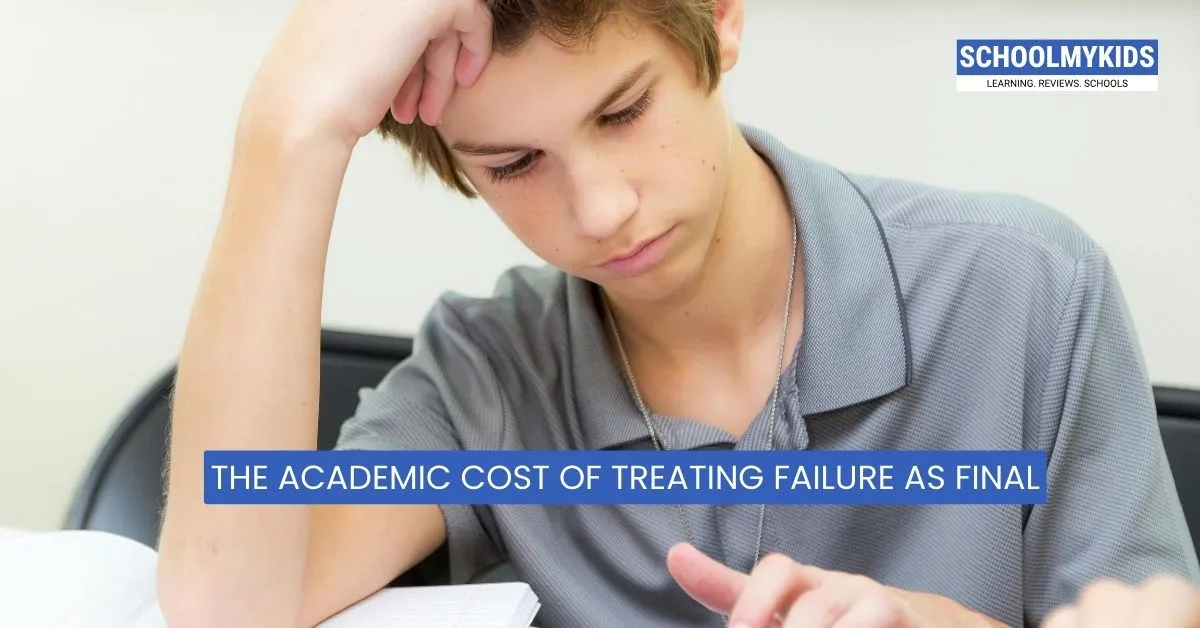
When One Mistake Starts Defining Everything
In most schools, failure is framed as a verdict, not a phase.
A low score. A failed exam. A poor performance. These moments are recorded, ranked, remembered, and quietly attached to a student’s identity. Over time, students stop seeing failure as information and start seeing it as evidence.
Evidence that they are not good at a subject. Evidence that they are behind.Evidence that they should stop trying.
This shift carries a heavy academic cost, one that is rarely acknowledged.
How Schools Turn Failure Into a Label
Failure becomes final not because of the mistake itself, but because of how systems respond to it.
Marks Freeze Students in Time
A single assessment often outweighs weeks of effort. Report cards capture outcomes, not trajectories.
Improvement is rarely visible. Recovery is rarely celebrated. What stays visible is the failure.
Students learn quickly that early mistakes follow them, even after understanding improves.
Rankings Lock Comparisons in Place
Once students are ranked, failure stops being private. It becomes social.
Students who fall behind are treated differently. Expectations drop. Opportunities narrow. Confidence erodes.
The system moves on, but the student stays stuck.
Why Fear of Failure Shrinks Learning
When failure feels permanent, students adapt in predictable ways.
Risk-Taking Disappears
Students avoid challenging questions. They stick to familiar formats. They choose safe answers over thoughtful ones.
Learning becomes defensive.
Exploration Feels Dangerous
Trying a new approach risks getting it wrong. Getting it wrong risks confirmation of inadequacy.
So students stop experimenting. Curiosity fades. Growth slows.
The Psychological Toll of Final Failure
Treating failure as final reshapes how students see themselves.
Fixed Self-Concepts Develop
Students internalize statements like:
- “I’m bad at math”
- “Science isn’t for me”
- “I’m not smart enough”
These beliefs form early and harden quickly, even when evidence changes later.
Effort Starts Feeling Pointless
If failure defines ability, effort loses meaning. Why try harder if outcomes feel predetermined?
This is how capable students disengage quietly.
Why “Learn From Failure” Advice Doesn’t Work
Schools often tell students to be resilient without changing structures.
Resilience cannot exist where recovery is not allowed.
You cannot ask students to treat failure as temporary while systems treat it as permanent.
How Treating Failure as Feedback Changes Everything
In environments where failure is reversible, learning accelerates.
Iteration Builds Mastery
When students are allowed to revise, retry, and resubmit, mistakes become stepping stones.
Understanding deepens because students stay engaged long enough to improve.
Confidence Comes From Recovery
Students who recover from failure trust their ability to adapt. This confidence is more durable than confidence built on early success.
What Schools Can Do Differently
Changing the role of failure does not require lowering standards.
Separate Assessment From Judgment
Feedback should guide improvement, not label ability. Descriptive comments matter more than final scores.
Make Improvement Visible
Track progress over time. Celebrate growth, not just outcomes.
Allow Safe Failure Early
Early mistakes should carry low stakes. This builds tolerance for challenge later.
Normalize Struggle Publicly
When struggle is acknowledged as part of learning, students stop hiding it.
What Parents Often Miss
Parents sometimes reinforce finality unintentionally.
They focus on results instead of process. They remember failures longer than improvements.
Children absorb this attention pattern quickly.
Asking “What did you learn from this?” matters more than “Why did this happen?”
The Long-Term Academic Cost
Students trained to fear failure:
- Avoid difficult subjects
- Underperform in unfamiliar situations
- Struggle with independent learning
- Lose confidence under pressure
Not because they lack ability, but because they were never allowed to fail safely.
Reframing Failure for What It Is
Failure is not the opposite of success. It is part of the mechanism.
When schools treat failure as information, students stay curious.When schools treat failure as final, students shrink.
Education does not need fewer failures. It needs fewer permanent judgments.
When failure becomes temporary again, learning becomes possible again.






Be the first one to comment on this story.