What Happened
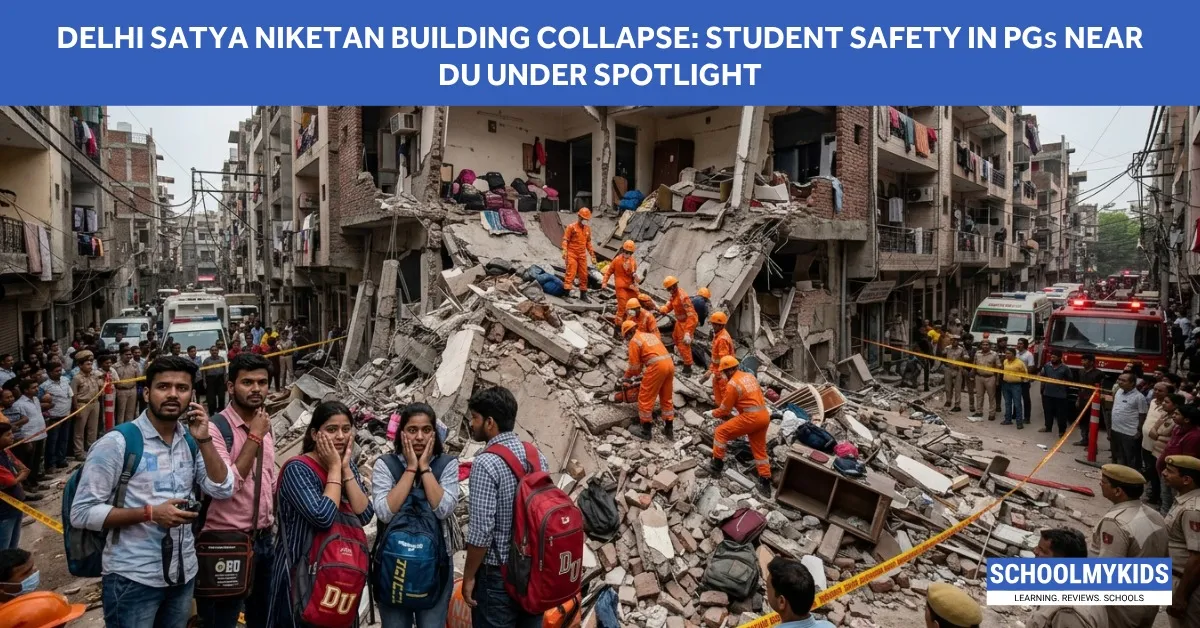
On Sunday, September 6, 2026, a five-storey building in Delhi's Satya Niketan area collapsed. The building housed a paying guest accommodation called "Hostel Daze" with around 75 beds for students.
This area is home to hundreds of Delhi University students. It’s right next to South Campus where thousands study every day.
The Building That Collapsed
Basic Details:
5-storey structure plus basement
Approximately 50 years old
Located in Satya Niketan near Delhi University South Campus
Housed male student accommodation
Capacity: approximately 75 students
Known as "Hostel Daze"
What Led To The Collapse
Repair work was underway in the basement when the building collapsed. Locals reported that water had accumulated in the basement following days of rain, which may have weakened the foundation, though the exact cause is still under investigation.
A fire official who investigated said: "This was an old building and it was not in a good condition to undergo renovation. They were breaking some structure for this purpose which led to the collapse."
Police have registered a case against the building owner and others connected with the incident.
The building didn’t need renovation. It needed demolition and rebuilding. But instead, people tried to squeeze more beds into an old structure.
The Human Cost
What We Know (as of Monday evening):
7 people confirmed dead
4 died on arrival at AIIMS Trauma Centre, 1 died later from injuries, 1 more recovered during overnight operations but brought dead
12 rescued from debris
Several with critical injuries, some undergoing treatment at AIIMS
Local residents and students pulled people out before emergency services arrived. Around 200 emergency personnel were involved in the initial rescue response. A local resident described it: "We heard people screaming. We all began removing debris. One student was stuck with his head resting on a pillow, ears bleeding."
It was luck that many students were home that day. If this had happened on a weekday morning, fewer students would have been there. But that’s not a comfort. It’s just chance.
Why This Happened (The Real Issues)
Building Quality: Old buildings converted into PGs aren’t safe. They weren’t built for that purpose. They don’t have proper fire exits. Plumbing wasn’t designed for 75 people. Electrical systems are outdated.
Lack of Proper Inspection: Nobody properly checked if this building should even operate as a PG. Or maybe someone checked but didn’t enforce standards.
Construction During Operation: The building was actively housing students while construction happened. You don’t renovate a structure while people are living in it. That’s basic safety. But it happens constantly in Delhi.
Weak Enforcement: Delhi has building safety codes. PG operators should follow them. But enforcement is loose. Nobody checks until something collapses.
Regulatory Gaps: Delhi has no dedicated law to regulate paying guest accommodations, no licensing framework, and no occupancy limits. On August 28, 2026, the Delhi Government notified the Delhi Fire Service (Amendment) Rules, 2026, prescribing 18 broad categories of fire-prevention and safety requirements, but these will come into force only when the Delhi Development Authority notifies the amended Unified Building Bye-Laws. The MCD has stated that any building over nine metres tall, or housing more than 20 students, needs a fire NOC before it can operate.
This Isn’t The First Time
Previous Incidents In 2026
In May 2026, a building operating as a PG collapsed in Saidulajab (south Delhi), killing six medical students.
Earlier in 2026, a PG building collapsed in Mehrauli (also in South Delhi), killing at least 6 people and injuring 8 others.
Same story. Old building. Converted to a PG. Cheap renovation. Collapse.
Satya Niketan itself saw a fatal building accident in 2022 during repair work.
This is a pattern. Not a one-time accident. It keeps happening because nothing changes after each incident.
The Real Problem: Student PGs In Delhi
How Many Are Unsafe?
Nobody has exact numbers. But hundreds of buildings near Delhi University house students in similar conditions. The Master Plan for Delhi-2047 recognises students as a key rental-housing group but stops short of creating a specific regulatory framework for high-density PGs.
Old residential buildings. Converted into PGs. Packed with more students than they can safely handle. Basic safety ignored.
Why This Keeps Happening
PG business is profitable. Old buildings are cheap. Renovation shortcuts save money. Nobody enforces standards. Students need cheap housing. Everyone compromises on safety.
It’s a system that incentivizes cutting corners.
What Makes A PG Actually Safe
Red Flags (Things To Avoid):
Building more than 30 years old without recent safety certification
No proper fire exits (UBBL requires at least two staircases in buildings of 15 metres or more)
Narrow stairs (minimum staircase width for hostels is 1.5 metres)
Electrical wiring that looks old or damaged
No fire extinguishers visible
Kitchen on upper floors
No emergency lighting
Overcrowding (more students than rooms can safely handle)
Construction happening while building is occupied
No six-metre right of way for fire engines
Green Flags (Things To Look For):
Recent building safety certificate from municipal corporation
Clear fire exits and evacuation routes (protected exits with fire check doors)
Fire extinguishers on every floor
Emergency lighting systems
Proper ventilation
Regular maintenance records
Clear communication about occupancy limits
Emergency contact numbers displayed
Backup power systems for critical fire and life-safety systems
Trade or health license from local MCD zone
What Students Should Do Right Now
If You’re Looking For A PG:
Ask to see the building safety certificate and trade/health license from MCD. If they don't have one or refuse to show it, don't take the room. It's that simple.
Visit during the day and at night. Check how the building feels. Are exits clear? Do fire safety signs exist? Can you easily get out?
Talk to students already living there. Ask them about safety. Ask if anything feels off.
Check the building’s age. If it’s very old, be extra careful.
If You’re Already In A PG:
Know where the fire exits are. Not in theory. Actually walk them. Know how long it takes to get out.
Ask your PG owner about safety protocols. Is there a fire extinguisher? Does everyone know where it is?
Keep important documents and valuables in a grab-and-go bag. If something happens, you’re ready.
Don’t ignore cracks in walls or ceilings. Tell the owner. If they don’t take it seriously, consider moving.
Check if the building has a fire NOC (mandatory for buildings over 9 metres tall or housing more than 20 students)
What Parents Need To Know
Before Your Child Moves Into A PG
Visit the building yourself. Don’t rely on photos or your child’s description. See it with your own eyes.
Ask about:
Building age and maintenance
Fire safety measures and fire NOC status
Number of students in the building
How many per room
Emergency protocols
Insurance coverage
Owner's contact and emergency procedures
Trade/health license from MCD
While Your Child Is In A PG
Call regularly. Don’t just ask “how are you?” Ask specifically: “Have you checked the fire exits? Do you know where they are?”
Make sure they have:
List of emergency numbers
Knowledge of nearest hospital
Connection with neighbors (so someone knows if something’s wrong)
Basic first aid kit
If Something Feels Wrong
Trust that feeling. If your child says the building feels unsafe, believe them. Don’t wait for an inspection. Get them out.
What Authorities Should Do
Immediate Actions
Inspect all PG buildings near universities
Close any that don’t meet safety standards
Force renovation or demolition of unsafe structures
Regular unannounced inspections
Long-Term Solutions
Create dedicated PG housing with proper standards
Make safety certifications mandatory (CM Gupta announced a policy for periodic structural audits for PGs, schools, and nursing homes)
Punish owners who ignore regulations
Train fire safety coordinators in each PG
Public database of approved PGs
Notify amended Unified Building Bye-Laws to enforce Delhi Fire Service (Amendment) Rules, 2026
Reality Check
Most of this won’t happen quickly. Systems move slowly. But students can’t wait. That’s why individual action matters.
The Numbers That Matter
Hundreds of students live in unsafe PG accommodation near Delhi University
Most buildings weren't designed for current occupancy
Safety inspections are rare
Enforcement is weak
This is the third major PG/building collapse in South Delhi in 2026 (Saidulajab May 2026, Mehrauli earlier 2026, Satya Niketan September 2026)
Delhi has no dedicated law to regulate PGs, no licensing, no occupancy limits
Key Takeaways
Satya Niketan collapse happened on September 6, 2026 in a 50-year-old converted PG
7 students died, 12 rescued (as of Monday evening)
Building was undergoing basement repair work while students lived there
This follows two other collapses in south Delhi in 2026 (Saidulajab May 2026, Mehrauli earlier 2026)
Police have registered a case against the building owner
CM Gupta announced policy for mandatory periodic structural audits for PGs, schools, nursing homes
Old buildings converted to PGs are inherently risky
Safety enforcement is loose
Students should check fire exits and safety features before moving in
Parents should visit the building and ask specific safety questions
What's Being Done Now
Government Response
Delhi Chief Minister Rekha Gupta visited the site on both Sunday and Monday. She announced that the government, in collaboration with the MCD, is drafting a policy to mandate periodic structural audits and safety certifications for all buildings used for public activity, including PGs, nursing homes, and schools.
Legal Action
Police have registered a case against the building owner and others connected with the incident. A magisterial probe has been ordered.
Rescue Operations
Teams from Delhi Police, Delhi Fire Service, NDRF, and DDMA are involved. Two NDRF technical teams with cutters, hydraulic jacks, and canine teams are on site.
What You Can Do Right Now
If You’re Looking For Housing: Don’t rush. Check safety first. A cheap room isn’t worth your life.
If You Know An Unsafe PG: Report it. Call the municipal corporation. Tell friends. Don’t just stay quiet.
If You’re In Politics Or Education: Push for stricter PG standards. Push for inspections. Make this a priority.
If You’re A Parent: Have the hard conversation with your child. Make safety non-negotiable. Don’t let cost override safety.
Sources
The New Indian Express, "7 killed after multi-storey hostel collapses in Delhi; 12 rescued", September 7, 2026.
The Print, "Collapsed building in Satya Niketan housed 75-bed PG; ground floor was under repair", September 6, 2026.
NDTV Profit, "Delhi Building Collapse: Six Killed, 11 Rescued - What We Know", September 7, 2026.
The Tribune, "Satya Niketan collapse exposes regulatory gaps in Delhi's congested neighbourhoods", September 7, 2026.
News18, "Delhi Building Collapse: PG and Hostel Rules - Permissions, Loopholes, And Why Do Matchboxes Thrive?", September 7, 2026.
The Hindu, "Delhi Satya Niketan building collapse September 6 2026", September 6, 2026.
Times of India, "Delhi tightens fire safety rules for buildings", August 30, 2026.




Be the first one to comment on this story.