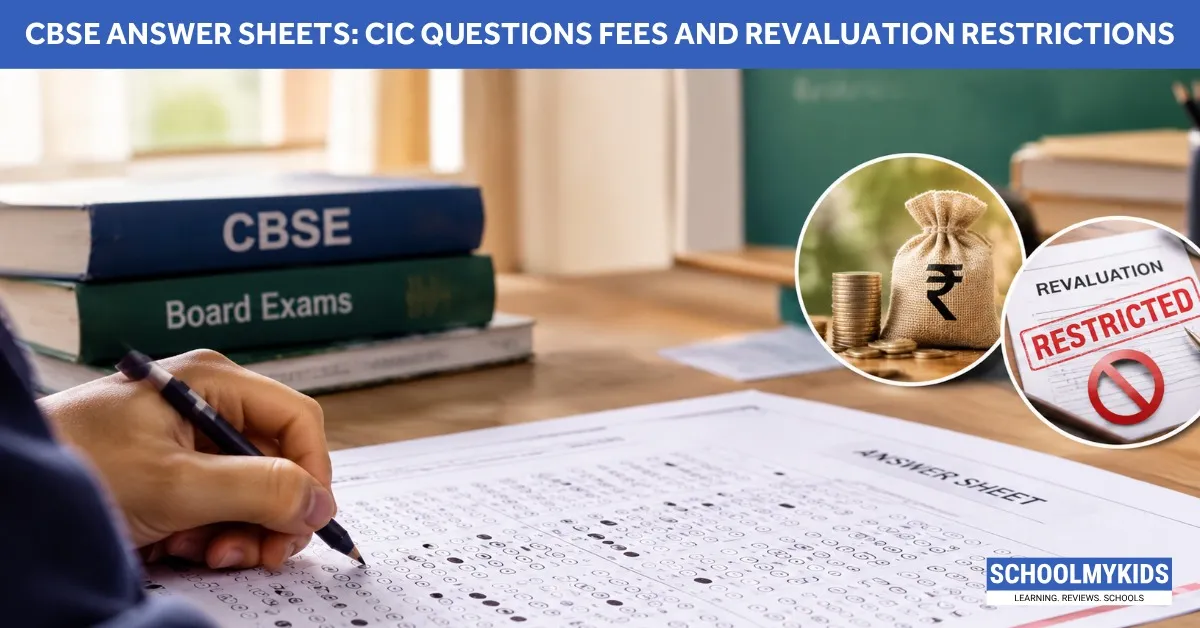
On September 7, 2026, India's Central Information Commission (CIC) directed CBSE to charge only the photocopying fee prescribed under the RTI Rules, 2012 for answer sheets.
The ruling says CBSE is overcharging. When students seek copies of their answer sheets under the RTI Act, CBSE was charging ₹500–₹700 per subject. The CIC said that’s too much. Under the Right to Information Act, the actual rate should be just ₹2 per page.
That’s a massive difference. An answer sheet might have 10-15 pages. So ₹500 suddenly becomes ₹20-30.
The CIC also said something else. CBSE had a rule that said you couldn’t ask for revaluation after getting your answer sheets through RTI. The CIC said that rule doesn’t make sense and should be changed.
Why This Happened: What Actually Triggered The Case
A Class 10 student wanted to see their answer sheet. They were unhappy with their marks. But CBSE’s revaluation costs money. A lot of money.
The student decided to use the Right to Information Act instead. RTI is a law that lets you ask for government information. CBSE is a government body, so RTI applies to them.
The student paid ₹10 for the RTI application (that’s the standard fee) and sought copies under the RTI Act because the regular CBSE process cost ₹2,500 for five subjects alone.
The student felt the high regular fees made access unfair. That’s why the matter reached the CIC.
How Much You’re Actually Paying Right Now
Normal CBSE Routes:
• Photocopy of answer sheet: ₹500 per subject
• Marks verification / re-verification: ₹500 per subject
• Revaluation per question: ₹100
(These figures reflect the higher rates that applied when the CIC case arose. CBSE later reduced its own process fees in May 2026 for the latest exam cycle.)
So if you want to see your answer sheet and maybe ask for revaluation of 5 questions, you’re looking at ₹500 + ₹500 + (₹100 × 5) = ₹1,500.
That’s real money for a student’s family.
Under RTI (According To The CIC):
• Application fee: ₹10
• Photocopy: ₹2 per page
• Inspection: Free for first hour
So the same answer sheet costs ₹10 + (₹2 × 15 pages) = ₹40 instead of ₹500.
That is more than twelve times cheaper.
What The CIC Actually Said
The commission said three important things:
First: CBSE cannot charge more than what the RTI Rules allow. The RTI Rules say ₹2 per page for photocopies. That’s it. CBSE can’t make up higher charges.
Second: The rule that blocks revaluation after RTI access is wrong. If you get your answer sheet through RTI, you should still be able to ask for revaluation. These are two separate rights.
Third: The RTI Act is more powerful than other board rules. If there’s a conflict, RTI rules win.
What Students Should Know Right Now
This ruling just happened. CBSE hasn’t changed their system yet. So right now, if you apply, you’ll probably still pay the old fees.
But the CIC has ordered CBSE to follow the new rules. How quickly they do it depends on CBSE. Usually these things take a few weeks.
Two ways to get your answer sheet:
Option One: Use CBSE’s regular system
• Pay ₹500 for photocopy
• Pay ₹500 for verification if needed
• Pay ₹100 per question for revaluation
Option Two: Use RTI
• Pay ₹10 for application
• Pay ₹2 per page for photocopies
• Then decide if you want revaluation
Most students don’t know Option Two exists. That’s the real issue here.
Understanding RTI (Right To Information)
RTI is a law that lets you ask government bodies for information. CBSE is a government organization, so they have to respond to RTI requests.
You don’t need a reason. You don’t need permission. You just ask.
How To File An RTI Request:
Visit rtionline.gov.in. Search for CBSE. Fill out the application. Say you want “photocopy of answer sheet for [your roll number], [subject], [year].”
Pay ₹10. They have 30 days to respond. If they say no or delay, you can file an appeal.
The Catch:
RTI is good for getting information. But revaluation is different. Getting your answer sheet doesn’t automatically mean your marks will change. Revaluation is when they look again and might increase your marks.
Those are two separate things. You need RTI to see the sheet. You need a formal revaluation request to ask them to reconsider marks.
The Revaluation Question: Can You Do Both?
This is where CBSE made a mistake. In its circular dated 19 May 2025, CBSE said candidates could obtain copies of answer books under the RTI Act, but requests for verification or revaluation could not be made under the Act.
Why would they say that? Probably because they thought people were using RTI to avoid paying revaluation fees. If you see your sheet through RTI, maybe you won’t ask for revaluation. That keeps CBSE’s revaluation fees coming.
But the CIC said that’s not fair. Just because you used RTI doesn’t mean you lose your revaluation rights. They’re separate.
The Supreme Court settled this point on 11 April 2019 in Institute of Company Secretaries of India vs Paras Jain. The Court held that remedies available under an institution’s own guidelines and those available under the RTI framework are not mutually exclusive.
So CBSE’s rule was wrong. The CIC is telling them to fix it.
What Actually Changes For Students
Right Now: Nothing changes immediately.
But this ruling sets the direction. CBSE has to follow it.
Soon:
You can file RTI requests at ₹2 per page instead of ₹500. This is huge for students who can’t afford the high fees.
After CBSE Updates Their System:
The revaluation block goes away. You can see your answer sheet through RTI. Then, if you want, ask for revaluation using your sheet as reference.
This gives students more options. More ways to challenge marks. More transparency.
Why This Matters: Beyond Just Money
This isn’t just about saving ₹460. It’s about fairness.
Revaluation costs money. Richer families can pay. Poorer families can’t. That gap means some students can challenge wrong marks. Others can’t. That’s unfair.
RTI at ₹2 per page changes that. Even families with limited money can afford to see the answer sheet. Then they can make an informed decision about revaluation.
This ruling helps level the playing field. That matters.
What Parents Should Do
If Your Child Just Got Results:
Check your child’s answer sheet if you’re concerned about marks. Use RTI at ₹2 per page. Look for obvious mistakes.
Don’t rush into paid revaluation immediately. First see what’s actually written.
If Revaluation Dates Are Still Open:
This ruling might help. You can get your sheet cheaper through RTI. Use it to decide if revaluation makes sense.
If you find a clear error (like the examiner forgot to count a section), then paid revaluation might be worth it.
Keep Documentation:
Save emails, receipts, dates. If CBSE hasn’t updated their system and you pay the old ₹500 fee, you might get it back later.
Key Takeaways
CIC directed CBSE to charge only the RTI Rules rate (₹10 application + ₹2 per page) instead of its ₹500–₹700 per-subject fee
CBSE’s rule blocking revaluation after RTI access is inconsistent with transparency law
RTI is a separate, cheaper way to access answer sheets
Revaluation and RTI are independent rights. You can do both
This ruling gives students more options to challenge marks affordably
CBSE hasn’t updated systems yet but must comply with the order
Moving Forward
CBSE will probably issue a notice soon. They’ll explain the new process. How to file RTI requests. How revaluation works now.
Watch your school’s notice board. Check cbse.gov.in regularly.
This ruling is good news for students. It’s about making education systems more transparent. More fair. More accessible.
The fight for fair assessment just got easier.



Be the first one to comment on this story.