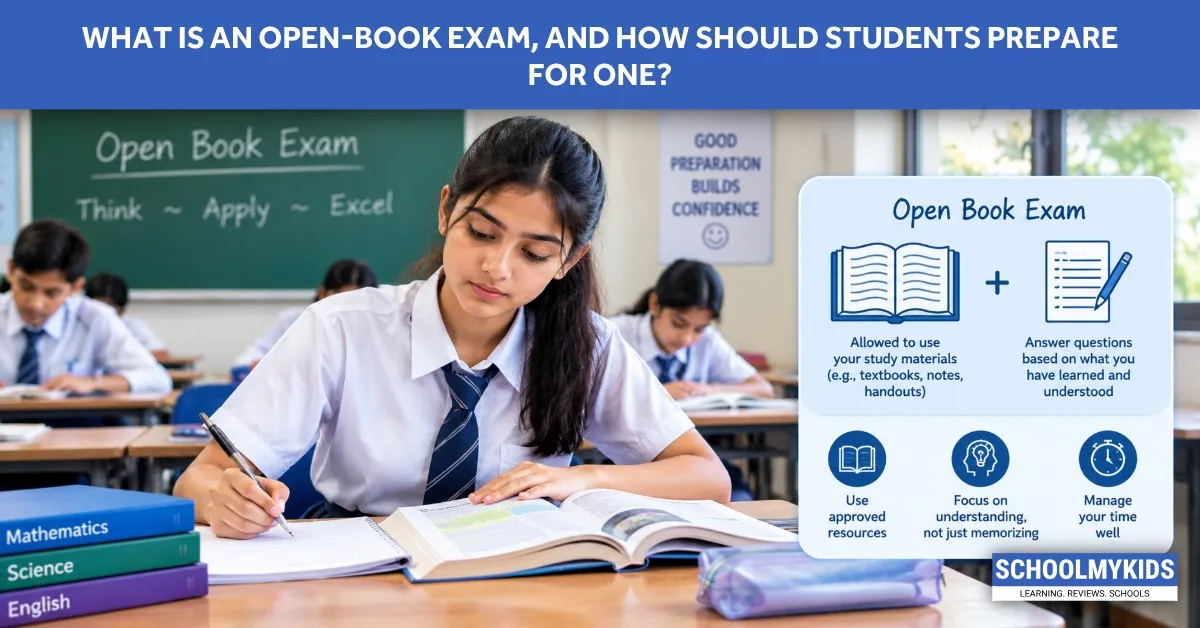
You walk into the exam hall. The student next to you is carrying four textbooks, a notebook stuffed with sticky notes, and a bag that looks like it's about to burst.
You're carrying one pen. Maybe a calculator.
Your stomach drops. Did you miss something? Is this supposed to be open book?
That confusion is common. Open-book exams have become increasingly common in some Indian universities and professional courses. CBSE is bringing them to Class 9 from the 2026-27 session as part of internal assessments, though individual schools may decide whether to adopt them. Law students write the AIBE carrying only bare acts without notes or commentary. Engineering colleges use them for internal assessments.
But most students walk in expecting an easy paper and walk out shell-shocked. Because the exam is not testing what you remember. It's testing what you can do with what's in front of you.
What Exactly Is an Open-Book Exam?
It means you can bring reference material into the hall. That's the simple part.
The complicated part? Every institution has its own rules about what counts as "reference material."
Some colleges allow only textbooks. Some allow handwritten notes. Some allow both, but no loose sheets. Some allow two books and nothing else. Some allow laptops, some don't.
Some universities, including Delhi University during the pandemic, used open-book formats for certain internal or special assessments. The UGC has encouraged varied evaluation methods, including open-text-based approaches, as part of assessment reforms.
So the first thing to do is not to prepare. The first thing to do is find out what your specific college allows. Ask your teacher. Read the exam notice carefully. Do not assume.
Why It's Harder Than It Sounds
An open-book exam is not easier. It's a different kind of hard.
A closed-book paper asks: "Define photosynthesis." You memorise the definition. You write it. Done.
An open-book paper asks: "A plant is kept in a room with no sunlight for a week. Using your understanding of photosynthesis, explain what will happen and why." You cannot copy this from a textbook. You have to think.
The questions are designed to test application and analysis, not recall. The book is there as a safety net. Not a substitute for studying.
Research on open-book formats suggests they don't automatically make things easier. If you don't understand the topic, the book won't tell you where to look. And if you do know where to look but spend the whole exam flipping pages, the material slows you down.
The Preparation That Actually Matters
You cannot prepare for an open-book exam the night before. Not because you need to memorise, but because you need to organise.
Think of it like this. You have three hours. You cannot spend fifteen minutes flipping through a textbook looking for one formula. You need to find it in thirty seconds.
Build an index.
Before the exam, write a one or two-page master list of every major topic. Note the page number. Write a two-word description of what's there.
For example: "Chapter 4: Thermodynamics - page 87. First law, sign conventions, numericals."
Stick it inside the front cover of your book. You'll find things in seconds instead of minutes.
Use tabs and colours.
Physical books work best for this. Use sticky tabs. One colour per chapter. Write the chapter name on the tab.
It sounds childish. It isn't. When the clock is ticking, a coloured tab is faster than an index page.
Make a formula sheet.
If your exam involves calculations, put every formula on a single sheet. One page. At the front of your notes.
You should not be hunting for a formula during the exam. You should be using it.
The Exam Hall Strategy That Saves You
You sit down. The paper is handed out. You open your book. Then what?
Do not start reading the book. Start reading the questions.
First pass: answer what you know without opening the book.
This feels counterintuitive. Why not use the book for everything? Because the book slows you down. If you know the answer, write it. Save the book for the questions that actually need it.
This first pass builds momentum. It banks easy marks. It settles your nerves.
Second pass: use the book for the harder questions.
Now you open the book. But you don't read whole chapters. You use your index, your tabs, your formula sheet. You find the relevant section and you apply it.
If you spend more than two minutes searching, move on. Circle the question. Come back later.
Third pass: the leftovers.
Return to the circled questions. Try them with whatever time is left.
In exams with no negative marking, attempt everything. In exams with negative marking, don't make wild guesses. Use elimination, and only guess when the marking scheme makes it worth the risk.
What Students Get Wrong
They think they don't need to study.
This is the biggest mistake. The book is not a replacement for understanding. If you don't know the concept, you won't know which page to open. You'll just flip randomly.
They bring disorganised notes.
A pile of loose sheets with no order is worse than no notes at all. You'll spend the whole exam sorting through paper instead of writing answers.
They search for every single answer.
Some students open the book for every question. They run out of time. They don't finish the paper. The clock kills them.
They bring the wrong edition.
Law students have made this mistake with bare acts. The Bharatiya Nyaya Sanhita replaced the IPC with effect from 1 July 2024. Carrying an old IPC is not just unhelpful. It's actively harmful.
They forget to check what's allowed.
Some exams allow only handwritten notes. Some allow only textbooks. Some allow both but no loose sheets. If you bring something that's not allowed, you can be disqualified. Read the rules before the exam, not on the morning of.
What About CBSE's New Open-Book Plan?
CBSE is introducing Open Book Assessments for Class 9 from the 2026-27 session. These will form part of the three pen-paper assessments per term and will cover languages, Mathematics, Science, and Social Science.
The board wants to move away from rote memorisation toward competency-based learning. The pilot study showed student scores ranging from 12% to 47%, with many struggling to use the available resources effectively. Teachers were more supportive of the idea than students.
The assessment is expected to be optional for schools at first. CBSE is likely to provide guidelines and sample papers.
Students may be allowed to refer to textbooks, class notes or other approved resources. But the exact rules will come in CBSE’s official guidelines, so check with your school early. Do not assume notes or textbooks will automatically be allowed.
So if you're in Class 9 in a CBSE school, ask your teacher whether your school is adopting it. Don't assume. Don't panic. Just ask.
A Few Things Students Ask
Can I write answers word-for-word from the book? You can, but you shouldn't. Open-book questions are designed to test application. Copied answers often miss the point of the question. Use the book to support your thinking, not replace it.
What if I don't finish the paper? Attempt the questions you're confident about first. An incomplete paper with strong answers scores better than a complete paper with copied, irrelevant answers.
Do I need a separate book for every subject? No. You need one well-organised book or set of notes per subject. Quality of organisation matters more than quantity of material.
Is it okay to bring extra books just in case? No. Extra books mean extra time wasted deciding which one to open. Bring what you've indexed. Trust your index.
The exam is not easier because the book is open. It's harder because you have to think. The book is a tool. You are still the one doing the work.
Walk in with an index, a pen, and a plan. That's enough.



Be the first one to comment on this story.