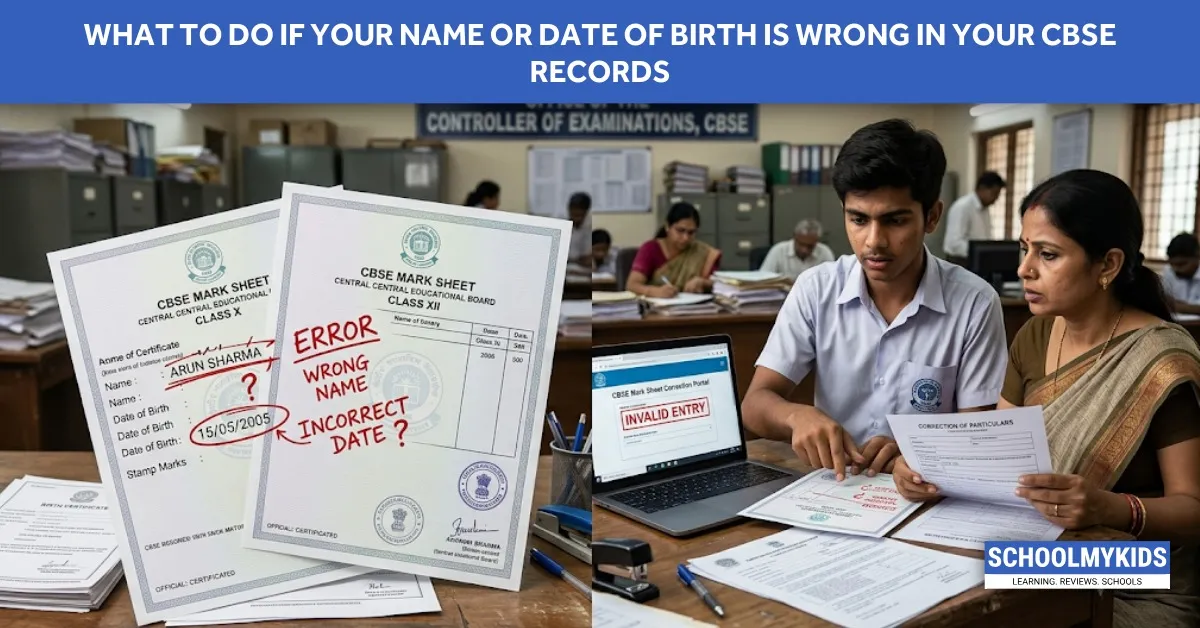
You check your Class 10 marksheet online. The school name is right. The roll number is right. The date of birth is not yours.
Or maybe the spelling of your name has an extra letter. It has been there since Class 1. Nobody noticed until the board certificate arrived.
It happens more than you think. And the fix is not a phone call to CBSE. There is a process. Miss one document, or miss the correction window, and the file sits in a drawer. So, let's see what the rulebook actually says.
Why the Mistake Happens in the First Place
The board does not type your name from thin air. Your school uploads it. The school copies it from the admission form your parents filled out years ago.
That form goes into the scholar register. Then the transfer certificate. Then the Class 9 registration. Then the List of Candidates, or LOC, before the board exam.
CBSE says schools and parents get around 20 chances to check these details before the marksheet is printed. Class 9 registration. Registration card. LOC submission. Admit card undertaking. The same cycle again in Class 11 and 12.
Still, mistakes slip through. A spelling typed wrong in Class 1 stays wrong. A date entered in the wrong format stays wrong. Nobody checks until the certificate is in your hand.
The Time Limit You Cannot Ignore
This is the part students find out too late.
For a date of birth correction, CBSE Examination Bye-Laws (revised by the circular of 10 November 2017 and later amendments) require the application, duly forwarded by the Head of the school, to reach the Board within five years of the result declaration for examinations from 2015 onwards. After that window, the Board will not consider it under its own process.
Name correction for spelling mistakes, factual errors and typographical errors follows the same five-year limit when the correction is meant to match the school record. Older certificates may still be governed by the earlier one-year rule that applied when they were issued.
What if you are still in school? Fix it before the LOC is submitted. That is the cheapest and fastest window. Once the board record is created, you are in correction territory.
For the 2026-27 session, the LOC correction window is November 2 to 4, 2026. If your school has generated the data verification slip and your name or date of birth is wrong, that is the window. No changes after that.
What Can Be Corrected and What Cannot
Not everything is a "correction." Some things are a "change." The difference matters.
A spelling mistake in your name, your father's name, or your mother's name is a correction. CBSE allows it if it matches your school records.
A date of birth that differs from your school records can be corrected only if the school records themselves were not altered after the exam form was submitted. The Board’s main purpose is to make its certificate match the school record as it stood at that time.
Changing your name or surname entirely is different. That needs a court order and a notification in the Government Gazette. And it has to happen before the result is published. After the result, it becomes much harder.
The Application Goes Through Your School, Not CBSE
You cannot walk into a CBSE office and submit the form yourself. The board has made this clear in the CBSE circular dated 23 September 2026 titled “Streamlining the process of corrections in the demographic details-reg. Direct applications, legal notices, and petitions from students are not entertained.
Start at the school office. Ask for the correction form. Some schools use the online e-Harkara system. Some still use the physical format listed on cbse.gov.in under "Duplicate Documents & Correction in Particulars".
Fill it carefully. The corrected spelling or date must match the supporting document exactly. Not close. Exactly.
Then attach the documents. This is where most applications die.
You need a true copy of the admission form your parents filled at the time of admission. It must be attested by the head of the school.
You need a true copy of the school leaving certificate from your previous school, if you changed schools.
You need a true copy of the page in the admission and withdrawal register where your entry is recorded.
For a date of birth correction, you may also need a birth certificate from the municipal authority. In some cases, an affidavit sworn before a notary or magistrate is asked for.
If any document is missing, blurred, or has cuttings, the board will reject the request. This is not a warning. The CBSE circular dated 23 September 2026 titled “Streamlining the process of corrections in the demographic details-reg.” says incomplete requests will be summarily rejected.
The Fee Is Not Small Anymore
From 2026, the correction fee is ₹5,000. It was ₹1,000 earlier. If you apply after a delay, add ₹1,000 for every extra year.
Students who passed in 2025 or earlier remain under the old fee structure of ₹1,000. Ask your school before paying anything.
What If the School Refuses or the Year Is Over?
This is the hard part.
If the school is not cooperating, you can escalate to the CBSE regional office. But the board will still ask for school records. Without them, the file does not move.
If the applicable time limit (five years for results from 2015 onwards, or the older one-year rule for earlier certificates) has passed, CBSE will not touch the date of birth on its own. The only route left is a court order.
Courts are not easy either. In June 2026, the Delhi High Court (Rewant Ahlawat matter) refused a date-of-birth correction sought roughly eight years after the Class X certificate was issued. The Division Bench held the plea was barred by the limitation that applied when the certificate was issued and that a date-of-birth dispute should first be pursued under the Registration of Births and Deaths Act, 1969.
There are exceptions. In July 2026, the same High Court allowed a correction based on undisputed public documents (birth certificate, Aadhaar, passport) even when the school and Board records matched each other, noting that a court’s power is not restricted by the administrative limits that bind CBSE. But those are case-by-case decisions. They take time and money.
Mistakes That Cost Students
Waiting until after the result. If you are still in school, check your details now. The LOC window is the cheapest fix.
Sending a legal notice directly to CBSE. The board has said this delays the file, not speeds it up.
Submitting photocopies that are not attested. Every copy needs the school head's signature and stamp.
Changing the school register after the exam form is submitted. Bye-law 69.2 says a correction will not be made if the school record was altered after the exam application. Do not let anyone "fix" the register quietly. It creates a bigger problem.
A Few Things Students Ask
Can I correct my name after the time limit?
Spelling and factual errors are also tied to the same limit (five years for results from 2015 onwards). After that, you need a court order.
Do I need a newspaper advertisement?
For a full name change, yes. For a spelling correction, no.
Can I apply for both name and date of birth in one form?
Yes. Mention both corrections clearly and attach documents for both.
My Aadhaar has the correct spelling but my marksheet does not. Is that enough?
Aadhaar alone is usually not enough. CBSE trusts the school admission records. Use Aadhaar as supporting proof, not the main proof.
The mistake is not your fault. But the fix is your responsibility. Start with the school office. Ask for the checklist. Get the documents attested. And if you are still studying, do it before the LOC window closes.
That window is smaller than you think.




Be the first one to comment on this story.