Why Cluttered Desks Feel Productive but Aren’t
Many students surround themselves with tools before they start studying. Multiple notebooks, highlighters in five colors, sticky notes everywhere, water bottles, snacks, phone, tablet, laptop, and background music. It looks serious. It feels like preparation.
It is mostly delay.
A cluttered desk gives the illusion of effort without demanding focus. Every extra item competes for attention, even if silently. The brain does not ignore visual noise. It processes it, and that processing drains energy.
Focus suffers long before studying begins.
Minimalism Is About Attention, Not Aesthetics
Fewer Objects, Fewer Decisions
Every object on a desk invites a micro-decision. Should I use this pen? Check that notification? Flip this notebook?
Minimalist studying reduces decision fatigue by reducing choices. When only essential tools are present, the mind settles faster into work.
This is not about beauty. It is about lowering the mental cost of starting.
Clean Does Not Mean Empty
Minimalism is not deprivation. It is intentionality.
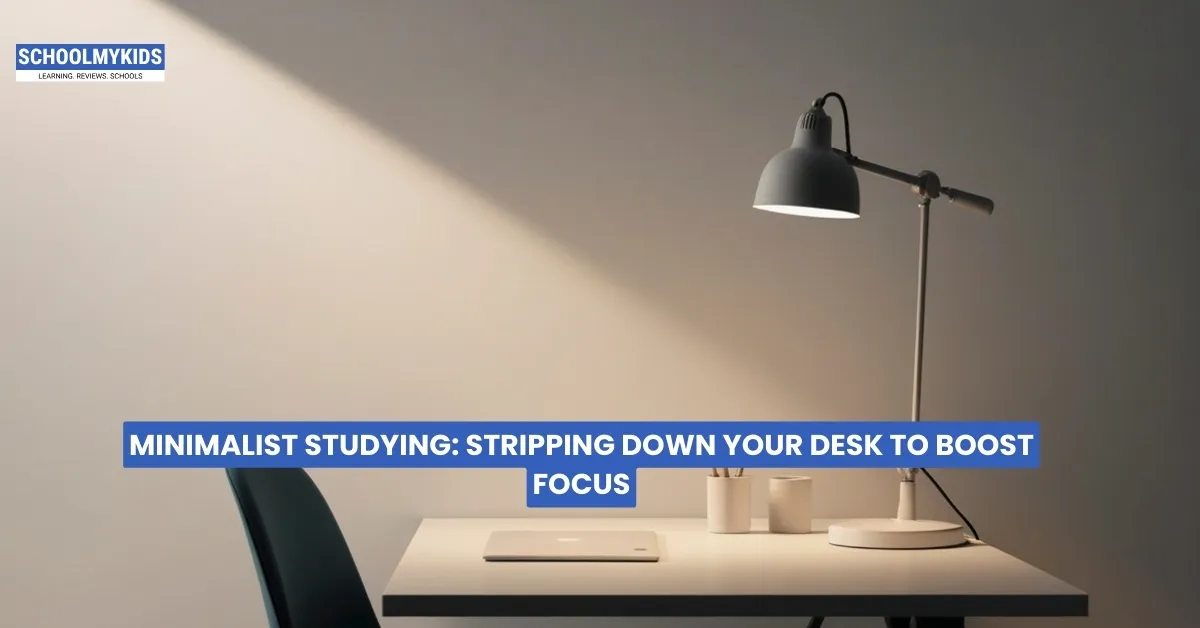
A minimalist desk holds what the current task demands. Nothing more. Nothing less.
For reading, this might mean one book and a pen. For problem-solving, one notebook and a calculator. Tools change. The principle stays.
What Actually Belongs on a Study Desk
One Primary Task at a Time
Minimalist studying begins with clarity. What is the one task being worked on right now?
Once that is defined, everything unrelated leaves the desk. Other subjects, even if important, wait their turn.
Multisubject desks invite mental multitasking. That always reduces depth.
Tools That Serve Thinking
Items should earn their place by supporting thinking, not decoration.
Highlighters that encourage mindless coloring, excessive notes that duplicate textbooks, or gadgets that invite distraction do not qualify.
If a tool does not help explain, solve, or recall, it is optional.
The Phone Problem Students Avoid Facing
Out of Sight Is Not Enough
Many students place their phone face down on the desk and call it discipline. It is not.
Even silent phones create cognitive load. Part of the brain stays alert, waiting.
Minimalist studying requires physical separation. Another room. A drawer. A bag across the room.
Focus improves dramatically when temptation is removed, not resisted.
Notifications Destroy Deep Work
Even a single notification breaks concentration and increases recovery time. Minimalist studying protects attention as a limited resource.
Silence is not empty. It is functional.
Digital Minimalism Matters Too
Too Many Tabs, Same Problem
A clean desk with a chaotic screen defeats the purpose. Dozens of tabs, split screens, and background apps recreate clutter digitally.
Minimalism applies equally to screens. One task. One window. Full attention.
Notes Should Reduce, Not Multiply
Digital notes often become endless collections. Minimalist studying favors condensed notes that force summarization.
If notes grow faster than understanding, something is wrong.
Why Minimalist Studying Improves Focus
Faster Entry Into Flow
Reducing clutter shortens the time between sitting down and starting real work. Less setup. Less hesitation.
Focus begins earlier and lasts longer.
Less Fatigue, More Consistency
Minimalist setups reduce sensory overload. This conserves mental energy, allowing longer, calmer study sessions without burnout.
Consistency beats intensity.
Common Misunderstandings About Minimalist Studying
It Is Not a Personality Type
Minimalism is a tool, not an identity. Students do not need to overhaul their lives or adopt rigid rules.
It applies only during focused work.
It Will Not Fix Poor Study Methods
A clean desk cannot compensate for passive studying. Minimalist environments support good methods; they do not replace them.
Clarity of space supports clarity of thought, not laziness.
How to Start Without Overthinking
Reset Before Each Session
Before studying, clear the desk completely. Then place only what is needed for the next task.
This reset acts as a mental signal that focused work is beginning.
Review What Stayed Unused
At the end of the session, notice what was not used. Those items should not return next time.
Minimalism improves through observation, not rules.
A Practical Way to Think About Minimalist Studying
Minimalist studying is not about having less. It is about thinking better.
A desk should not impress anyone. It should disappear from awareness.
When the environment stops demanding attention, the mind finally has room to work.
Focus is not something students force.It is something they protect.







Be the first one to comment on this story.