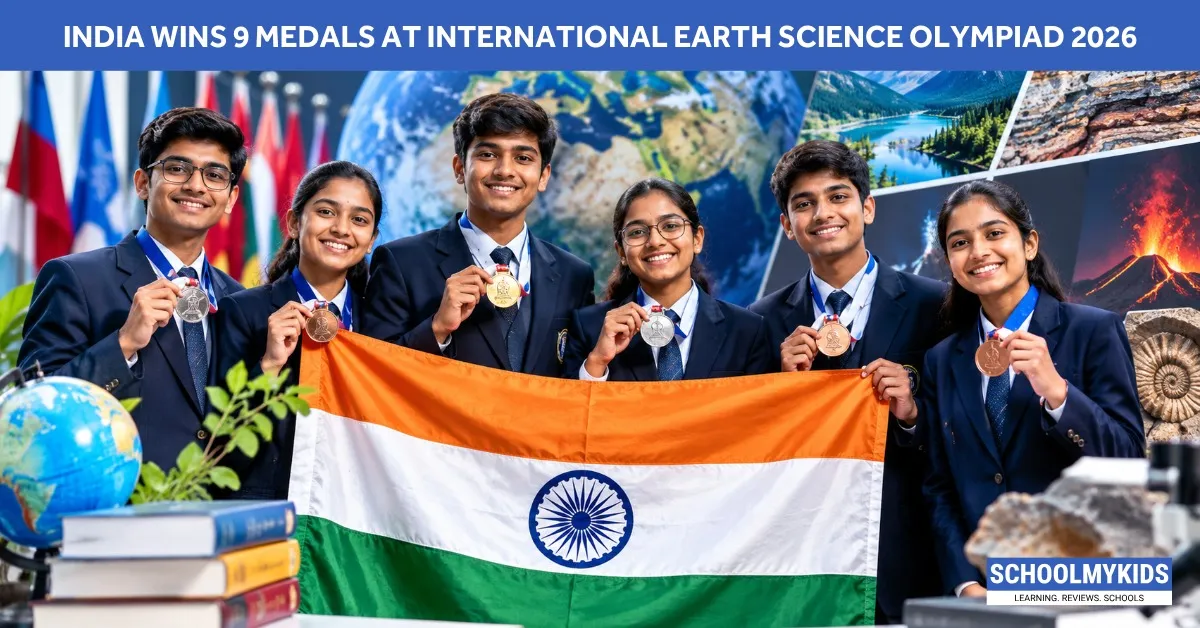
On August 27, 2026, India achieved something never done before. Team India won 9 medals at the International Earth Science Olympiad. This is the highest medal count India has ever earned in this competition.
Four of those medals were gold. Three were silver. Two were bronze.
The event happened in Turin, Italy, from August 20-27. Thirty-nine countries sent their best students (Ministry of Earth Sciences / PIB). India competed against all of them. And India won big.
On September 4, 2026, Union Minister Dr. Jitendra Singh felicitated these students at Prithvi Bhawan in New Delhi (PIB / Ministry of Earth Sciences). He called it extraordinary. He was right.
Who Were These Four Students
The Indian team had four members:
Soumik Mandal (DAV Model School, Durgapur) – 2 gold, 1 silver; finished third in overall individual ranking among participants from 39 countries
Aaron Maiti (DAV Model School, IIT-KGP) – 1 gold, 1 bronze
Riddhi Ranjan (Gyan Asthali International School, Patna) – 1 gold, 1 silver
Mohammed Ehtesham Rizvi (Jawahar Navodaya Vidyalaya, Bihar) – 1 silver, 1 bronze
Soumik Mandal was the standout performer. He won gold in the individual written and practical examination and recorded the third-highest individual score in the competition’s 19-year history (The Hindu; PIB / Ministry of Earth Sciences).
What Is Earth Science Olympiad and Why It Matters
Earth Science Olympiad isn’t like your regular school exams. It’s something completely different.
What Students Actually Do:
Written exams test knowledge of geology, meteorology, oceanography, and astronomy. But it’s not just memorizing facts. Questions go deep. They test real understanding.
Practical exams mean students do actual experiments. They might analyze rock samples. Identify minerals. Solve problems using real data.
Field investigations are the interesting part. Students go outside. They study actual landscapes. Rivers. Mountains. Weather patterns. They make observations and draw conclusions.
Project-based tasks mean students research Earth science topics and present their findings. This is where creativity matters.
Why This Matters For Your Child:
If your kid is good at science but bored by regular school exams, Earth Science Olympiad is different. It’s about real science. Real-world applications. Not just textbook knowledge.
Doing well in this competition looks incredible on college applications. Universities see this and know the student can think scientifically.
How These Students Got Here: The Selection Process
This wasn’t random. There was a system.
Step One: The Ministry of Earth Sciences held an all-India test. Approximately 17,800 students appeared across nearly 500 centres nationwide (PIB / Ministry of Earth Sciences). That’s massive participation.
Step Two: The top 25 students were selected from those approximately 17,800. That’s roughly 0.14% of participants (PIB / Ministry of Earth Sciences).
Step Three: These 25 went to an intensive three-week training camp in June 2026 at Maharaja Sayajirao University of Baroda, Vadodara, Gujarat (PIB / Ministry of Earth Sciences). They lived there, studied together, and were trained by experts.
The camp is serious business. Three weeks of concentrated Earth science training. Learning from professors. Practicing exams. Preparing for international competition.
Step Four: From those 25, the final four-member team was chosen for the international Olympiad.
Think about it. From approximately 17,800 students to 4. The selection is demanding.
What Makes This Victory Actually Important
This isn’t just a medal count. Let’s look deeper at what this means.
For India’s Scientific Talent Pipeline:
This victory shows India has young people who can compete globally in science. Not just in mathematics or computing. In Earth sciences too. This is a field where India has immense resources and potential.
For Students Interested In Science:
This proves that science careers are real and valued. These students didn’t just get medals. They got international recognition. This can shape their entire futures.
For The Ministry’s Efforts:
The Ministry of Earth Sciences has been working to build awareness of Earth system science. Programs like this Olympiad are part of that effort. The success shows it’s working.
The Subjects Being Tested: What Earth Science Actually Covers
When you say “Earth science,” most people think just geology. But it’s much broader.
Geology: Study of Earth’s rocks, minerals, and structure. How mountains form. Why earthquakes happen. What’s inside the Earth.
Meteorology: Study of the atmosphere and weather. How storms form. What causes climate patterns. How weather forecasting works.
Oceanography: Study of oceans. Currents. Marine life. How oceans affect climate. Pollution in oceans.
Astronomy: Study of space, planets, stars. How the solar system works. What’s beyond our atmosphere.
These aren’t separate subjects. They’re all connected. Earth as a system. Everything affects everything else.
This is what makes Earth Science Olympiad hard but interesting. Students have to understand how all these parts connect.
Career Opportunities: What These Students Can Actually Do
Winning medals in Earth Science Olympiad opens doors to real careers.
Climate Science: With climate change becoming critical, countries need climate scientists. These are good, well-paying jobs.
Geological Survey: India’s Geological Survey of India (GSI) hires Earth scientists. They map resources. Study geological hazards. Work on major infrastructure projects.
Environmental Consulting: Companies hire Earth scientists to study the environmental impact of projects. To find solutions to pollution. To ensure sustainability.
Oil and Gas Exploration: Energy companies need geologists to find resources. These are high-paying positions.
Meteorological Department: The India Meteorological Department needs scientists to predict weather. Understand climate. Prepare for disasters.
Research: Universities and institutes need researchers to advance Earth science knowledge.
Urban Planning: Cities need geotechnical experts to understand ground conditions before construction.
These careers exist. They pay well. Students performing at Olympiad level have access to all of them.
How To Prepare If Your Child Is Interested
Not every student will make it to the international Olympiad. But many can aim for the national level. Many can do well locally.
Start Early: If your child is in Class 9 or 10 and interested in Earth science, this is the time to start. Olympiads require deep knowledge, not cramming.
Find Good Resources: Look for coaching institutes that specifically teach for the Earth Science Olympiad. They know what’s tested. They have experienced teachers.
Practice Real Problems: Previous year question papers are available. Let your child solve them. This gives a feel for what’s expected.
Do Field Work: The competition involves actual observations. If possible, take your child to geological sites. Rivers. Mountains. Caves. Real observation matters.
Join Online Communities: There are forums where Olympiad aspirants share resources and help each other. These communities are helpful.
What The Victory Reveals About India
India has talent. In science. In research. In competing globally.
The problem isn’t ability. It’s visibility. Most students don’t know Earth Science Olympiad exists. Parents don’t encourage it.
This victory is an opportunity. It’s a moment to say to every student interested in science: “Look, India can compete globally. You can be part of this.”
The nine medals aren’t just about four students. They’re about India’s potential in science education.
What Happens Next For These Students
These four students are now ambassadors. They’ll likely get opportunities:
Scholarships to top universities
Recognition in science communities
Possible research opportunities
Media attention and interviews
Connections with scientists and researchers
Their lives just changed. Not just because they won medals. But because they proved they can think at an international level.
Many will pursue higher studies. Some in Earth sciences. Some might go into related fields. All will have doors open.
Key Takeaways
India won 9 medals at IESO 2026 in Turin (4 gold, 3 silver, 2 bronze)
Best-ever performance in competition’s 19-year history
From approximately 17,800 applicants, 4 reached international level
Earth Science includes geology, meteorology, oceanography, astronomy
Competition tests written exams, practical work, field investigations, projects
Career opportunities exist in climate science, geological surveys, environmental consulting
These Olympiads are entry points to science research careers
A Message For Young Students
If you’re in Class 8, 9, or 10 and good at science, consider this. Earth Science Olympiad isn’t just for winning medals. It’s about discovering if you like science enough to build a career in it.
Your country needs more scientists. More researchers. More people who understand how Earth works and how to protect it.
This victory by four students proves that if you put in effort, work hard, and think deeply, you can compete globally.
That opportunity exists for you too.
References:
Press Information Bureau / Ministry of Earth Sciences release, 4 September 2026
The Hindu, 1 September 2026: Team representing India wins 9 medals at 19th International Earth Science Olympiad in Italy
Times of India (Education and Vadodara editions), September 2026





Be the first one to comment on this story.