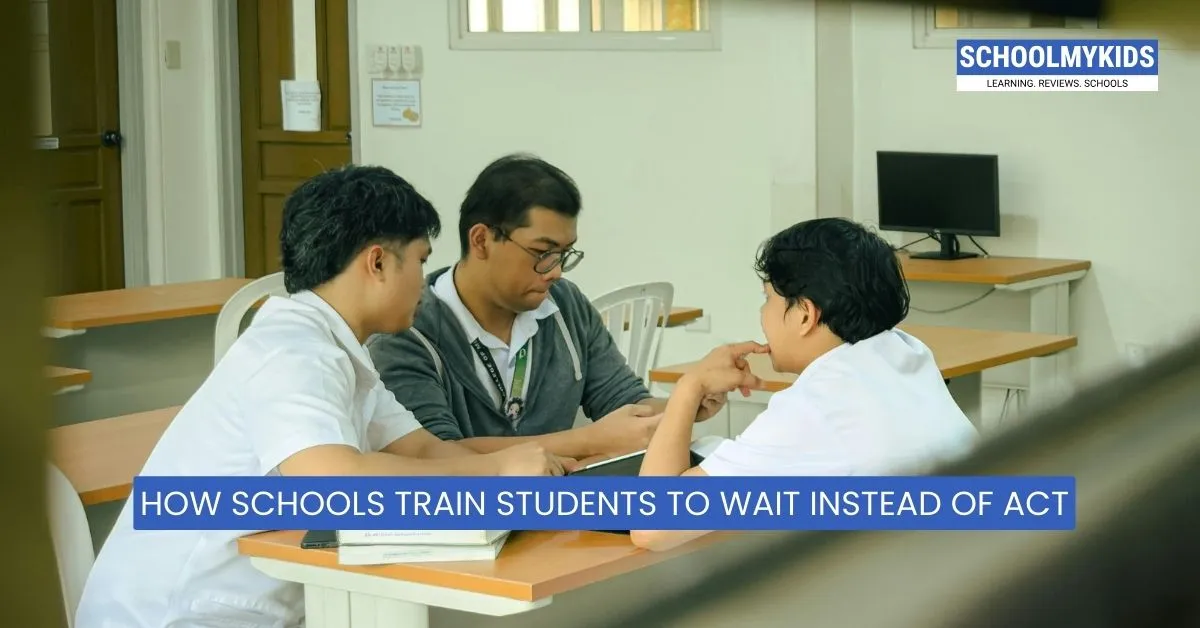
When Obedience Quietly Replaces Initiative
Walk into most classrooms and observe what good students are doing. They are sitting quietly. Waiting for instructions. Raising hands for permission. Completing exactly what was asked. Submitting work on time.
This behavior is praised as discipline and responsibility. But beneath it lies a troubling pattern.
Students are not being trained to act. They are being trained to wait.
Wait for instructions. Wait for approval. Wait for the syllabus. Wait for marks. Wait for someone else to decide what matters.
Over years, this waiting becomes automatic. And when school ends, many students struggle not because they lack ability, but because no one taught them how to initiate.
How Waiting Becomes the Default Mode
This habit does not appear suddenly. It is carefully reinforced.
Permission-Based Learning
From early grades, students learn that action requires permission. Speak only when called. Write only what is asked. Explore only what is in the textbook.
Curiosity without instruction is treated as distraction. Initiative without approval is seen as indiscipline.
Students adapt quickly. Waiting feels safe.
Instructions Over Intention
Most school tasks begin with detailed instructions. What to do. How to do it. How much to write. How it will be evaluated.
There is rarely space to decide what should be done in the first place.
Over time, students stop asking themselves:
- What do I want to explore?
- How else could this be done?
- What problem should I solve?
They wait to be told.
The Role of Assessment in Reinforcing Passivity
Evaluation systems reward compliance far more than initiative.
Acting Without Instructions Is Risky
If students try something different, they risk losing marks. If they follow instructions exactly, they are protected.
So they optimize. They minimize risk. They wait.
This trains students to associate action with danger and obedience with safety.
Marks Replace Ownership
When success is defined externally, students stop developing internal direction. They do not ask whether work is meaningful, only whether it meets criteria.
Learning becomes something that happens to them, not something they drive.
Why Waiting Feels Like Intelligence
Waiting is often mistaken for being thoughtful or mature.
Quiet Students Are Seen as Serious
Students who act cautiously are labeled responsible. Those who experiment are seen as careless.
The message is subtle but powerful: initiative is immature. Restraint is smart.
Thinking Is Confused With Hesitation
Real thinking involves trial, error, and action. Schools often reward hesitation disguised as correctness.
Students learn to delay decisions until certainty is guaranteed. That certainty rarely exists outside classrooms.
The Transition Shock After School
The cost of waiting appears later.
College and Work Expect Action
Suddenly, students are expected to:
- Ask questions proactively
- Manage time independently
- Start projects without instructions
- Make decisions with incomplete information
Many freeze. They wait for clarity that never arrives.
They were trained well for school. Not for reality.
Fear of Doing the Wrong Thing
Students hesitate to apply for opportunities, start projects, or explore ideas because they fear making the wrong choice.
Waiting feels safer than acting imperfectly.
Why Motivation Advice Fails Here
Students are often told to be confident, proactive, or self-driven.
This advice ignores training.
You cannot expect action from students who were rewarded for waiting for years. Behavior follows incentives, not speeches.
How Schools Can Teach Action Without Chaos
Action does not mean disorder. Initiative can be taught deliberately.
Open-Ended Tasks With Real Choice
Assignments that allow students to define problems, choose approaches, and justify decisions teach ownership.
The process matters more than the polish.
Valuing Attempts, Not Just Outcomes
When trying something new is rewarded even if it fails, students learn that action is safe.
This rewires fear.
Reducing Over-Instructions
Leaving space for interpretation forces students to decide. Decision-making is a skill that develops only when used.
Reflection on Decisions Made
Asking students why they chose an approach builds agency. Waiting students become thinking actors.
What Parents Often Miss
Parents sometimes unknowingly reinforce waiting.
They ask:
- What did the teacher say?
- What is the right way?
- What will be asked in the exam?
Rarely do they ask:
- What do you think?
- What would you try?
- What interests you here?
Direction is outsourced further.
Relearning How to Act
Students are not lazy or passive by nature. They are adaptive.
They learned that waiting is rewarded and acting is punished. They did exactly what the system taught them.
When learning environments reward curiosity, tolerate uncertainty, and respect initiative, students change quickly.
They stop waiting.
They start acting.
The Quiet Lesson That Needs Unlearning
School success often depends on waiting well.
Life success rarely does.
Education should not produce students who wait for permission to think, speak, or begin.
It should produce people who can act thoughtfully, even when instructions are missing.
That shift begins when schools stop mistaking obedience for readiness.








Be the first one to comment on this story.