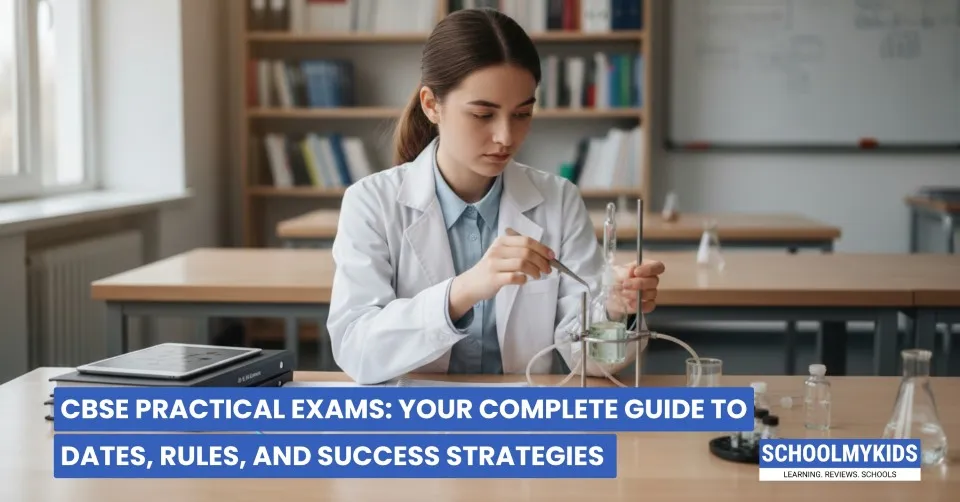
As Class 12 board exams approach, practical examinations remain a critical component that demands your attention well before the theory papers begin. With CBSE implementing updated guidelines and stricter protocols for 2026, understanding these changes and preparing strategically can make a significant difference in your final results.
Unfortunately, practical exams are often underestimated, yet they contribute substantially to your overall performance. Let's walk through everything you need to know about CBSE practical exams 2026.
Critical Timeline: Mark These Dates
Understanding the examination schedule is your first step toward effective preparation. For regular session schools, practical examinations are being conducted between January 1, 2026, and February 14, 2026. Winter-bound schools have already completed their practicals between November 6 and December 6, 2025.
Your theory exams start on February 17, 2026, so you'll have your practicals done well before that. This actually works in your favor because once practicals are over, you can focus completely on theory preparation.
Understanding the 2026 Guidelines: What's Changed and Why It Matters
CBSE has implemented comprehensive guidelines this year to enhance transparency and maintain evaluation standards across all affiliated schools. These aren't arbitrary rules; they're structured protocols designed to ensure fairness in assessment. Here's what you need to understand:
The External Examiner Protocol
Unlike Class 10, where internal assessment suffices, Class 12 practical examinations require both an external and internal examiner. This is a non-negotiable requirement. The external examiner is appointed directly by CBSE, not by your school.
This system eliminates potential bias and ensures consistent evaluation standards. Your school cannot make local arrangements for external examiners. If an appointed examiner fails to report, schools must immediately contact their Regional Office for official guidance. No practical examination can proceed without the CBSE-appointed external examiner; this rule has no exceptions.
The Batch Creation System: Structured Assessment
CBSE has introduced a systematic batch creation process to streamline practical examinations. Here's how it functions:
- Batch size: Maximum 30 students per subject batch
- Assessment schedule: Your entire batch's practical examination occurs on the same day
- Marks submission: All marks for your batch are uploaded simultaneously
- Sub-group flexibility: Within your batch, schools may create two sub-groups of 15 students each
This sub-group arrangement allows efficient use of laboratory resources, while one group performs hands-on practical work, the other completes written components, and then they switch. However, the complete batch assessment and marks upload must be completed on the same day.
Same-Day Digital Mark Entry: The Finality Factor
This is perhaps the most critical change you need to understand. Marks are uploaded to the CBSE portal immediately after your practical examination concludes, on the same day, from the school premises, by both examiners working together.
Once marks are finalized and uploaded, they become permanent. There is no provision for corrections, modifications, or reconsideration. CBSE has made this explicitly clear in their guidelines: schools requesting mark changes after upload will not be accommodated under any circumstances.
This policy places significant responsibility on both examiners and students. For you, this means your performance on the day of the practical is what counts; there's no scope for appeals or adjustments later.
Documentation Requirements: The Group Photograph Protocol
CBSE has introduced a mandatory photographic documentation requirement for accountability and verification purposes. After your practical examination, your complete batch must participate in a group photograph that includes:
- All 30 students from your batch
- The external examiner
- The internal examiner
- The observer (if appointed by CBSE for your school)
This photograph must be uploaded through a dedicated CBSE app-link. Technical specifications require:
- Clear visibility of all faces
- Laboratory setting visible in the background
- Automatic geotagging and timestamping (built into the app)
- Additional data entry: batch number, total batches, date, and time
This documentation serves as official evidence of proper examination conduct and examiner presence.
Absence Management: Know Your Options and Limitations
Medical emergencies and unforeseen circumstances are part of life, and CBSE's guidelines account for this reality. However, the protocols are specific:
If you're unable to attend your scheduled practical examination, your school can reschedule your assessment, but only within the official examination window (January 1-February 14, 2026). After February 14, no rescheduling requests will be entertained, regardless of circumstances.
The administrative process works as follows:
- Students absent on examination day are marked as "Re-scheduled" (not "Absent")
- This designation authorizes the school to conduct your practical on an alternate date
- The rescheduled examination must occur during the notified period
- Standard protocols apply: same examiner requirements, same mark upload procedures
Plan accordingly. If you're unwell or facing difficulties, communicate with your school immediately to arrange rescheduling within the permitted timeframe.
Strategic Preparation: Evidence-Based Approaches That Work
Now let's talk about how to actually prepare and ace these practicals:
1. Know Your Practical List Inside Out
CBSE provides a specific list of experiments/practicals for each subject. Go through this list on the CBSE academic website. Don't just memorize procedures; understand the concepts behind each experiment.
2. Practice Your Viva Answers
Both examiners will ask you questions during the viva. These won't be random general knowledge questions; they'll be directly related to the experiment you're performing or the project you've submitted.
Practice explaining:
- Why you're doing each step
- What results you expect
- What could go wrong and why
- How your experiment connects to real-world applications
3. Work on Your Projects Seriously
If you're doing an investigatory project, put in genuine effort. Projects that show originality and actual work get better marks. Copy-paste projects from the internet get mediocre marks. Your examiners have seen hundreds of projects, so they can tell the difference.
4. Keep Your Lab Records Updated
Your practical marks include marks for your lab records. Make sure they're:
- Complete and up to date
- Neatly maintained
- Contain all required experiments
- Include proper diagrams and observations
Don't try to complete all records in the last week. It shows, and it affects your marks.
5. The Day Before Your Practical
Check with your school about:
- Which batch you're in
- What time you need to report
- Which experiments are likely to be chosen
- What materials you need to bring (if any)
Get a good night's sleep. Being well-rested helps you think clearly during the practical and answer viva questions confidently.
Mark Distribution: Understanding the Assessment Structure
Your practical examination marks comprise multiple components, each carrying specific weightage:
- Practical performance: The actual experiment or practical work execution
- Viva-voce: Oral assessment of conceptual understanding
- Laboratory records: Year-long practical work documentation
- Project work: Investigatory project assessment (where applicable)
The exact distribution varies by subject.
Examination Conduct: What You Must Know and Avoid
CBSE's guidelines include strict protocols about examination conduct. Understanding these isn't just about compliance; it's about protecting your academic interests.
- Regarding examiner interaction: Any attempt to communicate with examiners outside the formal examination context, or any effort to influence evaluation through inappropriate means, constitutes use of Unfair Means (UFM). CBSE treats UFM cases with severe consequences. Your performance should speak for itself; that's the only appropriate approach.
- Regarding marks disclosure: After your practical examination, marks are not disclosed to students or parents. Practical marks carry the same confidentiality protocols as theory examination marks. They're revealed only when final results are declared. Do not expect or request mark information from examiners or school authorities.
The Stress Factor: Let's Address It
We understand that practicals can feel stressful, especially with external examiners watching. But these examiners are teachers just like your school teachers. They want you to do well. They're not there to fail you or make things difficult.
Most nervousness comes from being unprepared. If you've practiced your experiments, understood your project, and maintained good records, you'll be fine. Take a deep breath, follow the procedure carefully, and answer questions honestly. If you don't know something, it's okay to say "I'm not sure" rather than making up an answer
Post-Examination Protocol and Theory Preparation
Once your batch's practical is done and marks are uploaded, your part is complete. The school will send your answer books to the Regional Office. You don't need to worry about that.
Now you can focus entirely on your theory preparation. Use the gap between practicals and theory exams wisely. Your theory exams start on February 17, 2026, so you'll have time to revise everything properly.
Conclusion
The new guidelines might seem strict, but they're actually making the system more fair and transparent. Everyone's being evaluated by the same standards, with proper documentation and no scope for favoritism or errors.
Your job is simple: prepare well, give your best during the practical, and stay confident. These practical marks count toward your final result, so take them seriously, but don't stress yourself out unnecessarily.
You've got this! And remember, once practicals are done, it's one less thing to worry about during your theory exam prep.
All the best for your practicals and board exams!





Be the first one to comment on this story.