If your child is heading into Class 8 or Class 9 in the 2026–27 academic session, there is something critically important you need to know. The CBSE class 8 syllabus update and the CBSE class 9 syllabus change 2026 are not routine annual tweaks.
This guide breaks down every subject-wise change, explains what the new CBSE syllabus means in practice, and gives you clear, actionable steps to prepare confidently.
Why Is CBSE Changing the Syllabus Now?
The root of every change happening today traces back to two landmark documents: the National Education Policy (NEP) 2020 and the National Curriculum Framework for School Education (NCF-SE 2023). Together, these frameworks call for a fundamental shift, away from rote memorization and toward real-world application, competency-based learning, and skill-based thinking anchored in Indian Knowledge Systems (IKS).
This new curriculum marks a significant shift in how students will learn and be assessed, moving away from traditional rote learning and focusing instead on real-world skills and deeper understanding. The rationalized content structure follows a spiral curriculum model; concepts introduced at one stage deepen progressively at the next, rather than being taught in isolated bursts.
NCERT is implementing the most significant curriculum overhaul in over 20 years, driven by NCF-SE 2023, which itself emerged from NEP 2020. The CBSE curriculum changes are being rolled out in phases. Classes 1–8 have already received updated textbooks. Class 9 gets its new books in 2026–27, while Classes 10–12 follow in subsequent sessions.
CBSE Class 8 Syllabus Update 2026: What Has Changed?
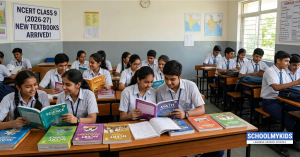
Both Hindi and English textbooks have been completely changed for the new session. The chapters and book titles differ from previous years, so students must refer only to the latest editions. The new Class 8 English textbook is Poorvi, replacing the previous edition entirely.
The most talked about change at the Class 8 level is in Social Science. The old three-book system of History, Geography, and Civics has been replaced by a single integrated volume, Exploring Society: India and Beyond. This new book covers five core themes: India and the World, Tapestry of the Past, Our Cultural Heritage, Governance and Democracy, and Economic Life.
A tech-forward update in the Geography component encourages use of ISRO’s School Bhuvan portal (powered by Bhuvan geoportal) for interactive geospatial mapping and real-time satellite data of local regions, supplementing traditional maps with digital tools.
Critical 2026 alert for parents: NCERT released Volume II (Part 2) of Exploring Society: India and Beyond in February 2026. Following objections raised over portions of the judiciary chapter, NCERT halted distribution of the book in February 2026 and announced that the chapter would be reviewed and rewritten. Volume I remains valid. NCERT has withdrawn Part 2; a revised version is expected. Schools must use only the official revised edition. Do not use the withdrawn Part 2.
Subject | Key Change in 2026 |
|---|---|
English | New textbook (Poorvi); new chapters replacing old ones entirely |
Hindi | Completely revised; old editions no longer valid |
Social Science | Single integrated book: Exploring Society: India and Beyond – Volume I valid; Volume II withdrawn per Supreme Court order (26 Feb 2026), await revised version |
Science | Concept-based, application-focused; integrated structure |
Mathematics | Spiral curriculum approach; problem-solving deepened |
Vocational Education | Introduced from Class 6 itself, continuing into Class 8 |
Important note for parents: From the 2026–27 session, the tradition of using inherited or second-hand books will lead to confusion as previous editions of textbooks will be largely irrelevant for students entering the new class.
CBSE Class 9 Syllabus Change 2026: The Biggest Shift
The CBSE class 9 syllabus change 2026 is where the transformation is particularly significant. Instead of individual disconnected subjects, Class 9 now has three clearly defined integrated parts:
Part 1 - Languages: Focused on meaningful communication, comprehension, and critical expression
Part 2 - Academic Core: Mathematics, Science, Social Science with a redesigned, competency-based approach
Part 3 - Holistic Development: Arts, Physical Education, Vocational Education, and new interdisciplinary areas including Individuals in Society
Additionally, under the NCF-SE 2023 framework, the three-language formula (with at least two Indian languages) is being strengthened. While traditionally two languages were studied, schools are aligning with the push for three languages starting from the middle stage, promoting multilingualism.
A major structural change also worth noting: rigid streams have been removed. Students can now choose interdisciplinary subject combinations. For example, Physics alongside Economics; giving learners far greater flexibility than the old Science/Commerce/Arts divisions allowed.
Subject-Wise Changes: Class 9
Mathematics
Following a spiral curriculum approach, Mathematics sees the most dramatic changes under the new CBSE syllabus 2026. The content is now organized into 15 themes rather than traditional chapters, with a strong emphasis on real-life application and computational thinking.
New additions and shifts include Logarithms (to build an earlier foundation for Physics and Chemistry calculations), Set Theory (to bridge middle and senior secondary Mathematics), and the area of cyclic quadrilaterals using Brahmagupta’s formula, a clear integration of Indian Knowledge Systems (IKS) into mainstream Mathematics. References to Baudhayana’s Sulbasutras are included in geometry content, linking ancient Indian mathematical traditions with modern concepts.
New Topic | Previously Taught In | Why Introduced Now |
|---|---|---|
Arithmetic Progression (AP) | Class 10 | Spiral Learning Foundation |
Geometric Progression (GP) | Class 11 | Progressive concept-building |
Logarithms | Class 11 (Advanced) | Builds early foundation for Physics & Chemistry calculations |
Set Theory | Class 11 (Advanced) | Bridges middle and senior secondary Maths |
Brahmagupta’s Formula (Cyclic Quadrilaterals) | Higher Secondary / Class 10 | IKS integration into geometry |
Note: Logarithms and Set Theory are part of the optional Advanced Level Mathematics.
A two-level assessment system has been introduced for Mathematics and Science: a mandatory Standard (Proficiency) Level for all students and an optional Advanced Level for students aiming for competitive exams or deeper mastery.
Science
The new Science syllabus has 12 integrated themes: Cell, Tissues, Reproduction, Diversity, Exploring Mixtures, Structure of an Atom, Atoms & Molecules, Earth as a System, Motion, Force & Laws of Motion, Work/Energy/Simple Machines, and Sound.
Earth as a System is a major 2026 highlight. It directly integrates Geography concepts like Plate Tectonics into the Science curriculum for the first time. The Gravitation chapter has been removed, while “Work and Energy” has been expanded and renamed “Work, Energy and Simple Machines,” introducing levers, pulleys, and inclined planes into the Class 9 framework.
Branch | Change |
|---|---|
Physics | Gravitation deleted; Work, Energy and Simple Machines introduced with practical machines |
Chemistry | Integrated into broader themes; application focus increased |
Biology & Earth Science | Environmental context deepened; Earth as a System (including Plate Tectonics) newly added |
Social Science
The Class 9 Social Science syllabus is structured in two parts (Part A: 9 chapters, Part B: 7 chapters). It integrates History, Geography, Political Science, and Economics into a single cohesive study of human society, prioritizing inquiry and Indian Knowledge Systems (IKS) which is a core requirement of competency-based learning under NCF-SE 2023.
English - The Kaveri Shift
The beloved Beehive and Moments textbooks are being completely replaced by a new single integrated book, Kaveri, which was released in March 2026. In a significant reduction of content load, Kaveri brings the total number of texts down from 29 to 16 (8 Prose, 8 Poetry).
Kaveri features a decisive shift toward Indian authors: it opens with Sudha Murty’s How I Taught My Grandmother to Read and also features Rabindranath Tagore and Temsula Ao, moving the curriculum away from Eurocentric literature selections of the past.
New Assessment & Exam Pattern Update for Class 9
The exam pattern update for Class 9 reflects a philosophy shift as significant as the syllabus itself. The weightage is shifting toward Continuous Formative Assessment, projects, quizzes, and the new Holistic Progress Card, providing a more holistic view alongside the year-end summative exam.
New assessment tools include Open-Book Tests, Student Portfolios for holistic growth tracking, and skill-based performance evaluation in Vocational and Arts subjects. CBSE has approved Open-Book Assessments (OBAs) for Class 9 in core subjects (Languages, Maths, Science, and Social Science) as part of three pen-and-paper internal term tests held at the school level. Board exams remain unaffected.
Early pilot studies for these OBAs showed scores ranging between 12%–47%, proving that having the book open does not make the exam easy; it makes it a genuine test of analysis over memory.
Assessment Type | Old Format | New Format (2026–27) |
|---|---|---|
Internal Exams | Closed-book recall | Open-book, application-based (3 term tests) |
Maths Assessment | Single level | Proficiency + Advanced levels |
Vocational & Arts | Written exam only | Task and creativity-based |
Projects & Portfolios | Optional/supplementary | Core part of evaluation via Holistic Progress Card |
What the New Interdisciplinary Subjects Mean
One entirely new addition deserves special attention: Individuals in Society. This interdisciplinary area allows Class 9 students to reflect on personal identity, ethics, and social harmony. It prepares them for Environmental Education in Class 10 and is assessed holistically through projects, portfolios, and presentations; not traditional exams.
Indian Knowledge Systems (IKS) are woven across subjects. From Brahmagupta’s geometry in Maths to Baudhayana’s Sulbasutras in geometry and indigenous ecological thinking in Science, helping students connect modern concepts with India’s rich intellectual heritage.
How Students Should Prepare for the New CBSE Syllabus 2026
The new CBSE syllabus 2026 rewards those who understand over those who memorize. Here is how to approach it smartly:
Get the correct new books immediately. Kaveri (Class 9 English) is already released. New Class 9 Maths, Science, and Social Science textbooks will be available on ncert.nic.in/textbook.php by end-March/early April 2026.
Shift from memorizing to understanding. The new syllabus emphasizes applying concepts. Rote learning will not deliver results under OBAs or portfolio assessments.
Prepare for higher difficulty early. Topics like AP, GP, Logarithms, Set Theory, and Earth as a System have been moved down from higher classes.
Build your portfolio from Day 1. Projects and presentations now carry real evaluation weight through the Holistic Progress Card.
Practice open-book thinking. Read with the intent to connect and analyze ideas, not just recall facts.
Guidance for Parents: How to Support Your Child
Download the official syllabus PDFs, already available on ncert.nic.in (Parts 1–3) and track new textbook releases at ncert.nic.in/textbook.php.
Verify with your child’s school that they are following the updated 2026–27 textbooks.
Class 8 parents specifically: Confirm with your school which version of Exploring Society: India and Beyond Volume II is approved after NCERT’s rewrite. Volume I is safe to use.
Avoid purchasing second-hand or previous-year books under any circumstances.
Stay updated through official CBSE circulars at cbseacademic.nic.in and avoid relying on unverified social media posts.
FAQs
Q1. Has the CBSE class 9 syllabus officially changed for 2026–27?
Yes. NCERT has released the revised draft syllabus for Class 9 aligned with NCF-SE 2023. New textbooks will be introduced from the 2026–27 session. This is the biggest revisions in over 20 years, driven by NEP 2020.
Q2. Are old NCERT books still valid for Class 9 in 2026?
No. Previous editions are largely irrelevant for students entering Class 9 in 2026–27. Beehive and Moments are replaced by Kaveri (already released). Other new Class 9 books are being released progressively for the 2026-27 session; verify latest availability on official NCERT site.
Q3. What is the biggest change in the CBSE class 8 syllabus update?
The most significant change is the integration of History, Geography, and Civics into one book called Exploring Society: India and Beyond, covering five core themes, along with completely new English (Poorvi) and Hindi textbooks.
Q4. Will the new exam pattern affect Class 9 board preparation?
Board exams remain annual and are unaffected. However, school-level internal assessments now follow an open-book, application-based format across three term tests, with Holistic Progress Cards replacing simple marks-based tracking. Students need applied thinking skills, not just recall ability.
Q5. Where can I download the official CBSE/NCERT syllabus for 2026–27?
Visit cbseacademic.nic.in/curriculum_2027.html for the official CBSE Curriculum 2026-27 PDFs (Secondary Curriculum Part-1 for Class IX). For NCERT textbooks, check ncert.nic.in/textbook.php. The draft syllabus (Parts 1–3) aligned with NCF-SE 2023 is available on the NCERT website.


Be the first one to comment on this story.