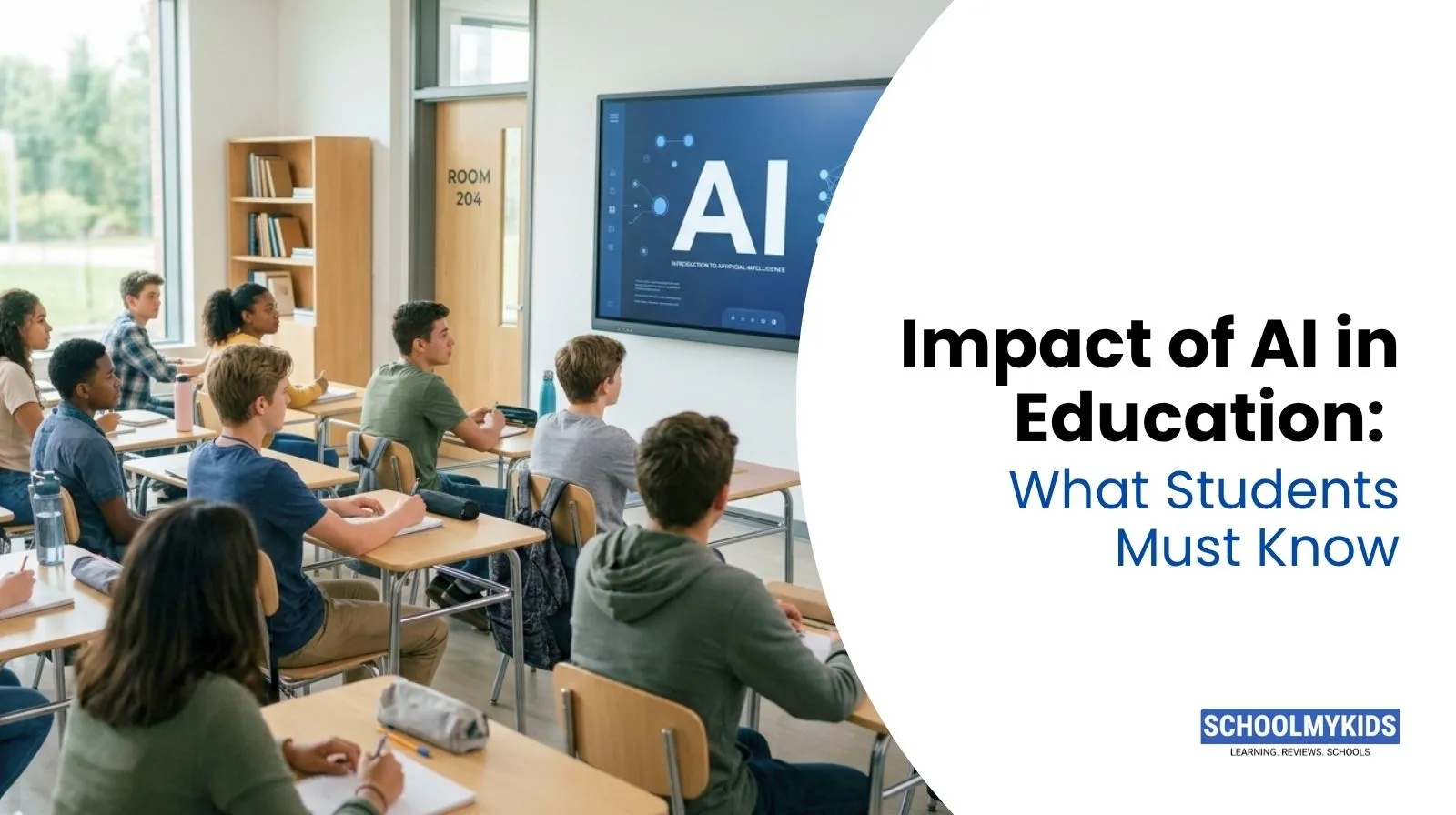
Imagine sitting in a Class 10 classroom in Pune. Before your teacher even starts the lesson, your study app already knows you are struggling with quadratic equations. It does not just give you the answer; it automatically adjusts your practice set to simplify the logic.
This is not science fiction. Pilot implementations and AI-enabled learning platforms are now reaching a growing number of Indian schools. But as we embrace this shift, we must ask: Is AI a crutch or a catalyst? This guide explores the benefits, risks, and significant policy shifts shaping the future of learning under NEP 2020 and NCF-SE 2023.
What Exactly Is AI in Education?
One important category of AI in education is Adaptive Instructional Systems (AIS), which personalize learning using machine learning and student interaction data. Smart platforms that use machine learning to analyze a student’s behavior, such as where they pause in a video or which hints they click, to personalize the curriculum in real time. Unlike a static textbook, AI responds to the individual’s pace, making one-size-fits-all learning obsolete.
5 Key Benefits of AI for Indian Students
The impact of AI on students is most visible in how it democratizes high-quality instruction across India’s linguistically and geographically diverse landscape.
1. Personalized Learning at Scale
Aligned with the NEP 2020 focus on competency-based learning, AI platforms ensure that if you master a concept in 10 minutes, you move forward. If you need two hours, the AI provides new analogies rather than repeating the same material. Union Budget 2026 announced plans to support AVGC Content Creator Labs in 15,000 secondary schools and 500 colleges nationwide.
2. Multilingual Support Through Bhashini
Through the BHASHINI initiative, students can increasingly access multilingual digital learning interfaces and AI-supported translation tools in Indian languages. This is one of the most powerful developments in AI and education in India. Real-time regional language access to quality learning, not just basic translation.
3. 24/7 Access to Learning Support
The AICTE-Perplexity partnership (announced in 2025) provides 4 million free Perplexity Pro licenses to students across approximately 14,000 technical institutions. This gives students access to AI-powered research tools with credible citations, helping narrow the quality gap between well-resourced and under-resourced institutions.
4. Inclusion for Students With Disabilities
DIKSHA has expanded accessibility features including multilingual support, read-aloud functionality, and improved search/discovery tools.
5. Teacher Empowerment, Not Replacement
One of the biggest misconceptions about artificial intelligence in schools is that it will replace teachers. In reality, AI handles the drudge work like grading objective tests, generating progress reports, and freeing teachers to focus on mentoring and emotional support. The teacher’s role has evolved from a lecturer to a learning coach.
The Risks Students and Parents Cannot Ignore
Being informed means looking at both sides. The future of learning powered by AI carries genuine risks that deserve honest discussion.
Risk | What It Means for Students |
|---|---|
Academic Dishonesty | AI writing tools are sophisticated; however, some institutions are beginning to experiment with AI-detection tools and metadata-based verification systems. |
Over-dependence | Constant AI assistance may weaken critical problem-solving and deep thinking if used without boundaries |
Data Privacy | AI tools collect student behavioral data; India’s Digital Personal Data Protection (DPDP) Act is now the primary legal shield |
Unequal Access | Students without reliable internet or devices cannot access AI tools for students, deepening the urban-rural divide |
Algorithmic Bias | AI systems trained on non-diverse data can reflect existing societal biases, disadvantaging certain groups |
While near-universal enrolment has been achieved, near-universal enrolment (~98%) continues as per recent ASER reports; learning outcomes remain a serious challenge. Recent ASER reports continue to show near-universal enrolment while highlighting ongoing foundational learning gaps. Many Grade 3 students still need stronger support in reading and arithmetic. If personalized learning AI tools are not distributed inclusively, they risk benefiting already-privileged students while leaving others further behind.
AI in Indian Schools: Where Things Stand in 2026
India’s approach to artificial intelligence in schools has moved from conversation to curriculum. Here is a snapshot of the current landscape:
Initiative | What It Does |
|---|---|
CBSE Computational Thinking & AI Curriculum | CBSE introduced a Computational Thinking & AI curriculum framework for Classes III–VIII beginning in the 2026–27 session. |
CISCE Board | Added robotics and AI to its curriculum from the 2025–26 academic year |
Grade 3 AI Rollout (2026–27) | AI and Computational Thinking integrated into core subjects under NCF-SE 2023, phased across CBSE, KVS, NVS, and state boards |
IndiaAI Mission | ₹10,371 crore initiative with FY27 allocation of approximately ₹1,000 crore to advance AI infrastructure and skilling |
AICTE-Perplexity Partnership | AI-powered research tools with credible citations reaching 4 million students across 14,000 institutions. |
Union Budget 2025–26 | ₹500 crore Centre of Excellence in AI for Education announced for personalized learning and skilling |
NEP 2020 has been the driving policy behind much of this change. Now in its fifth year, focus has shifted from policy writing to measurable outcomes. The government’s goal of reaching a 50% Gross Enrolment Ratio in higher education by 2035 makes AI integration not a luxury but a necessity.
AI Tools Students Are Actually Using in 2026
The category of AI tools for students has expanded significantly. Students today are actively using:
AI research partners that provide cited, credible academic sources (e.g., Perplexity via AICTE)
Writing feedback tools that assess grammar, structure, and argument clarity in essays
Concept explanation tools that break down complex topics through fresh analogies and visuals
Smart study planners that build revision schedules based on exam dates and identified weak areas
Simulated VR labs, AI-driven environments for science experiments that are too dangerous or expensive for physical classrooms
Language translation tools supporting regional Indian languages, vital for first-generation English learners
The key is using these as learning aids and not as shortcuts that replace the actual thinking process.
How Students Can Use AI Responsibly: The Dos and Don’ts
AI ethics for students is now as important a skill as using the tools themselves. Educators, policymakers, and industry experts agree: the quality of your education depends on how you use AI, not just which tool you pick.
Do This | Avoid This |
|---|---|
Use AI to understand why a formula works, not just what it is | Copying AI-generated answers without understanding them |
Use AI to simulate mock interviews or practice viva questions | Asking AI to complete your assignment for you |
Cross-verify all AI-generated information with textbooks and credible sources | Assuming AI output is always accurate or current |
Focus on prompt engineering and critical verification; 2026’s most in-demand study skills | Submitting AI-generated essays unedited; watermarking and metadata detection now flag these in schools |
Use AI study planners to stay organized and consistent | Relying on AI to make every academic decision for you |
The Future of Learning: What Comes Next
Over the next five years, the landscape of AI in education is set to evolve at pace:
AI co-pilots supporting every teacher in managing classroom data and student progress in real time
Predictive career counselling powered by AI analyzing a student’s aptitude alongside live labor market trends
Immersive AI-supported VR classrooms are being piloted in select institutions and may expand further over the coming years.
Green skills and sustainability education expected to be woven into AI-driven curricula from 2026–27 onwards
India’s AI talent pool is projected to grow to over 1.25 million professionals by 2027, according to NASSCOM and Deloitte, yet market demand is estimated at 2.3 million, creating a significant shortfall. The students in classrooms today are the workforce that will build, govern, and question tomorrow’s AI systems. That makes AI literacy (knowing how to use it, challenge it, and improve it) one of the most critical skills of this generation.
Frequently Asked Questions (FAQs)
Q1. What is the impact of AI in education for school students in India?
AI in education helps Indian school students by personalizing their learning, providing 24/7 doubt-solving support, and improving accessibility for differently abled learners. CBSE now offers an AI module from Class VI, with Computational Thinking being added from Grade 3 in the 2026–27 academic session under NCF-SE 2023.
Q2. Is AI in education harmful for students?
AI is not inherently harmful, but misuse carries real risks. Over-dependence, academic dishonesty, and data privacy concerns are the three primary issues. India’s DPDP Act provides legal protection for student data. Used responsibly as a learning aid rather than a shortcut, the impact of AI on students is largely positive.
Q3. What AI tools for students are commonly used in 2026?
Students in 2026 commonly use AI research partners with cited sources via AICTE-Perplexity, writing feedback platforms, concept explanation tools, multilingual translation apps through Bhashini, smart study planners, and simulated VR science labs.
Q4. How does NEP 2020 address AI in Indian schools?
NEP 2020 recognizes AI as a core driver of personalized learning and economic growth. It has led to CBSE introducing AI modules from Class VI, a planned Grade 3 rollout in 2026–27, and a ₹500 crore Centre of Excellence in AI for Education, all aligned with the NCF-SE 2023 framework.
Q5. Will AI replace teachers in Indian schools?
No. AI is designed to support teachers, not replace them. It manages administrative tasks, generates performance data, and personalizes content delivery, allowing teachers to focus on mentoring, critical thinking development, and the human dimensions of education that AI cannot replicate.
Q6. How can students use AI responsibly for studying?
Students should use AI to understand concepts, review mistakes, and organize study schedules, while still doing the core thinking themselves. Prompt engineering and critical verification are the most valuable AI-related skills in 2026. Some institutions are experimenting with AI-detection and provenance tools, though reliability remains debated.
Conclusion
The impact of AI on students in 2026 is neither a threat to fear nor a magic wand to rely on blindly. It is a powerful tool that responds to your intent. India is making serious, policy-backed investments, from the IndiaAI Mission to the NCF-SE 2023 rollout, to put AI in the hands of every student, from metro schools to rural classrooms.
The students who will thrive are not those who use AI the most. They are those who use it the smartest to learn deeper, think sharper, and grow faster.
The future of learning belongs to students who understand AI not just as a technology, but as a responsibility.


Be the first one to comment on this story.