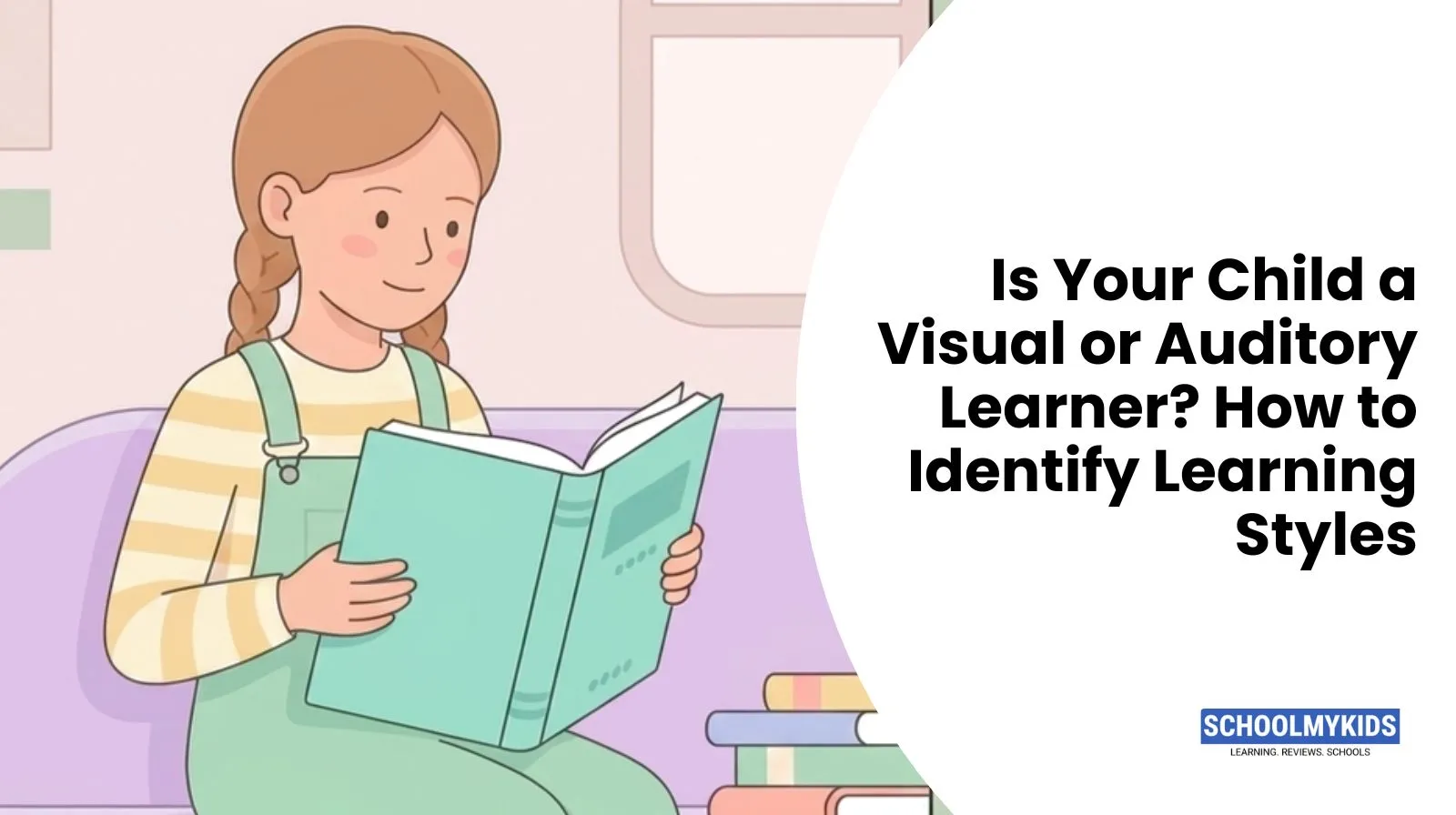
Every evening, millions of Indian parents sit beside their children during homework time and wonder the same thing: Why does explaining something verbally work for one child, while another needs to draw it out to understand? The answer often lies in how your child naturally processes information. Their learning style.
Understanding learning styles in children is not just an academic concept. It is a practical tool that helps parents observe their child’s sensory preferences and build a more supportive study environment. With India’s National Education Policy (NEP) 2020 now firmly in its implementation phase across schools in 2025–2026, personalized and experiential learning has become a policy priority, making this conversation more relevant than ever.
What Are Learning Styles and Why Do They Matter?
Learning styles refer to the preferred ways individuals absorb, process, and retain new information. In 2026, educational research makes one thing clear: children are not stuck in fixed learning boxes. Rather, they have sensory preferences that shift depending on the subject, a concept closely tied to neuroplasticity, the brain’s ongoing ability to adapt and rewire itself through experience.
The most widely used classroom framework remains the VARK model for kids, developed by educator Neil Fleming in 1987 and popularized through the 1990s. VARK stands for:
V – Visual
A – Auditory
R – Read/Write
K – Kinesthetic
It is essential to understand VARK correctly. Major research reviews in educational psychology have consistently found that strictly matching teaching to one dominant learning style shows little to no measurable improvement in learning outcomes. This rigid “matching hypothesis” is now widely considered a neuromyth in educational psychology. However, VARK remains a genuinely useful conversation starter. It helps parents and teachers identify a child’s observable preferences and design study environments that feel more engaging; not as a diagnosis, but as a practical guide. Many school counsellors and educators in India use it this way
The Rise of the Multimodal Learner
Current educational research suggests that many children are multimodal learners. They do not learn exclusively through one channel but through a natural combination of two or more. A child might prefer visual diagrams for Science while relying on auditory discussion for Language. This is normal, healthy, and actually advantageous.
The evidence-based takeaway is this: varied, multimodal instruction, combining visuals, discussion, hands-on activities, and reading benefits all children far more than any single-style approach. Techniques such as retrieval practice (self-testing), spaced repetition, and interleaving subjects are strongly supported by cognitive science and work across all preference types.
Use VARK to understand your child’s inclinations. Use multimodal strategies to actually teach them.
The VARK Model for Kids: A Simple Breakdown
Learning Style | How They Process Information | Common Strengths | 2026 Digital Tool |
|---|---|---|---|
Visual | Images, charts, colors, diagrams | Strong spatial memory, patterns | Canva, mind-mapping apps |
Auditory | Listening, discussion, rhythm | Verbal recall, storytelling | Podcasts, AI read-alouds |
Read/Write | Written words, notes, lists | Reading comprehension, note-taking | Notion, digital notepads |
Kinesthetic | Touch, movement, real-world doing | Hands-on problem solving | AR/VR labs, interactive simulations |
How to Identify Your Child’s Learning Style at Home
Observation is your most powerful tool. Watch your child closely during play, homework, and free time. Below are key behavioral signs for each type.
Visual Learner Child
A visual learner tends to:
Doodle or draw diagrams while studying
Remember faces but forget names
Love picture books, maps, and color-coded notes
Get distracted easily in a noisy environment
Ask “Can you show me?” rather than “Can you tell me?”
In a typical Indian classroom with 40+ students, visual learners often struggle when instruction is purely lecture-based. They thrive when given charts, NCERT diagrams, mind maps, and concept illustrations.
Auditory Learner Child
An auditory learner tends to:
Read aloud or mouth words while reading silently
Enjoy group discussions and debates
Remember song lyrics and rhymes effortlessly
Prefer verbal instructions over written ones
Talk through problems rather than writing them down
These children often do very well in schools that encourage classroom discussion. They benefit enormously from listening to recorded lectures, engaging with podcasts, or reciting content aloud before tests.
Read/Write Learner
This style often aligns well with the written and structured nature of many CBSE and CISCE assessments, although both boards are increasingly emphasizing competency-based questions. These children:
Take exhaustive notes during class
Prefer reading textbooks over watching videos
Make lists and written summaries to study
Score well in written examinations when given adequate preparation time
Rewrite notes multiple times as a revision strategy
Kinesthetic Learner
The kinesthetic learner is often the child labeled “restless” or “distracted” in a traditional classroom. However, they are not disengaged; they simply need to do to understand. They:
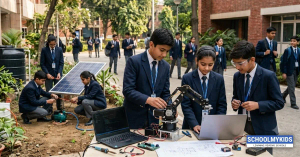
Learn through experiments, models, and role-play
Fidget during long lectures
Prefer science labs, cooking, crafts, and sports
Understand concepts better through real-world examples
Struggle with lengthy periods of passive sitting
NEP 2020’s emphasis on experiential learning and activity-based education is a significant step forward for kinesthetic learners across Indian schools.
Quick VARK Learning Styles Quiz for Parents
Use this informal VARK Learning Styles Quiz at home. Ask your child: “When you are trying to learn something new, what helps you most?” Then observe and tick accordingly.
Disclaimer: This quiz highlights preferences, not fixed or permanent learning styles.
Question | V | A | R | K |
|---|---|---|---|---|
Prefers diagrams and charts over text | ✓ | |||
Remembers better after hearing it explained | ✓ | |||
Likes to write summaries and re-read notes | ✓ | |||
Needs to physically try something to understand it | ✓ | |||
Gets distracted by visual clutter on a page | ✓ | |||
Talks to themselves while solving problems | ✓ | |||
Prefers written instructions | ✓ | |||
Learns best through experiments or field trips | ✓ |
Score: Count the ticks in each column. The highest score indicates your child’s dominant preference. Most children will score across two columns. That is completely normal and reflects multimodal learning.
Study Tips Tailored to How Children Learn Best
Education experts suggest combining these preference-based strategies with evidence-based techniques like active recall and spaced repetition for the strongest results.
For Visual Learners
Use color-coded highlighters for NCERT chapters
Create mind maps before writing essays
Watch educational YouTube videos or animated explainers
Draw timelines for History and flowcharts for Science concepts
For Auditory Learners
Record key points and play them back before sleep
Join or form a small study group for discussion
Use mnemonics and rhymes for formulas; a popular technique in Indian classrooms
Ask teachers to explain concepts verbally before self-study
For Read/Write Learners
Rewrite notes in your own words after each chapter
Use structured revision timetables with written checklists
Convert diagrams into written descriptions
Practice previous years’ CBSE question papers extensively
For Kinesthetic Learners
Use physical models (clay, blocks, charts) for Science and Math concepts
Take short movement breaks every 25–30 minutes (Pomodoro technique)
Visit science exhibitions, historical sites, or nature walks tied to curriculum topics
Act out historical events or conduct home science experiments
Week 1 Challenge for Parents: Pick one tip from your child’s dominant preference column. Try it consistently for seven days and observe whether their engagement or recall improves. Keep a simple note of what you observe. This reflection is more valuable than any quiz result.
How Indian Classrooms Are Adapting in 2025–2026
The NEP 2020 rollout has brought meaningful changes to how schools approach instruction. Crucially, NEP does not endorse VARK-style matching. Instead, it promotes varied, inclusive methods for all learners, which align with the multimodal evidence base. Key 2025–2026 developments include:
Greater emphasis on competency-based assessment alongside reduced focus on rote memorization across CBSE-affiliated schools. From 2026, approximately 50% of CBSE board exam questions for Classes 10 and 12 are competency-based (application-oriented and case-based), with roughly 20% objective/MCQs and 30% descriptive questions
SAFAL (Structured Assessment for Analyzing Learning) assessments, introduced by CBSE as competency-focused diagnostic assessments in selected grades, continued expanding in 2026.
Expanded use of digital tools through the DIKSHA portal, including virtual labs and e-content that create genuinely multimodal classrooms benefiting visual and kinesthetic learners
Activity-Based Learning approaches have been adopted in various forms across several Indian states, including Tamil Nadu.
Holistic Progress Cards replacing traditional report cards, evaluating children across creativity, collaboration, and subject learning; not just written scores
The National Curriculum Framework encourages flexible and inclusive teaching approaches across school stages.
A Note for Teachers
If you are an educator reading this, simple classroom adaptations make a significant difference. The goal is not to label students but to rotate methods, so every child connects with content in at least one meaningful way per lesson.
Adaptation | Helps |
|---|---|
Drawing concept maps on the board | Visual learners |
Encouraging peer explanation and discussion | Auditory learners |
Providing written summaries and structured notes | Read/Write learners |
Including lab work, models, or role-play | Kinesthetic learners |
This approach, known as differentiated instruction, is backed by strong evidence and sits at the heart of NEP 2020’s vision for inclusive classrooms.
FAQ: Learning Styles in Children
Q1. Is the VARK learning style fixed for life?
No. Learning preferences can evolve as children grow. A child who is strongly kinesthetic at age 7 may develop stronger read/write preferences by Class 9. Think of it as a current tendency, not a permanent label.
Q2. Can a child have more than one learning style?
Absolutely. Research and classroom observations show that many (likely most) children are multimodal learners with two or more dominant preferences. The VARK quiz helps identify tendencies, not limitations.
Q3. How is this relevant to CBSE board exams?
From 2026, approximately 50% of CBSE board exam questions for Classes 10 and 12 are competency-based, focusing on application and conceptual understanding. Understanding your child’s natural preferences helps them prepare more effectively. A visual learner, for instance, can convert text chapters into mind maps and still excel in written tests.
Q4. Should I tell my child’s teacher about their learning style?
Yes, and most teachers welcome this. A brief conversation with the class teacher or school counsellor about your child’s preferences can lead to small but meaningful adjustments in how they are supported in class.
Q5. Are learning styles scientifically proven?
This is an important question. Major research reviews in educational psychology find little to no evidence that strictly matching teaching to one learning style improves outcomes. The rigid “matching hypothesis” is considered a neuromyth. However, the broader principle that children benefit from varied, multimodal instruction combining visuals, discussion, hands-on activity, and reading is strongly supported. Use VARK as a practical preference guide, not a diagnostic tool. Pair it with evidence-based strategies like retrieval practice and spaced repetition for the best results.
Final Thoughts
Every child carries a unique blueprint for how they make sense of the world. By exploring whether your child leans toward visual, auditory, read/write, or kinesthetic learning, you are not putting them in a box; you are opening a conversation. A conversation that leads to more varied study strategies, a more engaged learner, and a more confident child.
As India’s education system continues to evolve under NEP 2020, with competency-based learning, digital tools through the DIKSHA portal, and holistic assessment reshaping classrooms, the responsibility does not rest with schools alone. Parents who understand their child’s learning preferences and embrace a multimodal approach at home become their child’s most effective learning partner.
Consult your child’s school counsellor for personalized guidance on learning support strategies.

Be the first one to comment on this story.