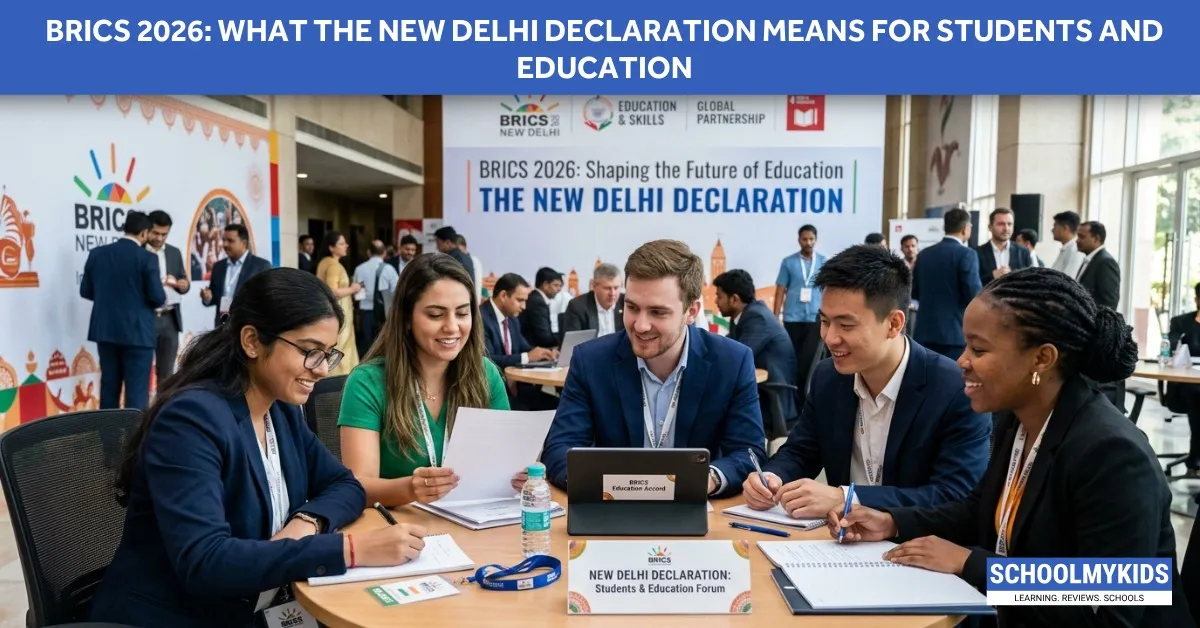
India hosted the BRICS Summit on September 12-13, 2026 at Bharat Mandapam in New Delhi. BRICS is now bigger than it used to be. It’s not just Brazil, Russia, India, China, South Africa anymore. It now includes Egypt, Ethiopia, Indonesia, Iran, the UAE and Saudi Arabia. That’s 11 countries total. Saudi Arabia’s formal status has some ambiguity, but official Indian and BRICS materials for the 2026 summit list it among the members.
They all agreed on something called the New Delhi Declaration. This isn’t some random document. It lays out what these countries will actually do in the next few years. On education specifically, they committed to some things that matter for your future.
The Education Commitments: What They Actually Agreed To
Safe AI in Classrooms
BRICS countries want AI used in education. But they’re saying it needs to be safe, ethical, and human-centered. That means AI tutors are fine. But not AI that replaces teachers completely. Not AI that collects unnecessary data about students. This matters because it sets a direction for how education tech gets developed in these countries.
Recognizing Your Degree Across Countries
Right now, if you get a degree from an Indian college, that degree might not be automatically recognized if you want to study or work in Brazil or China. You have to get it evaluated separately. BRICS countries agreed to work on mutual recognition of qualifications.
What does that mean? Eventually, your Indian engineering degree could be directly recognized in BRICS countries without extra paperwork. Same with nursing, commerce, and IT degrees. This makes it easier to study abroad and work across countries.
Student Mobility
BRICS agreed to make it easier for students to move between countries for studies. That means cooperation on visa processes, student exchange programs, and credit transfers. If you study one semester in India and another in Brazil, your credits count toward one degree.
BRICS Network University
BRICS countries reaffirmed support for the existing BRICS Network University. It was set up in 2015 as a consortium of higher-education institutions from member countries. It already connects universities for joint programmes, research and student mobility. You could take classes or pursue collaborative degrees involving institutions in Russia, China or other BRICS countries while enrolled in India. India has pushed further development, including possible addition of traditional and indigenous knowledge as a thematic group.
Why This Matters For Indian Students
Right now, Indian students who want to study abroad spend enormous amounts on applications, visas, and getting degrees recognized. All that friction reduces mobility.
With these BRICS commitments, that changes. More affordable study abroad options. Easier recognition of Indian degrees globally within BRICS. More scholarship opportunities because BRICS countries are coordinating education funding.
A student from Mumbai could get her engineering degree recognized in Brazil without extra evaluation. A student from Bangalore could do an internship in China and have it count toward his Indian degree.
The Job Market Angle: Career Implications
BRICS is positioning itself as an alternative economic bloc to Western institutions. That means BRICS countries are increasingly doing business with each other. Infrastructure projects. Technology partnerships. Trade.
If you have a degree recognized across BRICS, you have access to job markets in 11 countries, not just India.
Right now, most international job opportunities for Indian students are in Western countries. BRICS opens new markets. A software engineer with credentials recognized in Russia, China, and Brazil has more options. These are growing economies with lots of opportunities.
The salary potential is significant too. Professionals who work internationally earn more. These BRICS commitments make working internationally easier.
TVET Cooperation: Vocational Education Matters Too
BRICS also focused on Technical and Vocational Education and Training (TVET). This is important because not everyone goes to university. Plumbers, electricians, nurses, mechanics - these vocations need training.
BRICS countries agreed to share best practices in vocational training and recognize vocational qualifications across countries. That means a vocational diploma from India could lead to jobs in other BRICS countries.
This is understated but matters. Vocational skills are actually in short supply globally. A welder trained in India could work in Brazil or Indonesia if qualifications are recognized.
What About Traditional Knowledge: India’s Push
India pushed for recognition of traditional and indigenous knowledge systems. Ayurveda, traditional crafts, indigenous agriculture methods. These are being incorporated into education frameworks.
Why? Because these knowledge systems have value. Someone trained in Ayurveda or traditional Indian medicine could potentially practice or teach across BRICS countries if credentials are recognized.
This isn’t just sentimental. It’s economic. Traditional medicine is a multi-billion dollar global industry. Recognizing these qualifications opens job markets.
Youth Engagement Beyond Just Education
BRICS didn’t stop at academics. They committed to youth cooperation in entrepreneurship, science, technology, innovation, and cultural exchange.
That means there will be youth conferences, startup competitions, and innovation challenges across BRICS countries. Funding opportunities for young entrepreneurs. Research collaborations.
If you’re a student with an idea for a startup or research project, BRICS is creating frameworks to connect you with peers and resources in other countries.
The Realistic Timeline: When This Actually Happens
BRICS declarations aren’t instant. They take time to implement. The mutual recognition framework won’t be complete in 2027. Expanded collaborative programmes under the BRICS Network University won’t scale up immediately.
But these are now official commitments. Government officials are being assigned to make them happen. Universities are getting resources. This is different from a vague statement. There’s bureaucratic weight behind it.
Expect real changes over 2-3 years. By 2028-2029, many of these should be operational.
The China and Russia Angle
Some of these commitments are geopolitical. BRICS is explicitly positioning itself as an alternative to Western-dominated education and economic systems.
That’s not bad or good necessarily. It just means the motivations are mixed. Yes, they want to help students study across countries. But they also want to build influence and alternatives to Western institutions.
For students, this means more opportunities. But also awareness that these are political relationships.
The Honest Reality: What Actually Changes For You
If you’re applying to college right now, these BRICS commitments don’t change your immediate options. The infrastructure isn’t built yet.
But if you’re planning for 5-10 years ahead, the landscape is shifting. A degree from an Indian institution will mean something different in 2030. More recognition. More mobility. More job options.
The student visa process might be easier. Employer sponsorship will be easier. Work permits across BRICS countries more streamlined.
Key Takeaways
BRICS 2026 summit was held September 12-13 in New Delhi
11 countries now in BRICS: Brazil, Russia, India, China, South Africa, Egypt, Ethiopia, Indonesia, Iran, UAE and Saudi Arabia (Saudi Arabia’s formal status has some ambiguity)
New Delhi Declaration commits to ethical AI in education, mutual degree recognition, student mobility
BRICS Network University (existing since 2015) strengthened for cross-country education and mobility
TVET qualification recognition across BRICS countries
Youth entrepreneurship and innovation funding coordination
These changes will take 2-3 years to fully implement
Opens job markets beyond India within BRICS bloc
Vocational and traditional knowledge systems getting formal recognition
FAQs
Q1: Will my Indian degree automatically be recognized in all BRICS countries now?
Not immediately. The New Delhi Declaration commits to working toward mutual recognition. But the actual framework is still being built. By 2028-2029, recognition should be significantly easier. For now, check with specific universities or employers in BRICS countries about their current recognition process.
Q2: Can I study for free across BRICS countries under these commitments?
Not free, but more accessible. BRICS countries are coordinating on scholarships and student exchange programs. That means more funded opportunities than before. But you’ll likely still need to cover some costs or qualify for scholarships. Check your university’s BRICS partnership programs.
Q3: What if I want to work in a BRICS country after graduation?
These commitments make it easier but not automatic. Work visas still depend on individual country policies and employer sponsorship. But as mutual recognition increases and economic ties deepen, there will be more job opportunities and streamlined hiring processes across BRICS.
Q4: How does this affect my career choices right now?
If you’re choosing a field of study, remember that skills needed in BRICS countries might differ from Western markets. Infrastructure, energy, technology, and vocational trades are big in BRICS expansion. These fields might have more opportunities. Consider learning Mandarin or Portuguese alongside your studies to access these markets better.




Be the first one to comment on this story.