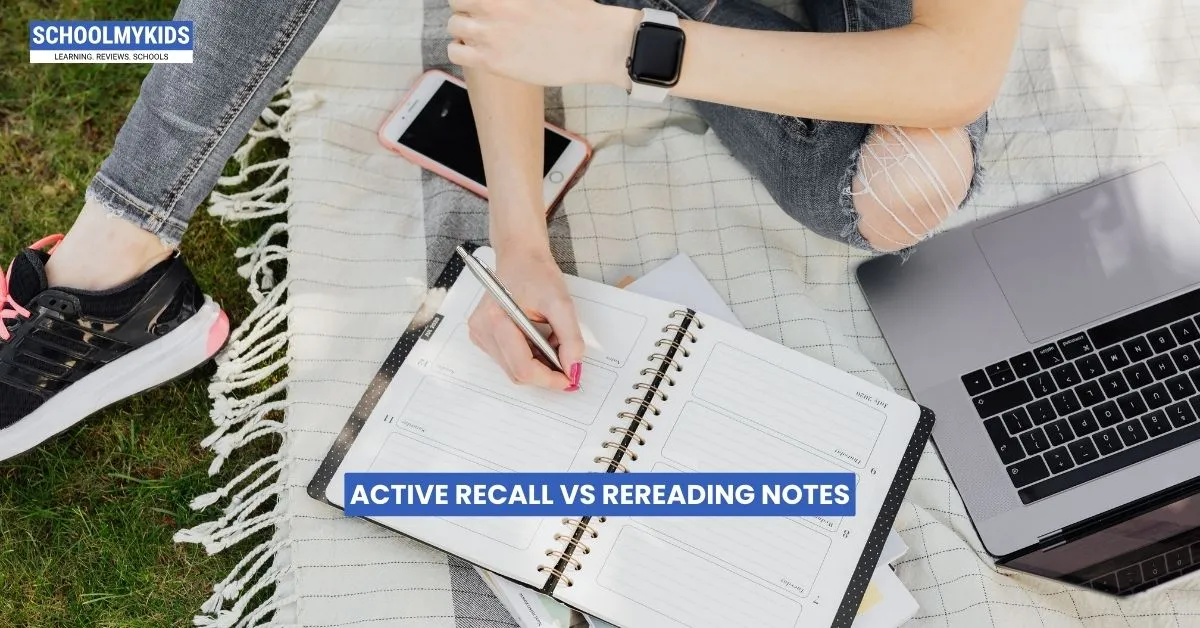
Why Familiarity Feels Like Learning
Most students reread notes because it feels productive. Pages look familiar. Concepts seem recognizable. There is a sense of progress, even comfort. This feeling is deceptive.
Rereading creates familiarity, not understanding. The brain mistakes recognition for knowledge. Students believe they know the material because it looks known, not because they can actually use or explain it.
This is why rereading is popular and why it so often fails.
What Rereading Actually Does to the Brain
Rereading is a passive activity.
The brain receives information without effort. There is no demand to retrieve, connect, or apply ideas. As a result, memory traces remain weak. The information stays short-term and fragile.
Rereading feels smooth because the material is already processed. Smoothness is misinterpreted as mastery.
When exams require recall or application, this illusion collapses.
What Active Recall Really Means
Active recall reverses the process.
Instead of looking at information, students pull it out of memory. They close notes and try to explain concepts, answer questions, solve problems, or write what they remember.
This effort feels uncomfortable. Gaps appear immediately. Forgetting becomes obvious. That discomfort is not failure. It is learning happening in real time.
Why Active Recall Feels Hard but Works Better
Active recall strengthens memory because it forces the brain to reconstruct information.
Each attempt to recall builds stronger neural pathways. Even incorrect attempts help by highlighting what is missing. The brain adjusts and stores information more durably.
This is why active recall often feels slower and more tiring, yet produces far better retention.
Why Students Avoid Active Recall
Students often avoid active recall because it threatens confidence.
Rereading protects self-image. Active recall exposes gaps. Students interpret difficulty as a sign they are bad at the subject, rather than as a sign the method is working.
Time pressure also plays a role. Rereading feels faster. Active recall feels inefficient at first, even though it saves time later.
How Exams Punish Rereading and Reward Recall
Most exams are recall-based.
They demand retrieval under pressure, not recognition. Students who relied on rereading struggle to access information quickly. Those who practiced active recall find retrieval familiar.
The mismatch between study method and exam demand explains why long hours of rereading often produce disappointing results.
The False Security of Neat Notes
Well-organized notes increase the temptation to reread.
Students trust the quality of their notes and assume that repeated exposure will transfer knowledge automatically. It rarely does.
Notes are storage tools, not learning tools. Learning happens when notes are used, not revisited passively.
How to Combine Notes With Active Recall
Notes still matter, but their role must change.
They should be references, not the activity itself. Students can:
- Read notes once
- Close them
- Test recall
- Return only to fill gaps
This cycle converts notes from comfort objects into learning aids.
Why Active Recall Reduces Last-Minute Panic
Students who practice active recall know exactly what they don’t know.
This clarity reduces anxiety. Revision becomes targeted. Time is used efficiently.
Rereading hides gaps until the exam exposes them. Active recall exposes gaps early, when they can still be fixed.
The Long-Term Learning Difference
Rereading fades quickly.
Active recall compounds over time. Information retrieved repeatedly becomes stable, transferable, and usable in new contexts.
This is why students who rely on recall retain concepts months later, while rereaders often feel like they are starting from zero again.
The Core Difference That Matters
Rereading creates the feeling of learning. Active recall creates learning itself. One is comfortable but shallow. The other is uncomfortable but effective. When students choose rereading, they protect confidence temporarily and sacrifice retention later. When they choose active recall, they tolerate short-term difficulty and gain long-term clarity. Learning does not improve by seeing information more often. It improves by pulling it out of memory until it stays.







Be the first one to comment on this story.