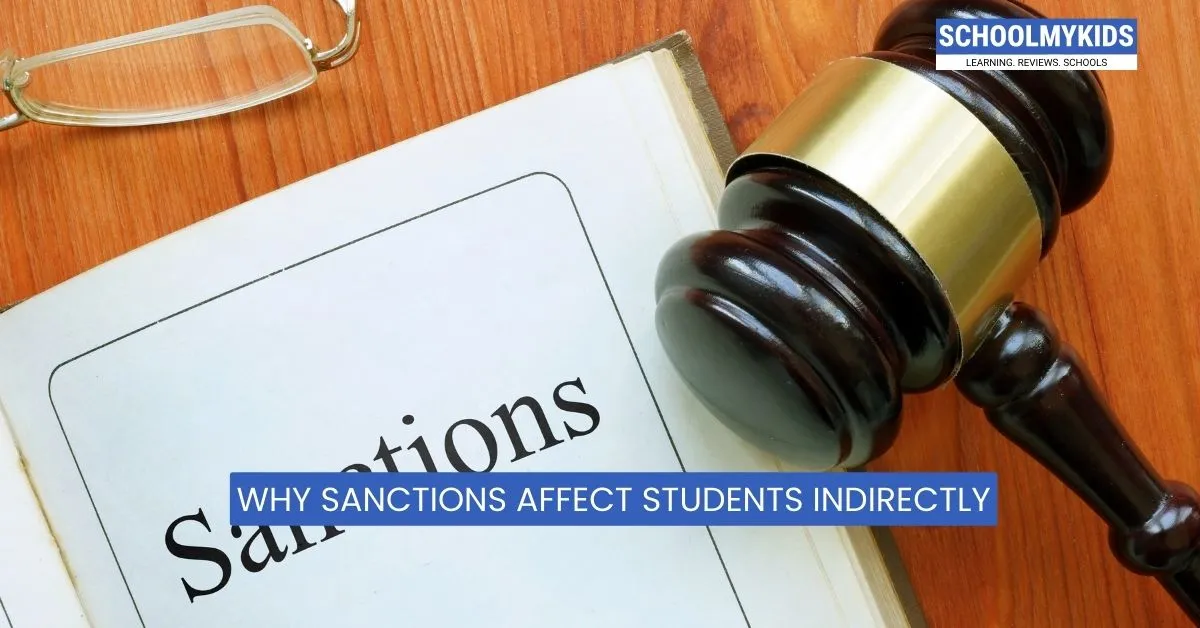
When Political Decisions Reach the Classroom
Sanctions are designed to pressure governments, not classrooms. They target trade, finance, technology, and diplomacy. On paper, students are not mentioned anywhere.
In reality, students feel the consequences long before policymakers do.
The impact is indirect, delayed, and often invisible. That’s why it’s easy to dismiss. But for students, sanctions quietly reshape education access, costs, opportunities, and futures.
How Sanctions Disrupt Education Without Targeting It
Sanctions rarely say “education.” They don’t need to.
Funding Shrinks Before Anything Else
When a country’s economy is strained by sanctions:
- Government revenue falls
- Currency weakens
- Budgets tighten
Education, especially higher education and research, is often one of the first areas to feel cuts. Infrastructure upgrades are delayed. Scholarships shrink. Teacher hiring freezes.
Students experience this as overcrowded classes, outdated resources, and fewer opportunities, without ever hearing the word “sanctions.”
The Rising Cost of Studying
Sanctions increase costs in subtle ways.
Imported Educational Resources Become Expensive
Textbooks, lab equipment, software licenses, scientific journals, and digital platforms often rely on international supply chains.
Sanctions disrupt access or raise prices. Institutions pass these costs on to students through:
- Higher fees
- Reduced facilities
- Limited access to modern tools
For students, education becomes harder and more expensive at the same time.
International Education Takes a Hit
Sanctions heavily affect cross-border academic exchange.
Reduced Scholarships and Mobility
Countries under sanctions often lose access to:
- International scholarships
- Exchange programs
- Joint research grants
Students who planned to study abroad suddenly face visa issues, funding gaps, or blocked pathways.
Even students from non-sanctioned countries are affected when universities cut partnerships or shut programs.
Degrees Lose Global Portability
When academic collaborations weaken, degrees risk losing international recognition or relevance.
Students pay the price years later when applying for global opportunities.
Technology Access Is Quietly Restricted
Modern education depends on technology.
Software, Platforms, and Tools Get Blocked
Sanctions can limit access to:
- Cloud services
- Research databases
- Educational software
- Online certifications
Students don’t hear “geopolitics.” They hear “service unavailable.”
This widens the gap between students globally, not because of ability, but because of access.
Research and Innovation Slow Down
Students in research-heavy disciplines feel sanctions sharply.
Labs Without Supplies, Projects Without Funding
Restricted imports delay experiments. Funding uncertainty kills long-term projects. International conferences become inaccessible.
Graduate students and doctoral candidates lose years of work momentum. Careers stall before they start.
This damage is invisible but permanent.
Psychological and Career Uncertainty
Sanctions also affect students emotionally.
Planning Becomes Impossible
Students make long-term decisions based on assumptions about stability:
- Will my degree still be valued?
- Will I be able to work abroad?
- Will my institution survive financially?
Uncertainty breeds anxiety. Motivation drops. Students focus on survival, not growth.
Why Students Are Rarely Part of Sanctions Conversations
Students don’t vote on sanctions. They don’t negotiate them. They don’t lobby effectively.
Their losses are:
- Diffuse
- Delayed
- Politically inconvenient
So they’re ignored.
The Unequal Impact on Vulnerable Students
Sanctions don’t affect all students equally.
First-Generation and Low-Income Students Suffer More
Students with financial buffers find alternatives. Others drop out.
Women, minorities, and rural students often lose access first when resources shrink.
Inequality widens quietly.
Long-Term Damage to Human Capital
The most serious impact is delayed and cumulative.
Lost Cohorts Cannot Be Rebuilt Easily
When education quality dips for years:
- Skill pipelines weaken
- Innovation slows
- Brain drain accelerates
Even after sanctions end, recovery takes decades.
Students carry the cost into adulthood.
What This Means for the Global Community
Sanctions are political tools. But education is a long-term investment.
Damaging education weakens societies in ways sanctions were never meant to address.
Students become unintended casualties of geopolitical strategy.
The Quiet Truth About Sanctions and Students
Sanctions rarely break governments quickly. Their impact is seldom immediate or visible at the level where political decisions are made.
However, they consistently reshape futures in quieter, less visible ways. The effects accumulate over time, altering opportunities, access, and stability for groups that have no role in shaping the policies themselves.
When students lose access to education, resources, or global mobility, the consequences extend far beyond the duration of the sanctions. Lost learning years, disrupted academic pathways, and diminished career prospects do not reverse when restrictions are lifted.
Education absorbs political shock because it lacks mechanisms for protest or negotiation. Students cannot pause their development, relocate systems, or wait out policy cycles.
This does not reduce the scale of the damage. It simply makes that damage easier to overlook.




Be the first one to comment on this story.