The Biggest Shift: From Information to Judgment
In ten years, knowing facts will matter far less than knowing what to do with them.
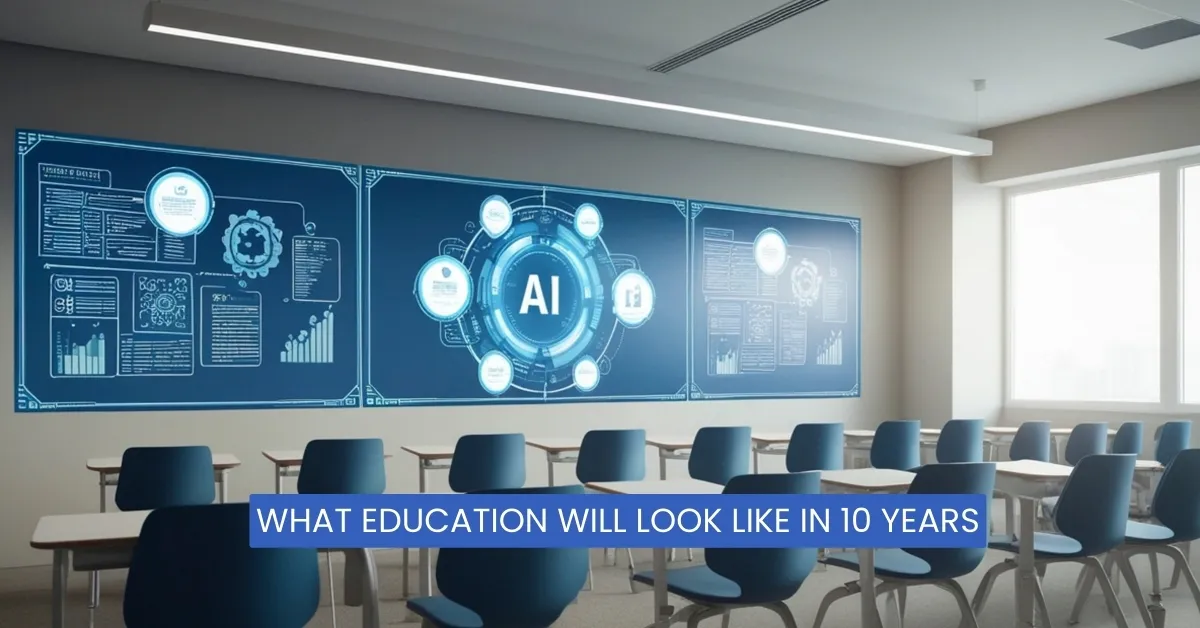
Information is already abundant. In a decade, it will be unavoidable. AI systems will retrieve, summarize, explain, and even test knowledge faster than any human teacher can.
So education’s role will shift from delivering information to teaching judgment:
- What to trust
- What to question
- What matters
- What doesn’t
Students won’t be rewarded for knowing answers. They’ll be rewarded for choosing good questions.
Classrooms Will Stop Being the Center of Learning
Learning Will Detach From Place
Physical classrooms won’t disappear, but they’ll stop being the primary source of instruction.
Core content will move online, on-demand, and adaptive. Classrooms will be used for:
- Discussion
- Problem-solving
- Collaboration
- Mentorship
This flips the model. Teaching happens before class. Thinking happens during it.
Schools that don’t make this shift will feel increasingly irrelevant.
Time Will Matter More Than Attendance
Seat time will lose importance. Progress will matter more than presence.
Students will move forward based on mastery, not calendar age. Fixed-grade systems will start looking outdated, even if they survive administratively.
Exams Will Change (Because They Have To)
Memorization-Based Testing Will Collapse
When AI can answer factual questions instantly, testing memory becomes meaningless.
Exams will shift toward:
- Open-resource formats
- Scenario-based questions
- Applied reasoning
- Explanation and justification
Cheating won’t be the main concern. Shallow thinking will.
Continuous Evaluation Will Replace High-Stakes Panic
One final exam deciding everything will feel increasingly absurd.
Assessment will spread across:
- Projects
- Iterations
- Reflections
- Long-term performance
Pressure won’t vanish, but it will redistribute.
Teachers Will Become Mentors, Not Content Deliverers
Teaching Will Be More Human, Not Less
AI will handle repetition. Humans will handle:
- Feedback
- Motivation
- Ethical judgment
- Emotional support
- Context
The best teachers won’t be the best lecturers. They’ll be the best guides.
This will expose weak teaching faster. It will also elevate great teaching in ways the current system doesn’t.
Authority Will Come From Insight, Not Position
Students will challenge more. Not out of disrespect, but because tools will empower them.
Teachers who welcome inquiry will thrive. Those who rely on control will struggle.
Personalization Will Be the Default
One-Speed Education Will Break
Students learn at different speeds. That reality has been ignored for centuries because it was inconvenient.
Technology removes that excuse.
Learning paths will adapt based on:
- Pace
- Strengths
- Gaps
- Interests
The average student will no longer exist as a design target.
But Guidance Will Matter More Than Ever
Personalization without mentorship becomes chaos.
Students will need help choosing paths, not just following them. Decision-making will become a core educational skill.
Credentials Will Lose Monopoly Power
Skills Will Compete With Degrees
Degrees won’t disappear, but they’ll stop being the only signal of competence.
Portfolios, project histories, and verified skills will matter more. Employers will ask:
- What can you do?
- What have you built?
- How do you learn?
Education systems that ignore this shift will lose credibility.
Lifelong Learning Will Stop Being a Slogan
Careers will change faster than degrees can keep up.
Education will become modular, repeatable, and ongoing. People won’t “finish” education. They’ll cycle through it.
The Hidden Risk: Inequality Will Widen
Access Will Be Easy. Navigation Won’t.
Information access will be cheap. Guidance will be expensive.
Students with mentors, structure, and support will thrive. Others may drown in choice and misinformation.
The education gap will shift from access to direction.
Schools Will Be Judged on Outcomes, Not Intentions
Feel-good policies won’t matter. Results will.
Parents and students will gravitate toward systems that demonstrate clarity, adaptability, and real-world relevance.
What Won’t Change (Despite the Hype)
- Learning will still require effort
- Confusion will still be part of growth
- Discipline will still matter
- Curiosity will still outperform compliance
Technology will amplify good systems and expose bad ones. It won’t save weak thinking.
What Students Should Prepare For Now
The students who thrive in 10 years will:
- Ask better questions
- Learn independently
- Adapt quickly
- Handle ambiguity
- Build things, not just consume content
The students waiting for clear instructions will struggle.
A Hard but Honest Conclusion
Education in 10 years won’t look futuristic everywhere. It will look uneven.
Some systems will evolve. Others will cling to familiarity. The gap between them will matter more than ever.
The real future of education isn’t about screens or AI. It’s about whether systems teach people to think, adapt, and decide for themselves.
Those that do will shape the next generation. Those that don’t will quietly be bypassed.





Be the first one to comment on this story.