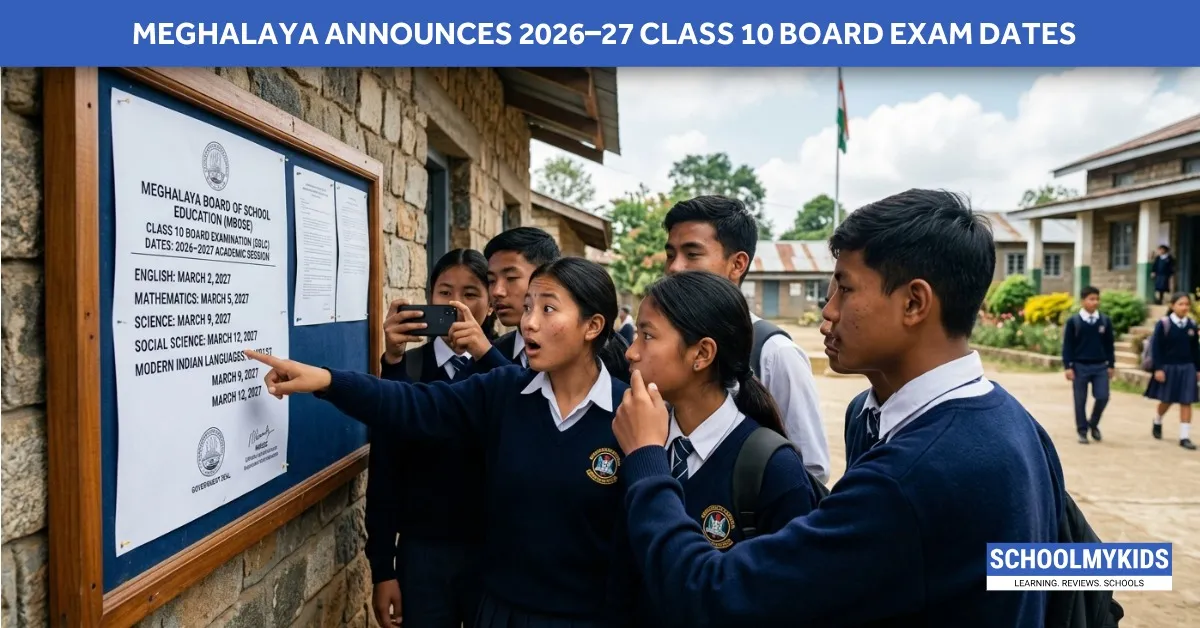
Meghalaya’s Class 10 board exams start on December 4, 2026, and end on December 16, 2026. The board announced this on September 14.
English is the first paper on December 4. Science follows on December 7. Indian Languages and Additional English come on December 9. Health and Physical Education, Computer Science, and vocational subjects are on December 11. Social Science is on December 14. Mathematics or Special Mathematics closes the schedule on December 16.
Indian languages on December 9 include Garo, Khasi, Hindi, Bengali, Assamese, Nepali, Urdu and Mizo.
Vocational subjects (in place of Computer Science or Health and Physical Education) include Beauty and Wellness, Tourism, Health Care, Electronics, Agriculture, ITES, Apparel, Plumbing, Food Processing, Telecom, Banking and Automobile Repair.
That’s about 11 weeks of preparation time from now (mid-September) until the first exam. Not a lot of time if you haven’t started seriously preparing.
How The Exam Day Actually Works: What To Expect
Arrive by 9:30 AM. The exam hall opens at this time. You don’t need to come earlier. Coming at 8:45 just means sitting around nervous.
At 9:45 AM, the invigilator hands out the question paper. You get 10 minutes to read it silently (reading time). You’re not supposed to write anything yet. This is just for understanding what’s being asked.
At 9:50 AM, answer sheets get distributed.
At 10 AM, writing time begins. You have until 1 PM. That’s three hours to write your answers.
The whole thing ends sharply at 1 PM. No extensions. No extra five minutes.
Regular subject exams run the full three hours. Vocational subjects run only one hour (10 AM to 11 AM). If you’re taking a vocational subject, plan for a much shorter paper.
How to get the official date sheet
Go to mbose.in. Look for the notification titled “Program for SSLC Examination - 2026-27” dated 14 September 2026. Download the PDF and keep a printed copy. Schools will also share it, but it is better to have the original.
What To Prepare For Right Now: Actual Timeline
You have roughly 11 weeks.
Weeks 1-3 (Now Through Early October):
Finish your syllabus. Don’t half-study topics. If you’re only halfway through your courses, start moving faster. You need the entire syllabus done by early November at the latest.
Weeks 4-6 (Mid-October Through November):
Start solving previous years’ question papers. This is when you realize what you actually know and what’s just fuzzy. Solve full papers in exam conditions (three hours, no breaks, no phone).
Weeks 7-9 (Early-Mid November):
Review your weak areas. If you score 40% on a previous paper, identify which sections you got wrong. Practice those sections repeatedly. Don’t just solve more papers; solve smarter.
Weeks 10-11 (Late November Through Early December):
Light revision. Solve one more paper if needed. But mostly rest. The night before the exam, don’t cram. Cramming at that point creates panic, not learning.
What Actually Changes With These Earlier Dates: Why December Matters
Meghalaya moved exams to December instead of the January-February window many other states use. This matters for several reasons.
December weather in Meghalaya is cool. Easier to concentrate during three-hour exams in a classroom without sweating through your answers.
Results come earlier. If exams happen in December, results probably come in January or early February. That’s ahead of most other states. Students get to start college or their next chapter earlier.
Winter holidays won’t interfere. Some students had to study during their main holidays before. Now exams finish before Christmas, so students actually get holiday time to rest.
But the pressure hits differently. You’re preparing during your regular school sessions (September-November). No break to recover between the end of school teaching and the start of exams.
The Numbers: Who’s Sitting These Exams
In 2025, 63,682 students appeared, and the pass rate was 87.10%. Boys recorded 92.08% and girls 92.59%. Two students shared the top rank with 582 marks each.
In 2026, 48,623 students appeared, and the pass rate was 86.84%. The highest score was 585.
Important Things Students Miss
Bring your hall ticket (admit card). It is not optional. No hall ticket, no exam. Schools will download and distribute them closer to the exam. Make sure your school has submitted your form by 30 September 2026. If your name is missing, fix it immediately.
Bring an ID card. Aadhaar, school ID, or passport. Something with your photo and name. Verification is strict.
Know which exam center you’re assigned to. It’s not always your school. If your school doesn’t have enough space, they split students across centers. Check this beforehand. Don’t show up at your school on exam day to find out you’re supposed to be elsewhere.
Pen selection matters. Use the pen you practiced with. If you always use a particular brand, bring that. The last thing you need is getting used to a different pen’s ink flow during the actual exam.
Know the math on passing. You need a minimum of 30% in each subject overall. On the 80-mark theory paper, that works out to about 24 marks. If you do not do well in one subject but score well in others, you still might pass. If you fail badly in multiple subjects, you might have problems.
FAQs
Q1: Can Exam Dates Change After Being Announced?
Yes. The board’s official statement says dates “may be revised in the event of any unforeseen exigencies or important announcements from state or central governments.” This is rare, but it happens. If the state announces a holiday that conflicts with exam dates, or if there’s a natural disaster, dates shift. But this is uncommon. December 4-16 is likely your actual exam window.
Q2: What If I’m Absent On An Exam Day?
You miss that exam. There’s no retake. You might get a zero or a mark based on other exam scores, depending on board rules. A medical emergency might get you a rescheduled exam, but this requires a doctor’s certificate and approval. Don’t count on it. Plan to be there.
Q3: How Early Should I Arrive On Exam Day?
9:30 AM is when the hall opens. Arriving at 9 AM is reasonable. Arriving at 8 AM means sitting in panic for an hour. Arriving at 9:35 AM risks missing the 9:45 paper distribution if there’s any delay. 9:15-9:25 is the sweet spot.
Q4: Are Vocational Subject Papers Really Only One Hour?
Yes. If you’re taking a vocational subject (IT, ITES, Tourism, Healthcare, etc.), your exam runs 10 AM-11 AM. This is shorter but also covers less content. The difficulty shouldn’t be greater because there’s less to test. But confirm with your school which subjects are classified as vocational at your center.





Be the first one to comment on this story.