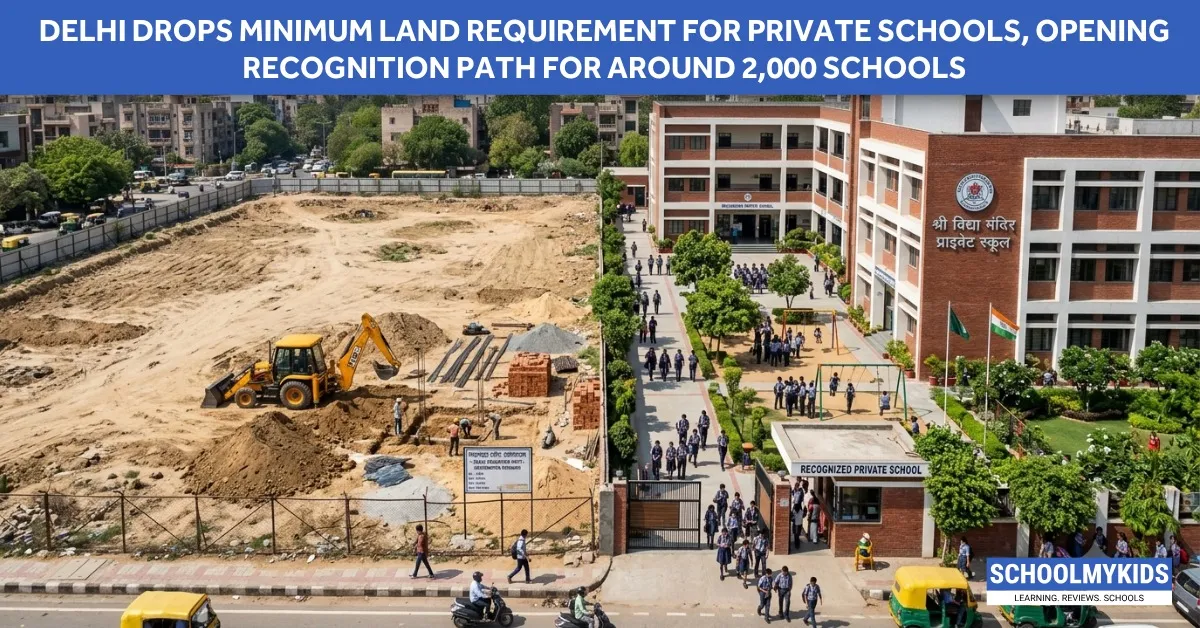
On August 26, 2026, Delhi made a big change to how private schools get recognized. The government removed the rule that said schools need a certain amount of land.
Before August 26: A school needed at least 800 square meters for a primary school (Classes 1 to 5). Middle schools (Classes 6 to 8) needed 1,000 square meters. Senior secondary schools needed around 2,000 square meters under the earlier norms. This was to ensure space for classrooms, playgrounds, and sports areas.
After August 26: No minimum land requirement. A school can be recognized without it.
This sounds like a small technical change. It’s not. It affects around 2,000 schools that have been operating without official recognition.
Why Delhi Made This Change: The Government’s Reason
Education Minister Ashish Sood said the rule was outdated. He said it didn’t match the RTE Act (Right to Education Act). The RTE Act focuses on “objective standards,” not local rules about how much land you need.
He also said Delhi is crowded. Urban space is expensive. A school in central Delhi can’t always find 800 square meters. So the land rule was keeping good schools from getting recognized.
By removing the rule, the government says around 2,000 unrecognized schools can now get official status. That opens the path for thousands of new seats. Earlier recognition drives of schools in non-conforming areas created around 20,000 seats.
What This Actually Means: Real Impact
Before this change, thousands of schools operated without official recognition. They couldn’t get grants. They couldn’t participate in government programs. Parents were nervous because the school wasn’t “official.”
Now, these schools can apply for recognition. If they meet other requirements (building safety, qualified teachers, curriculum), they get recognized.
More recognized schools means more seats. More seats means more children can get into school. Especially poor families who can’t afford the expensive recognized schools.
That’s the theory. The reality is more complicated.
What Critics Are Actually Saying: The Worry
Education activists aren’t happy. They say Delhi removed one of the few real checks on school quality.
A school with no land requirement could operate from a cramped building. Or a balcony. Or a converted warehouse. As long as it meets other (less strict) requirements, it’s legal.
Ashok Agarwal, an education activist and advocate, called it “a leakage in education, like a chai ki dukaan.” He meant: standards are leaking out. Schools are getting weaker, not better.
The worry is real. A school that’s just a room can’t have a playground. Kids can’t move around. They can’t play. They can’t breathe.
What The School Boards Still Require: There Are Still Rules
The Delhi government’s land rule is gone. But the school boards (CBSE, ICSE, State Board) still have land requirements.
If a school wants CBSE affiliation, CBSE will ask: Do you have space for classrooms, labs, and sports? If not, no affiliation.
So a school that operates without a board can ignore the land rule. But most schools want board affiliation. They need it for credibility and exams.
This means: the practical impact might be smaller than it sounds. Schools still need land to function as real schools.
RTE Act still requires an all-weather building, one classroom per teacher, separate toilets, safe drinking water, a playground, and a boundary wall or fencing. None of those requirements were removed.
The Timeline: How This Actually Happened
July 18, 2026: Delhi removed the “Essentiality Certificate” requirement. This was another rule that said you needed to prove a school was actually needed in that area before opening one.
August 26, 2026: Delhi removed the minimum land area requirement.
Both moves in the same direction. Fewer rules. Easier to open and recognize a school.
Who Benefits: The Real Winners
Poor students in crowded areas. If a small school opens in a neighborhood with no recognized schools, those kids get access.
Schools that have operated without recognition for years. Now they can get official status. This means government support, accountability, and legitimacy.
Parents who want more school options. More schools means more choices. More competition between schools.
School owners who want to open new schools. Fewer bureaucratic hurdles mean faster approval and lower startup costs.
Who Loses: The Real Concerns
Students in schools that operate from inadequate spaces. A room isn’t a school. It’s just a room with a teacher.
Parents who relied on the land requirement as a safety check. You could assume a recognized school had proper facilities. Now that assumption is weaker.
Government schools competing with unregulated private schools. If a cheap private school operates from a balcony with low standards, it might pull students from government schools.
The principle of educational quality. Standards are there for a reason. They ensure children get proper education, not just babysitting.
What Parents Should Actually Know: Practical Advice
When looking at a school, the land requirement isn’t the only safety check. Ask:
Does the school have CBSE or board affiliation? That means it still meets board standards.
Is the school registered with the Directorate of Education? That’s official recognition.
Has it been operating for a while? Long-standing schools are usually more stable.
What do other parents say? Visit the school. Talk to current parents. See what the actual facility looks like.
Don’t assume small schools are bad. Some excellent schools operate in small spaces. But verify the quality yourself.
The Bigger Picture: What This Reveals
This change reveals a tension in education policy. You can make rules stricter (ensure quality, safety, standards). Or you can make rules looser (increase access, reduce bureaucracy).
Delhi chose looser rules. More children can access education. But some quality standards dropped.
This isn’t unique to Delhi. It’s happening globally. Balancing access and quality is always hard.
Key Takeaways
Delhi removed minimum land area requirement for school recognition on August 26, 2026
Around 2,000 unrecognized schools can now apply for official status
Opens the path for thousands of new education seats
Education Minister Ashish Sood said it aligns with the RTE Act and Delhi’s urban density
Critics worry it compromises school quality and safety standards
School board requirements (CBSE, ICSE) still apply
Parents should verify school quality independently
FAQs
Q1: Does this mean schools can operate from tiny spaces now?
Technically, Delhi’s government rules no longer require minimum land. But school boards (CBSE, ICSE) still have space requirements for affiliation. So a school can get Delhi recognition without land. But it can’t get CBSE affiliation without meeting CBSE’s space standards. Most schools want board affiliation, so the practical impact is limited. But it’s possible.
Q2: Will my child’s school close because it can’t meet the land requirement anymore?
No. This rule change helps schools that were already operating. It doesn’t affect existing recognized schools. They’re grandfathered in. Only new schools or schools seeking recognition for the first time are affected.
Q3: Should I worry about my child’s school quality now?
Not automatically. The land requirement removal is one factor. But other safety checks still exist. Building safety inspections. Teacher qualifications. Curriculum standards. Check multiple things, not just land area.
Q4: Will this help poor students get into good schools?
Potentially. More affordable schools might open in poor neighborhoods. More seats in recognized schools. But it depends on implementation. If cheap schools operate with very low standards, students won’t learn well even if they attend.





Be the first one to comment on this story.