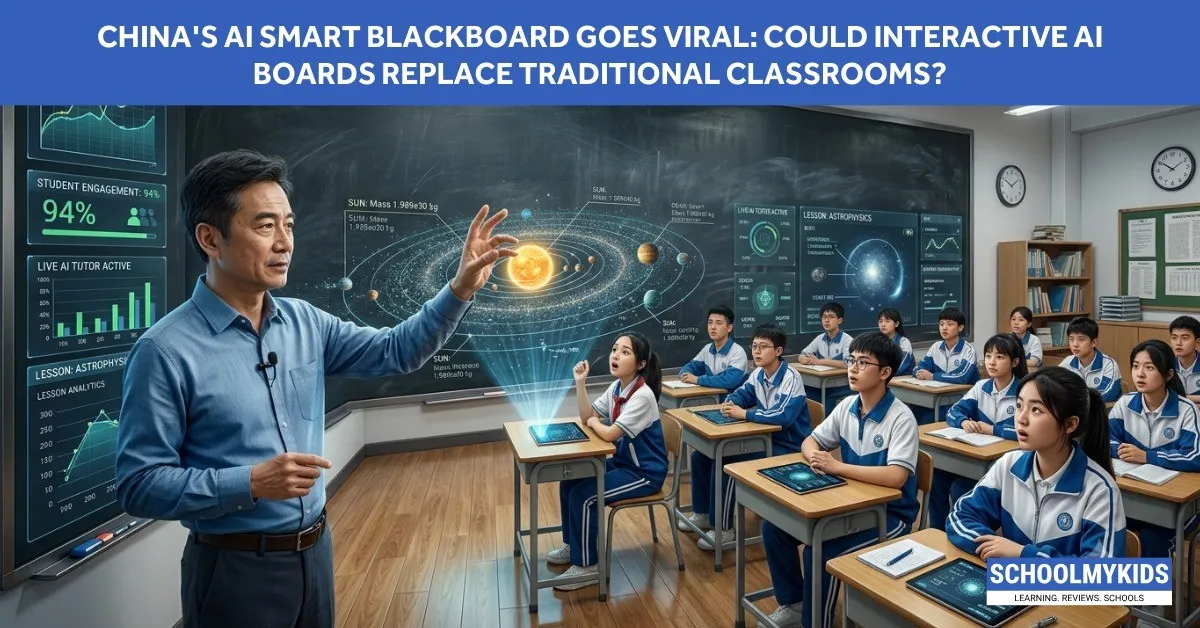
In July 2026, a mathematics instructor stood in front of a board in Shanghai and wrote y = x² − 3. Within a second, a parabola appeared on the board itself. The curve was perfect. Interactive. Students could rotate it, zoom in, explore angles.
Then the teacher sketched a rough cube shape. Instantly, it became a three-dimensional model with labeled angles and calculated surface areas. No clicking. No waiting for software to render. No projector. Just handwriting on a board becoming something students could actually manipulate.
That video was from iFLYTEK’s Xunfei Tongchuang AI Blackboard (also referred to as TRULEARN AI Blackboard), shown at China’s World Artificial Intelligence Conference 2026. The internet went wild. YouTube creators called it the future of education. Comments flooded in saying this would revolutionize classrooms. Teachers would become obsolete. Classrooms would never be the same.
Half the internet was right. The technology is genuinely impressive. The other half was wrong. Teachers going extinct? Not happening.
What This Blackboard Actually Does
The board recognizes handwriting. Literally any handwriting. The messy way you write, the way your colleague writes, the way a student writes on it. The AI sees the marks and understands what they mean.
Write an equation, it graphs it. Draw a shape, it converts it to 3D. The teacher doesn’t need to know software. Doesn’t need to know how to operate technology. Just write like they always did.
According to iFLYTEK figures released around WAIC 2026, the board is deployed across 33 provinces in China. It is in over 60,000 schools. It serves 160 million students and teachers combined. That’s not experimental. That’s mainstream now.
Teachers using this board say one thing repeatedly. They waste less time struggling with technology. They spend more time actually teaching because the technology doesn’t get in the way. The board does what a teacher draws. Simple.
For younger kids in primary school, visualization helps massively. A third grader understanding fractions through an interactive visual beats explaining fractions through a textbook diagram. The AI board makes that visualization instant.
For secondary students studying geometry, being able to rotate a 3D shape on the board while discussing it changes how concepts stick. A student can see instantly what happens when you change the angle. Understanding comes faster.
Why This Sparked The “Will Teachers Disappear” Debate
The internet saw impressive technology and thought logically: If technology can do this, why do we need teachers?
The assumption makes sense on the surface. Wrong, but it makes sense.
The board converts equations to graphs. Great. But it doesn’t know why a student got the wrong answer. Is it a conceptual misunderstanding? A computational error? Carelessness? Anxiety about math? A bad day? The board can’t tell.
The board shows a 3D model. Excellent for visualization. But it can’t read the expression on a student’s face and realize they’re completely lost. It can’t adjust the explanation when it sees confusion. It can’t be encouraging when a shy student finally raises their hand.
The board can’t decide which student needs an extra five minutes to understand. Can’t say “I know this is hard, but you’ve got this.” Can’t remember that this student is dealing with family issues and needs gentleness today. Can’t recognize when pushing harder will break someone versus when they need to be pushed.
Teaching runs on trust. That connection between a teacher and a student is the foundation. The technology is just the tool.
What The Board Does Well | What Teachers Do That Boards Can’t |
Converts handwriting to graphs instantly | Recognizes when students are lost by their facial expression |
Creates 3D visualizations from sketches | Adjusts teaching based on emotional state of students |
Saves teacher time on technical setup | Knows which student needs encouragement vs challenge |
Makes abstract concepts visible | Builds relationships that make students want to try |
Handles repetitive visualization tasks | Makes judgment calls in complex classroom moments |
Displays information clearly and instantly | Remembers personal context about individual students |
The Reality About Teacher Jobs
UNESCO’s Global Report on Teachers (with continued tracking through 2025) shows the world still needs 44 million additional teachers by 2030. Forty-four million. That’s not surplus. That’s a severe shortage.
If AI blackboards were replacing teachers, you’d expect fewer teaching jobs. Instead, the opposite is happening. Schools are desperately trying to hire teachers. Many classrooms sit without teachers because there aren’t enough people to fill positions.
In America, the Gallup and Walton Family Foundation’s 2025 survey of 2,232 teachers found that those using AI tools weekly saved an average of 5.9 hours per week. That’s six full weeks of reclaimed working time per year.
What were they doing with that time? Not being eliminated. Actually teaching better. Preparing more thoughtful lessons. Giving individual students more personalized attention. Grading fewer papers and providing more feedback instead.
The concern teachers have isn’t baseless. Change is happening. But the change isn’t “goodbye humans.” It’s “hello, let me do less paperwork and more actual teaching.”
What Different Age Groups Actually Get From This Technology
Primary students (ages 6-10):
Visualization matters a lot. An eight-year-old learning about fractions struggles with the concept. Seeing it drawn instantly, manipulating the visual, rotating shapes, measuring lengths. The abstract becomes concrete. Retention improves noticeably.
A teacher with this board doesn’t lecture fractions the same way. They sketch on the board. The visualization appears instantly. They ask students questions about what they see. The board responds to their questions by showing different examples.
The boring lecture becomes interactive exploration.
Middle school students (ages 11-14):
Geometry comes alive with 3D. A student struggling with spatial reasoning suddenly understands when they can rotate a 3D model on the board itself. They see how different angles change the shape. How side lengths relate to surface area.
Algebra becomes less abstract when equations immediately show as graphs. A student can see the relationship between an equation and its visual representation without waiting for software to render or a teacher to draw perfectly.
Chemistry becomes more intuitive when molecular structures display as rotatable 3D models drawn directly from the teacher’s sketch.
Secondary students (ages 15-18):
By this age, abstract thinking should be developed. But visualization still helps. Calculus students seeing the relationship between a function and its derivative by seeing both graphs simultaneously on the board grasp the concept faster than reading equations.
Physics students watch as a teacher sketches a problem and the board shows the vector diagrams, force calculations, and trajectory paths. The connection between the problem and its solution becomes visible.
What doesn’t change: Students still need a teacher who understands where they’re confused. Who can see that a student nodding doesn’t mean understanding. Who can explain the same concept five different ways until it clicks.
The Cost Question India Should Ask
China deployed this across 60,000 schools. Cost per board isn’t published widely. Public estimates from vendors put the cost somewhere around 2 to 4 lakh rupees per unit, though exact pricing is not widely published. That’s not cheap for Indian government schools.
The global smart board and interactive display market was valued in the $4–5 billion range in 2024 and continues to grow as schools adopt AI-enhanced boards. That growth is real. Technology vendors are investing heavily.
But cost remains a barrier for many schools. A school deciding between buying new textbooks or buying an AI blackboard has to make choices.
What matters more than the board itself is what happens after you buy it. Teacher training. Integration into curriculum. Actual pedagogical change. You can install expensive technology and have nothing change if teachers don’t know how to use it differently.
A basic interactive board used the same way as a traditional blackboard isn’t revolutionary. It’s just expensive chalk.
Key Takeaways
iFLYTEK AI blackboard deployed in 33 Chinese provinces serving 160 million students across 60,000+ schools as of mid-2026
Technology converts handwritten equations to live graphs and sketches to rotatable 3D models instantly without software delays
Global smart board and interactive display market valued in the $4–5 billion range in 2024 and continues to grow as schools adopt AI-enhanced boards
UNESCO projects need for 44 million additional teachers by 2030, contradicting theory that technology eliminates teaching roles
Teachers using AI tools save average 5.9 hours weekly on preparation and administrative tasks, not replacement
Primary students benefit from instant visualization of abstract concepts, improving retention
Secondary students use interactive 3D models to understand spatial and mathematical relationships faster
Teacher judgment, emotional intelligence, and relationship building remain irreplaceable by any technology
AI boards function best as tools teachers control, not as systems replacing teacher decision-making
Cost barrier remains significant for resource-constrained schools considering adoption
Frequently Asked Questions About AI Blackboards And Teacher Jobs
Q1: If this technology exists in China, will it come to Indian schools soon?
Probably gradually. Cost is the main barrier. Chinese schools have government investment and scale. Indian schools would need significant funding. Private schools might adopt first. Government schools will take years. Don’t expect this everywhere by 2027 or 2028.
Q2: Will my child’s teacher be replaced if the school gets an AI blackboard?
No. The board is a tool the teacher uses. Like how computers didn’t replace teachers even though every school has them now. This is similar but better. The teacher controls it. Uses it to teach better. That’s all.
Q3: Are students learning better with these boards compared to traditional teaching?
In specific contexts, yes. Visualization of abstract concepts improves understanding. Interactive manipulation of 3D shapes helps spatial reasoning. But the board alone doesn’t make learning happen. A great teacher using the board teaches better than a mediocre teacher with expensive equipment.
Q4: What if my child’s school can’t afford an AI blackboard?
Your child will be fine. Excellent teaching happens without this technology. Good books, dedicated teachers, engaged students. Millions of students learn deeply without interactive boards. The technology helps but isn’t essential.
Q5: Could this technology hurt students with learning disabilities?
Potentially if not implemented carefully. Flashing visuals could trigger issues for some students. Too much happening on screen at once could overwhelm. But used thoughtfully, the visualization actually helps many students with learning challenges understand concepts they struggled with in traditional settings.


Be the first one to comment on this story.