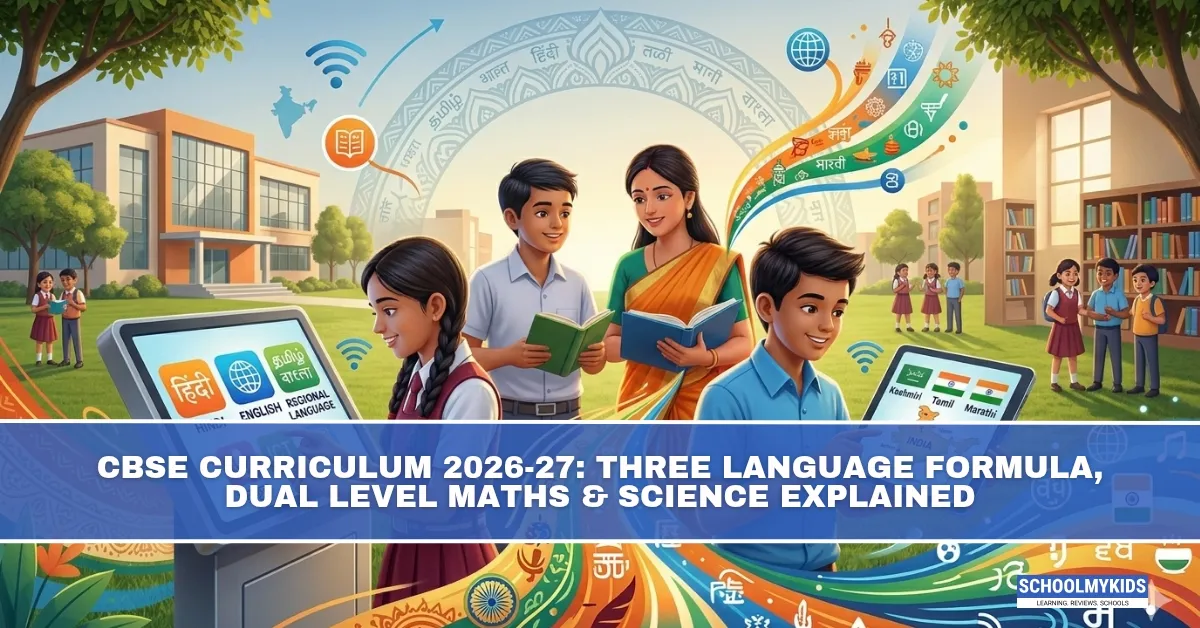
CBSE rolled out changes in April 2026 that shift how millions of Indian students will study. Not small tweaks. Real structural changes starting from this academic year. Class 6 students this year are the first batch entering a completely different system, as announced by CBSE in April 2026.
Most parents are confused. Teachers are scrambling. Students don’t know what’s changing. So let’s break down what’s actually happening, when it affects your child, and what the whole thing means.
The Three-Language Formula: R1, R2, R3
This is the biggest shift. Starting Class 6 in 2026-27, every CBSE student must study three languages instead of two. Not optional. Mandatory.
Let’s see how it works. Instead of just saying “three languages,” CBSE created a framework with specific purposes for each language:
R1 (Regional Language): This is where the student is most comfortable. Usually the mother tongue or the regional language of the area. If you’re in Maharashtra, this might be Marathi. In Tamil Nadu, Tamil. In Delhi, Hindi. Doesn’t matter what the language is. R1 is the foundation. The language the student can think in most naturally.
R2 (Second Language): This adds communication skills. Often English for most students. Or another Indian language. The point is gaining broader communication ability. R1 connects you to roots. R2 connects you to wider India.
R3 (Third Language): New mandatory addition starting Class 6 in 2026-27. This emphasizes practical knowledge over mastery. It's about exposure, not depth. At least two of the three languages must be Indian languages. So students can't do English-Hindi-French. They need to include Indian languages.
The requirement is specific: at least two of the three must be Indian languages. English can still be one. It is not being removed. It is just not the only international language option anymore.
What R3 Actually Looks Like
What R3 is not: it’s not a third language where you learn complex grammar and literature. It’s not a subject where you’re tested heavily.
What R3 is: practical language exposure. Maybe conversational Hindi if you’re in a southern state. Maybe Sanskrit if your school offers it. Maybe a classical Indian language. The focus is communication and cultural connection, not academic mastery.
R3 textbooks are being introduced in Class 6 this year (2026-27). Full integration with board exams for the complete three-language scheme is phased, with the first major impact expected around 2030-31 for the pioneering cohort. So currently, there’s a phased transition. Class 6 starts R3 now. By the time they reach Class 10 in 2031, R3 will be part of board exams.
Why This Is Happening
NEP (National Education Policy 2020) explicitly recommends multilingual education. The idea: students should stay connected to Indian roots while also gaining global competency. Three languages achieve both.
CBSE isn’t inventing this. It’s implementing NEP guidelines through the National Curriculum Framework. The rationale: language isn’t just communication. It connects students to culture, knowledge systems, and identity.
For many states and regions, this is a win. Regional languages get importance. Students don’t lose connection to their mother tongue. But it also means more languages to manage in school.
According to NEP 2020 and NCF-SE 2023, this promotes multilingualism while preserving cultural roots, benefiting the vast majority of students, as nearly 98.5 percent already engage with multiple languages in some form.
The Dual-Level Math and Science System
Starting Class 9 in 2026-27, math and science stop being one-size-fits-all subjects.
Every student takes a mandatory standard exam: 80 marks, three hours. This covers the core curriculum. Everyone does this. Same test. Same time. Same marking.
But students who want more can opt for an additional advanced paper: 25 marks, one hour. This paper tests higher-order thinking and deeper conceptual understanding. Not just memorization. Actual problem-solving and application.
The important part: the advanced marks don’t get added to the total. It’s not 80 + 25 = 105 marks total. The standard exam stays at 80 marks. The advanced is separate.
If a student scores 50% or above on the advanced paper, the board notes this separately on the mark sheet. “Advanced Level Mathematics” or “Advanced Level Science” appears as a qualification. It’s additional recognition, not part of the main score.
Who Should Take Advanced?
The standard exam is designed for students going into fields where math and science are supporting subjects, not core. Commerce, humanities, vocational streams. The standard curriculum covers what they need.
Advanced is for students planning engineering, medicine, pure science, or fields where deep math and science understanding is required. It’s optional but recommended if that’s your direction.
The intent is clear: stop forcing everyone through the same curriculum. Let students take the depth they need, not the depth everyone gets.
When These Changes Kick In
2026-27 (This Year):
Class 6 starts the three-language system with R1, R2, R3.
Class 9 gets the dual-level option for math and science (standard mandatory; advanced optional).
AI and Computational Thinking formally enter Classes 3-8 as part of the curriculum structure.
2027 Board Exams:
No major structural changes for most current students.
For Classes 7-9 (2026-27):
One-time relaxation applies, especially for those already studying two foreign languages. They can continue with adjustments by adding one Indian language, with school-level assessment for the third language (no board exam requirement in immediate transition). Current Class 10 fully exempt.
2028 Board Exams:
First visible impacts from the dual-level math and science for the 2026-27 Class 9 cohort.
2030-31 Board Exams:
Full three-language scheme effects become prominent for the Class 6 (2026-27) starters reaching Class 10.
The AI and Computational Thinking Piece
From 2026-27, computational thinking and artificial intelligence gain formal structure in Classes 3-8 curriculum (integrated, not separate), with further developments for higher classes.
For Classes 3-8, AI and computational thinking are now part of the formal curriculum structure. Not a separate club activity. Core learning.
What This Means For Parents
If your child is entering Class 6 this year, they’re learning three languages. Talk to your school about which R3 language is offered. Make sure it’s something available at your school.
If your child is in Class 9 this year, they’re getting the option for advanced math and science. If they’re planning science or engineering, encourage them to consider advanced. If they’re unsure, the standard curriculum is designed to be sufficient.
For younger kids (Class 3-8), computational thinking is now formally assessed. Don’t worry about special tutoring. Schools are expected to teach it as part of the regular curriculum.
Exemptions and Special Cases
Students returning from foreign schools may get exemptions from R3 if the third language they studied abroad isn’t available in Indian schools. This is case-by-case with school administration.
English isn’t being replaced. It’s just one of three languages now, not the default second language. Schools can still choose English as R1 or R2 if they want.
Additionally, current students in Classes 7-9 receive transition relaxations as per June 2026 guidelines.
Key Takeaways
Three-language formula starts in Class 6 in 2026-27, with at least two being Indian languages. Phased board impacts follow, with full effects for the first cohort around 2030-31.
Dual-level math and science in Class 9 gives students choice: standard 80-mark mandatory exam or optional advanced 25-mark paper for deeper learning.
Advanced paper doesn’t add to overall marks but gets noted separately on the mark sheet if 50%+ achieved.
AI and computational thinking enter formal curriculum structure from 2026-27 for Classes 3-8, with further developments in higher classes.
Board exams remain unchanged in 2027. First impact visible in 2028 board exams.
Real Questions Parents and Students Have
Will learning three languages overload my child?
The board balanced this by reducing assessment load for R3 and focusing on proficiency rather than depth. It’s not three “main” languages. It’s two main (R1, R2) and one practical exposure (R3).
Can my child opt out of the third language?
Not in CBSE schools. It’s mandatory from Class 6. Some exemptions exist for students from foreign backgrounds, but general students must take R3.
What if my school doesn’t offer the R3 language I want?
Schools will offer multiple options. Talk to your school about what R3 languages are available. Most schools will offer 3-4 options, so students have choice within their school’s offerings.
If my child doesn’t take advanced math or science, will it affect their college admission?
Not directly. Colleges look at overall marks. Advanced qualification is additional recognition. But for science and engineering colleges, having advanced shown on the mark sheet might be considered a plus. It’s not required though.
Does this mean my child studied different math than other Class 9 students?
No. Everyone studies the same standard curriculum (80 marks). Advanced is optional additional content, not a replacement. The core learning is identical.
When will computational thinking and AI be officially tested in board exams?
From 2028 onwards for Classes 9-10. Classes 3-8, it’s already integrated into curriculum assessment from 2026-27.
What about students already in Class 7, 8, 9 this year?
Class 7-9 this year follow transition guidelines with relaxations (especially for existing foreign language combinations). Class 9 gets the dual-level math and science option. The full new system primarily targets Class 6 entrants and below.
Are these changes only for CBSE or state boards too?
CBSE is implementing independently. State boards may or may not follow the same structure. Check your state board’s guidelines if your child isn’t in CBSE.
Conclusion
The CBSE curriculum overhaul is significant but not chaotic. It’s being phased in gradually. No sudden shocks to students currently preparing for board exams. Class 6 students this year are pioneering the new system, but it’s designed to be manageable alongside regular academics.
The core shift is philosophically important: moving from one-size-fits-all to flexibility. Students choosing depth in subjects they care about. Languages connecting them to roots while maintaining global access. That’s the direction these changes are pointing.







Be the first one to comment on this story.