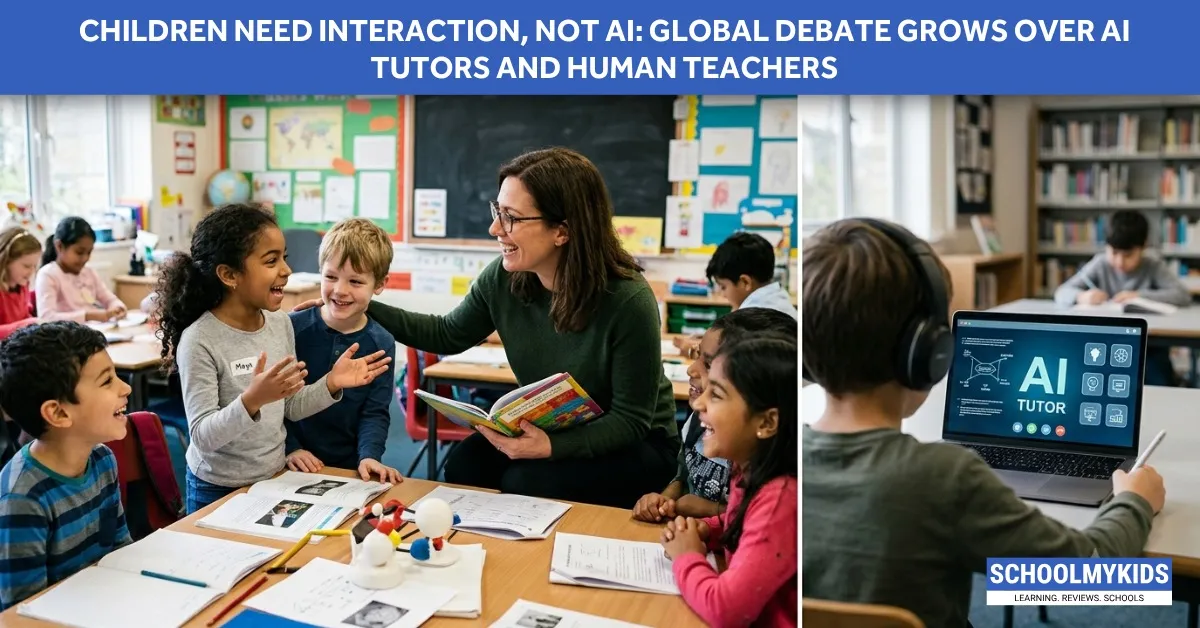
The moment that caught everyone’s attention came in early 2026. A teenager in California said her AI tutor explained calculus better than her teacher. Her mother posted about it online. Within hours, people were arguing whether teachers were obsolete.
They’re not. But something real is shifting.
AI tutoring apps like Talkpal, Praktika, and Gliglish now let students have 30-minute conversations in Spanish, French, or Mandarin with AI that adapts to their level, corrects errors, and costs less than a single session with a human tutor.
Khan Academy’s AI tutor explains concepts. Math problems get instant feedback. Language learners practice for hours without a real person on the other end.
But this isn’t replacing teaching. It’s changing what teachers do.
What The Data Actually Shows: It’s Not What You’d Expect
According to the latest U.S. Bureau of Labor Statistics employment projections, overall employment of kindergarten and elementary school teachers is projected to decline about 2 percent from 2024 to 2034. Secondary school teachers face a similar mild decline. The drop is driven mainly by falling student enrollment, not by AI replacing teachers.
Despite limited overall job growth, educational instruction and library occupations are still projected to have about 871,900 openings each year on average. Most of those openings come from teachers leaving the profession through retirement, burnout, or career change.
If AI were actually replacing teachers, you’d see fewer job openings. Instead, you see a decade-long teacher shortage. Schools can’t find enough humans to hire.
What AI Tutors Are Actually Good At: The Real Strength
An AI tutor excels at specific things. It never gets impatient. It explains the same concept 50 different ways. It gives instant feedback. It works at 3 AM when you’re cramming for an exam.
In language learning, the apps are genuinely useful. A student can practice conversation without fear of being judged. No human embarrassment. No live audience watching you mess up.
For math and coding, AI handles the drill-and-practice layer. Repetition. Correction. Immediate feedback. This is exactly what AI does best.
Cost is another advantage. An AI tutor costs ₹200-500 per month. A human tutor costs ₹500-2,000 per session.
Where AI Tutors Actually Struggle: The Hard Stuff
But there’s a line AI doesn’t cross yet. Open-ended discussions. Debate. Critical thinking development. Project-based learning. These require human judgment.
When you’re stuck on a tough concept, a good teacher doesn’t just explain. They ask questions that make you think differently. “What would happen if…?” “Why do you think that’s true?” They listen to your reasoning and challenge the weak parts.
AI can ask scripted questions. But it can’t have a real conversation about why you’re struggling or what’s underneath your confusion.
A student in Mumbai was learning history from an AI tutor. The app explained World War II facts perfectly. But when she asked “Why did people follow Hitler?” the AI gave a textbook answer. It didn’t help her understand how misinformation works or how to recognize propaganda today.
A human teacher would have had that conversation. Would have made it personal.
The Jobs That Are Actually Disappearing
Not all teaching positions are equally protected. Some will shrink.
Lecture-only teaching (one teacher talking to 30 students for 45 minutes) is under pressure. An AI video explains concepts more clearly. Students can pause and replay. That pure lecture format becomes less valuable.
Rote testing and manual grading of simple questions? AI handles that faster. Checking whether students know capitals of countries or basic math facts? An algorithm does it in seconds.
Tutoring that just repeats what an AI tutor can already explain? That disappears.
But mentoring? Holding students accountable? Pushing them when they want to give up? That’s protected. An AI can’t do that.
What This Means For Teacher Salaries And Career Paths: The Economic Picture
Traditional school teaching salaries remain low in many regions. India, for example, many government school teachers still earn in the ₹25,000–45,000 range in a number of states, though central and higher-paying state scales start higher. It is often not enough.
But teachers who adapt are seeing opportunities. EdTech instructional designers earn more. Online teachers earn more. Curriculum designers for AI platforms earn more.
Teachers and instructors who specialise in AI concepts or work in EdTech curriculum roles often command higher pay than pure classroom teaching in many markets. In India, AI instructor roles commonly fall in the ₹30,000–60,000 range depending on experience and city.
The economic message is clear: teachers who stay pure classroom educators face salary pressure. Teachers who move into hybrid roles by combining classroom teaching with online content creation, EdTech curriculum design, or instructional coaching are earning better.
The Global Picture: What’s Happening Worldwide
UNESCO and the International Task Force on Teachers continue to project that the world will need around 44 million additional primary and secondary teachers by 2030 to reach universal education goals. The nature of teaching jobs is changing globally at the same time.
In developed countries (USA, UK, Australia), schools are piloting hybrid models. AI handles data and identifies struggling students. Teachers then focus on those students intensively. The result: teachers spend more time on actual mentoring, less time on admin.
In developing countries (India, parts of Africa, Southeast Asia), the picture is different. Many schools lack basic connectivity. AI tutors work when the internet is reliable. In rural areas with no internet? AI doesn’t help.
This creates a new problem. Access to good teaching gets even more unequal. Kids in cities get AI tutors plus human teachers. Kids in villages get one or the other.
What Students Actually Need
Research is pretty clear on this. Students who combine AI tools with human mentorship learn better than using either alone.
Emerging research and classroom pilots consistently show that students who use AI for practice and then work with human teachers on discussion and application develop stronger critical thinking than those relying on either alone.
But students also need emotional connection. They need someone who notices when they’re struggling and checks in. Someone who believes in them when they don’t believe in themselves.
An AI tutor can say, “You got this question wrong. Here’s the right answer.” A human teacher can say the same thing plus communicate actual care. That matters for motivation.
What This Means For Student Career Preparation
Schools worldwide are scrambling to add AI literacy to curricula. A clear majority of teachers believe AI skills will help students access better-paying jobs.
But surveys through 2025 and 2026 show that large shares of teachers still report insufficient formal AI training. In multiple countries, substantial majorities say they lack adequate preparation, and only a minority feel confident teaching AI literacy.
So you have schools adding “AI” to curriculum names without actually teaching it well. Students get check-box AI education that doesn’t build real skills.
Meanwhile, employers expect roughly 39% of workers’ core skills to change by 2030, according to the World Economic Forum’s Future of Jobs Report 2025. But schools aren’t keeping up. Teachers need training. Curriculum needs updating. That takes time and money neither typically has.
The Reframe That Actually Matters: How To Think About This
AI has made certain teaching services cheap. Speaking practice in a language? Used to cost money. Now it’s ₹100/month.
That changes what human teachers need to offer. Learners aren’t paying teachers for speaking practice anymore. They’re paying for guidance, accountability, motivation.
This isn’t a disaster. It’s a shift.
In the best version of this future, teachers become coaches. They use AI data to understand exactly which students need help. Then they work intensively with those students on the hard stuff: judgment, critical thinking, character development.
Schools already trying this model are seeing what it looks like: teachers spending more time on meaningful work, less time on grading papers.
FAQs
Q1: Will my child’s teacher be replaced by AI?
Unlikely. But your child’s teacher’s job will change. Less time grading. Less time on admin. More time on actual mentoring. Whether that’s good or bad depends on whether your teacher embraces the change or resists it. Teachers who learn to use AI tools become more valuable, not less.
Q2: Should I hire an AI tutor or a human tutor for my child?
Both is the honest answer. AI tutors are great for practice, immediate feedback, and building confidence. Human tutors are better for motivation, strategy, and pushing your child to think deeper. The best students use AI for drilling skills and human tutors for coaching.
Q3: What AI skills should my child learn?
Basic AI literacy is becoming essential. Understanding how AI works. Using AI tools effectively. Knowing when AI helps and when it doesn’t. Recognizing AI limitations and bias. That matters more than specific coding or technical skills for most students.
Q4: Are teachers’ salaries going up or down with AI?
Traditional classroom-only teachers face salary pressure in many regions. But teachers who add skills like instructional design, online teaching, curriculum development, and EdTech expertise see better opportunities and higher pay. The trajectory is: adapt or face stagnation.








Be the first one to comment on this story.