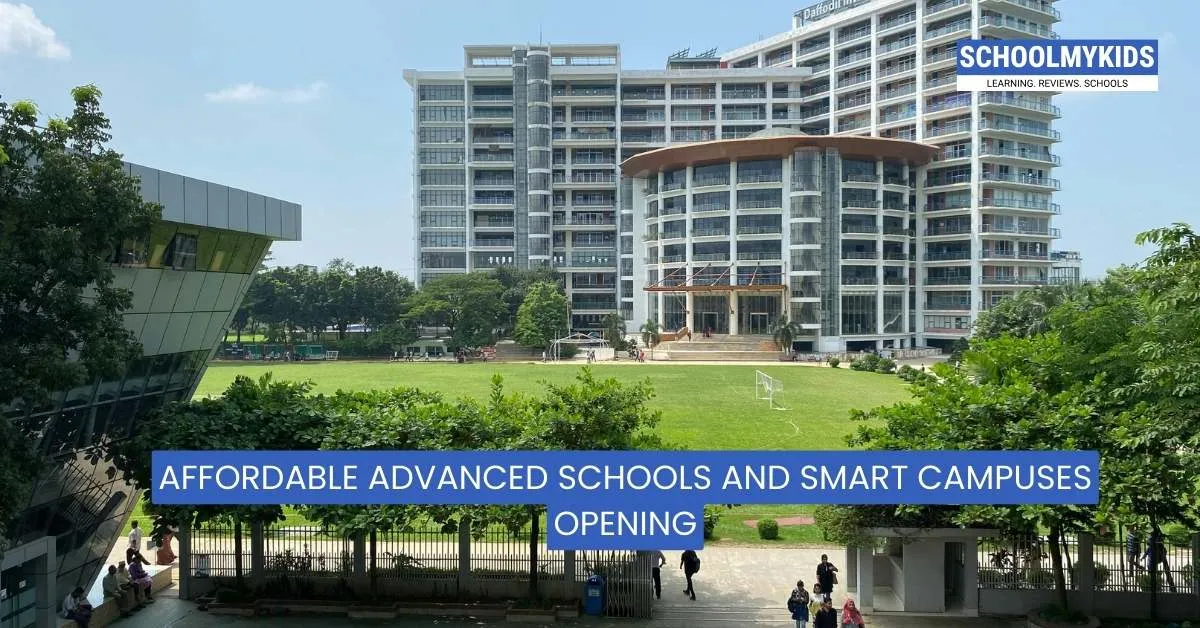
For years, advanced schooling meant high fees. Smart boards, labs, robotics rooms, and digital platforms were associated with elite private schools or international curricula. Technology in education became a status symbol rather than a learning tool.
As a result, affordability and advancement were treated as opposites. Parents believed they had to choose between cost and quality. Most schools reinforced this belief by pricing innovation as a premium feature.
That equation is now starting to change.
What Affordable Advanced Schools Actually Mean
Affordable advanced schools are not cheap versions of elite institutions. They are redesigned systems.
Instead of adding technology on top of old models, these schools rethink how infrastructure, teaching, and operations work together. The focus is not on luxury facilities, but on functional intelligence.
Smart classrooms, blended learning, data-informed teaching, and efficient campus design are used to improve learning outcomes without inflating costs.
How Smart Campuses Reduce Long-Term Costs
Smart campuses are built to optimize, not impress.
Energy-efficient buildings reduce electricity costs. Digital attendance, assessments, and communication lower administrative overhead. Shared resources replace redundant infrastructure.
Once established, these systems reduce recurring expenses. Savings are then passed on through stable or lower fee structures, making advanced education financially sustainable rather than continuously expensive.
Technology as a Cost-Saver, Not a Cost-Adder
In traditional models, technology is an add-on.
In smart schools, technology replaces inefficient practices. Digital content reduces textbook costs. Adaptive learning tools reduce the need for excessive remedial classes. Online platforms streamline communication between teachers, students, and parents.
When used strategically, technology reduces waste. When used cosmetically, it increases fees without improving learning.
How Teaching Changes in Advanced Affordable Schools
Advanced schools do not rely on lectures alone.
Teachers use class time for discussion, application, and guidance, while content delivery happens through structured digital resources. This blended approach improves clarity without increasing teacher workload unsustainably.
Teachers become facilitators of understanding rather than distributors of information. This improves learning depth while keeping staffing ratios manageable.
Why Parents Are Trusting These New Models
Parents are becoming more cost-aware and outcome-focused.
They question fee hikes that do not translate into better learning. Affordable advanced schools offer transparency. Parents can see how systems work, how technology is used, and how learning is tracked.
Trust grows when advancement feels purposeful rather than decorative.
The Role of Public-Private Collaboration
Many affordable advanced schools emerge through partnerships.
Governments provide land or policy support. Private players bring technology, management, and innovation. Nonprofits contribute curriculum and teacher training.
This hybrid approach lowers entry barriers and spreads risk, allowing advanced schools to operate at scale without premium pricing.
Who Benefits the Most From Smart Campuses
Students benefit from exposure to modern learning tools without financial strain.
Teachers benefit from structured systems that reduce administrative burden. Parents benefit from predictable costs. Communities benefit from local access to quality education without forcing relocation or private tutoring dependence.
The largest impact is on middle-income families who were previously priced out of advanced schooling.
The Risks and Misconceptions
Not every “smart” school is effective.
Some institutions market technology without changing pedagogy. Screens replace blackboards, but teaching remains rote. Fees rise without corresponding outcomes.
Affordability works only when innovation is tied to learning design, not branding.
What This Trend Signals About the Future of Schooling
The opening of affordable advanced schools signals a structural shift.
Quality education is no longer defined by how expensive a campus looks, but by how intelligently it operates. Smart systems reward efficiency, clarity, and adaptability.
As these models expand, the gap between elite and affordable education may narrow, not through compromise, but through design.
The Core Reality Behind This Shift
Affordable advanced schools and smart campuses are emerging because traditional education models are too costly and too rigid for today’s realities. By redesigning infrastructure, teaching methods, and operations, these schools deliver modern learning without premium pricing. When technology is used to simplify systems rather than decorate them, advancement becomes accessible. The future of schooling is not about choosing between affordability and quality, but about building institutions that deliver both deliberately and sustainably.








Be the first one to comment on this story.