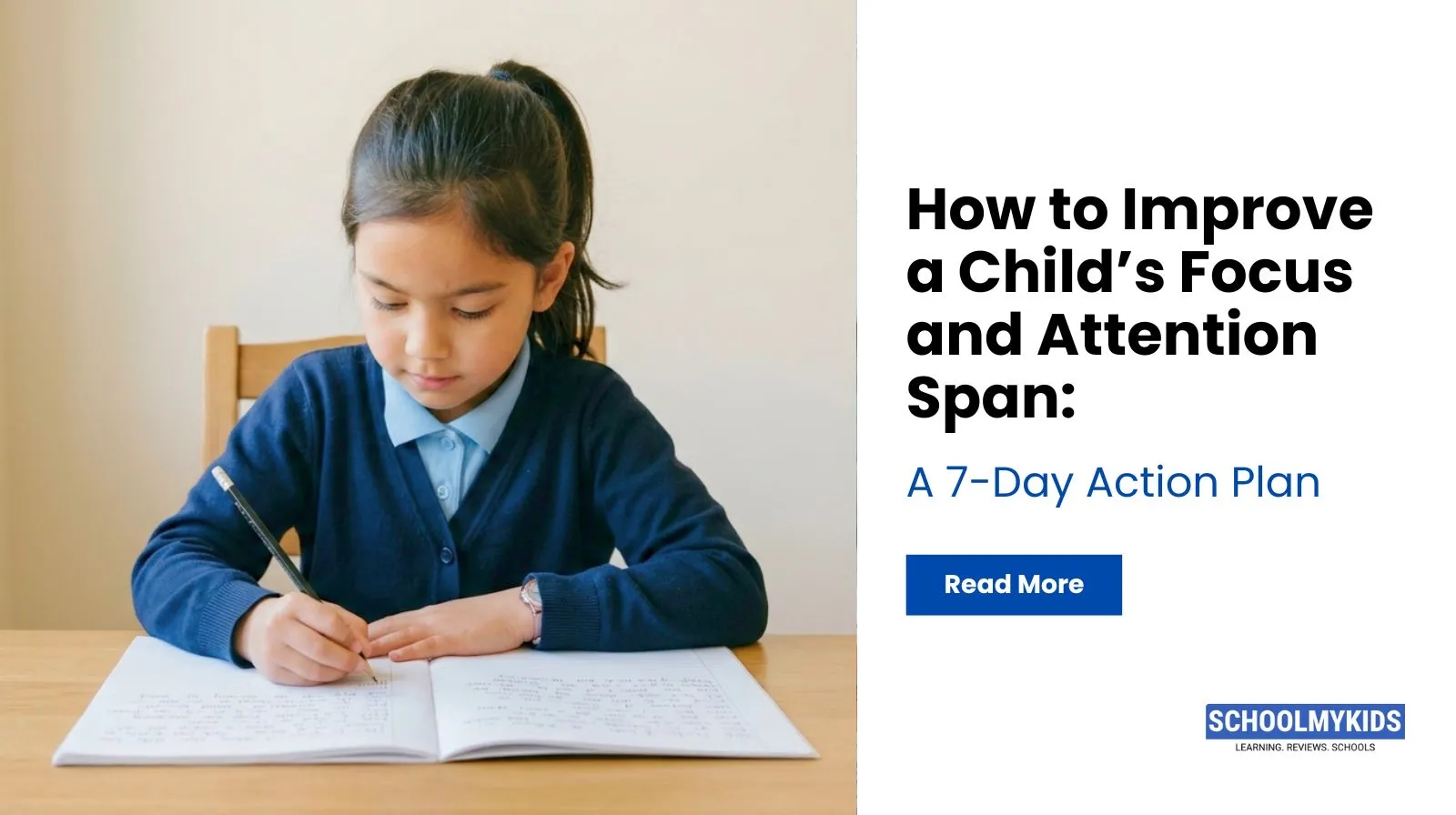
Picture this: your child sits down for homework at 5 PM. By 5:07, they are staring at the ceiling, doodling in the margins, or asking for water for the third time. You remind them to focus. They nod. Five minutes later, same story.
If this sounds familiar, you are not alone. Millions of Indian parents face this daily battle. The good news? The ability to improve focus in children is not fixed at birth. It is shaped, day by day, by the environment you create, the habits you build, and the support you offer. Here is everything you need, including a practical 7-day action plan, to make a real difference.
What “Focus” Actually Means for a Growing Child
Focus is not a single switch you flip on or off. It is a combination of a child’s ability to direct attention, filter distractions, and sustain mental effort long enough to complete a task.
Child development research identifies three core skills that underpin a child’s ability to improve focus: working memory (holding and using information mid-task), cognitive flexibility (shifting thinking when needed), and self-control (pausing before reacting). All three can be strengthened with the right support.
These are approximate ranges based on child development guidelines, often cited as roughly 2–5 minutes per year of age, with higher ends applying to engaging, interest-led tasks. Attention also varies significantly based on environment and individual differences:
Age Group | Healthy Focus Duration | Common Challenges |
|---|---|---|
3–5 years | 6–15 minutes | Short bursts, easily distracted by surroundings |
6–8 years | 12–24 minutes (e.g., 16–24 minutes for ages 7–8) | Restlessness, daydreaming mid-task |
9–12 years | 20–35 minutes | Difficulty with multi-step tasks |
13+ years | 30–45+ minutes | Screen dependency, exam anxiety |
When your child consistently falls well below these benchmarks across both home and school settings, that is when the situation deserves closer attention.
Early Signs Your Child May Be Struggling
There is a meaningful difference between occasional daydreaming and a persistent pattern of inattentiveness. Some signs worth watching:
Difficulty completing tasks even when genuinely interested
Frequently losing track of instructions midway through
Restlessness or inability to sit still for age-appropriate periods
Being overwhelmed by multi-step assignments
Consistent teacher feedback about inattentiveness in class
These signs do not automatically mean ADHD. However, it helps to understand what ADHD symptoms in children actually look like because ADHD is significantly underdiagnosed in India, often mistaken for laziness or a lack of discipline.
Indian studies report varying prevalence estimates for ADHD depending on diagnostic criteria and population studied, with pooled estimates commonly falling around 5–7%. Some urban school-based screenings report higher rates of attention-related symptoms, though many children remain undiagnosed, particularly girls.
Despite this, many cases go unidentified, particularly in girls, due to limited access to specialists and cultural stigma around neurodevelopmental conditions.
ADHD Symptom | What It Looks Like at Home | What It Looks Like at School |
|---|---|---|
Inattention | Forgetting homework, losing items regularly | Missing instructions, incomplete classwork |
Hyperactivity | Constantly moving, unable to sit through meals | Fidgeting, leaving seat without permission |
Impulsivity | Interrupting conversations, acting without thinking | Blurting answers, difficulty taking turns |
Emotional dysregulation | Intense reactions to small frustrations | Meltdowns over minor setbacks |
Only a qualified pediatrician or child psychologist can diagnose ADHD. These signs are prompts for observation, not conclusions.
The 7-Day Action Plan to Improve Focus in Children
Day 1: Create a Distraction-Free Study Zone
The environment your child studies in directly determines how well they can concentrate. A cluttered table, background television, or a nearby phone are all silent concentration killers.
Today’s task: Designate one consistent study spot. Remove non-essential items. In joint family homes, where grandparents, cousins, and evening activity make quiet time genuinely difficult, a physical “Study Mat” or a specific lamp can act as a psychological anchor. When the lamp is on or the mat is laid out, the brain learns over time to filter background noise. This is a simple form of environmental conditioning that works particularly well for children aged 6–12.
A visual cue like a “Focus Time” sign on the door also helps signal to the rest of the family that the child needs uninterrupted time. This creates a small but surprisingly effective boundary in busy Indian homes.
Day 2: Introduce Time-Blocked Study Sessions
The Pomodoro Technique, adapted for children, works well for building concentration without burnout. Evidence supports short timed intervals for gradually building attention, especially in children who struggle with sustained tasks.
Age Group | Focused Work Block | Break Duration | Sessions per Sitting |
|---|---|---|---|
6–9 years | 15 minutes | 5 minutes | 2–3 sessions |
10–12 years | 20–25 minutes | 5–7 minutes | 3–4 sessions |
13+ years | 25–30 minutes | 7–10 minutes | 4–5 sessions |
During breaks, encourage movement like stretching, water, and brief outdoor time. Avoid screen-based breaks: they prevent the brain from truly resetting and make it harder to refocus afterward.
Bonus tip: The 20-20-20 Rule: Every 20 minutes, have your child look at something 20 feet away for 20 seconds. This reduces digital eye strain, which is now recognized as a contributing factor to poor focus in children who spend significant time on screens or textbooks.
Day 3: Add a Short Mindfulness Practice
Even 5–10 minutes of daily mindfulness practice can reduce anxiety and measurably improve a child’s ability to sustain attention. Research on mindfulness meditation in children aged 6–9 confirms benefits for inattention and emotional regulation, with positive effects extending to children with ADHD-related attention difficulties as well.
Try the 4-7-8 Breath before study sessions: Inhale for 4 counts, hold for 7 counts, exhale slowly for 8 counts. Repeat three times. This technique draws from Pranayama breathing traditions, making it culturally familiar and easy to introduce in Indian households. Anulom Vilom (alternate nostril breathing) is an equally effective option for older children who attend yoga classes or are comfortable with a slightly more structured practice.
This is especially valuable for children preparing for CBSE or ICSE board exams, where elevated cortisol levels directly impair working memory and the capacity to concentrate under pressure.
Day 4: Use Concentration Exercises for Kids Through Play
Concentration exercises for kids do not have to feel academic. The most effective ones feel like playing games. Matching activities to your child’s natural learning style makes them significantly more effective:
Learning Style | Best Concentration Exercises | Why It Works |
|---|---|---|
Visual learners | Spot-the-difference, mind maps, color-coded notes | Engages spatial attention and pattern recognition |
Auditory learners | Reading answers aloud, mnemonic songs, storytelling | Channels the need for sound into productive focus |
Kinesthetic learners | LEGO, fidget tools while reading, hands-on projects | Uses physical engagement to anchor mental attention |
Additional concentration exercises for kids that work across learning styles include memory card matching, chess, carrom, Sudoku, and Rubik’s cubes; all of which require multi-step thinking and sustained effort.
Day 5: Revisit Sleep and Nutrition
Many Indian parents invest heavily in tuitions and revision timetables while overlooking two of the most powerful focus-boosters: sleep and food.
Age Group | Recommended Sleep | Impact of Sleep Deprivation on Focus |
|---|---|---|
6–12 years | 9–12 hours per night | Reduced attention span, emotional volatility |
13–18 years | 8–10 hours per night | Impaired memory consolidation, poor concentration |
On nutrition, traditional Indian breakfasts like poha, idli-sambar, dalia, upma with vegetables, eggs are genuinely excellent brain foods. Beyond these staples, walnuts is rich in Omega-3 fatty acids that directly support sustained cognitive function. Consistent meals with complex carbohydrates, proteins, and healthy fats help the brain maintain steady energy while frequent sugary snacks cause the crashes that make concentration nearly impossible.
Day 6: Manage Screen Time Intentionally
This is not about banning screens. It is about making your child’s relationship with screens deliberate rather than automatic. Heavy consumption of short-form content, particularly YouTube Shorts and Instagram Reels, is linked to reduced sustained attention and poorer impulse control, with some surveys specifically showing heavy use tied to greater inattention symptoms, especially in children under 12.
Practical boundaries that work in Indian households:
Phones in a charging basket during study hours
No screens during family meals
1-hour screen-free wind-down before bed
Weekend screen time linked to completed responsibilities
Co-create these rules with your child. Children who have a voice in setting boundaries are significantly more likely to follow them and less likely to resent the limits.
Day 7: Build Emotional Safety
Focus does not happen in an emotional vacuum. A child anxious about CBSE exam results, worried about parental expectations, or dealing with peer conflict cannot simply “try harder” to concentrate. Emotional weight consumes the cognitive bandwidth that would otherwise go toward the task.
On Day 7, do something low-pressure and genuinely enjoyable together like cooking, board games, a walk, or storytelling. Then talk about how the week felt. Celebrate small wins: a completed timed session, a calmer homework sit-down, a breathing exercise tried without complaint. Positive reinforcement builds the internal motivation that long-term focus ultimately depends on.
ADHD Focus Tips: When to Go Beyond Home Strategies
If you have applied consistent strategies for four to six weeks with little improvement, especially if teachers are raising concerns or your child is showing signs of distress, it is time to consult a professional.
Concern | Who to Consult | What to Expect |
|---|---|---|
Attention struggles at home and school | Developmental pediatrician | Behavioral screening, referral if needed |
Suspected learning difficulty | Child psychologist | Psychoeducational assessment |
Emotional dysregulation alongside attention issues | Child psychiatrist | Comprehensive evaluation, therapy options |
School-based support | School counsellor | In-class accommodations, teacher coordination |
A diagnosis, if it comes, is not a label. It is a roadmap to the right kind of support. Many children with ADHD thrive with appropriate non-pharmacological therapies, school accommodations, and consistent parental involvement.
Frequently Asked Questions
What is a normal attention span for a 7-year-old?
Roughly 14–24 minutes on a single task in a low-distraction environment, based on current child development guidelines. Consistently falling below 10–12 minutes across both home and school settings may warrant closer observation, particularly if accompanied by other signs of difficulty.
What are the early ADHD symptoms in children I should watch for?
Common early ADHD symptoms in children include persistent difficulty finishing tasks, frequently losing belongings, difficulty waiting for turns, excessive talking, and appearing constantly restless even in situations that call for stillness. These patterns must appear across multiple settings and not just at homework time and be more intense than what is typical for the child’s age group.
What are the best concentration exercises for kids that do not feel like schoolwork?
Memory card games, spot-the-difference puzzles, chess, carrom, Rubik’s cubes, and LEGO are all excellent concentration exercises for kids. Matching the activity to your child’s learning style (visual, auditory, or kinesthetic) makes it significantly more effective.
Can what my child eats really affect their focus?
Yes, meaningfully. Consistent meals built around complex carbohydrates, proteins, and Omega-3 fatty acids (eggs, nuts, fish, whole grains, dal) support sustained cognitive function. Frequent sugary snacks contribute to energy crashes that directly impair attention. Traditional Indian diets are naturally well-suited to brain health when meals are regular and breakfast is not skipped.
How quickly will the 7-day plan show results?
Most parents begin to notice incremental improvements, like slightly longer focus windows, fewer reminders needed, calmer homework sessions, within two to three weeks of consistent practice. The 7-day plan is a starting point, not a one-week cure. Repeat, adjust, and build on what works for your specific child.
The Bottom Line for Parents
Improving focus in children is not about pressure drills or strict discipline alone. It is about building the right environment, the right habits, and the right emotional foundation, one consistent day at a time.
India’s children carry enormous academic weight: board exams, competitive entrances, high family expectations layered over a rapidly changing world. Teaching a child to focus is one of the most valuable gifts you can offer them. Not just for better grades but for a life where they can show up fully for whatever matters most.
Start small. Start today.
Explore more on SchoolMyKids. From concentration games and age-appropriate activities to CBSE study guides, career options, and expert parenting tips.








Be the first one to comment on this story.