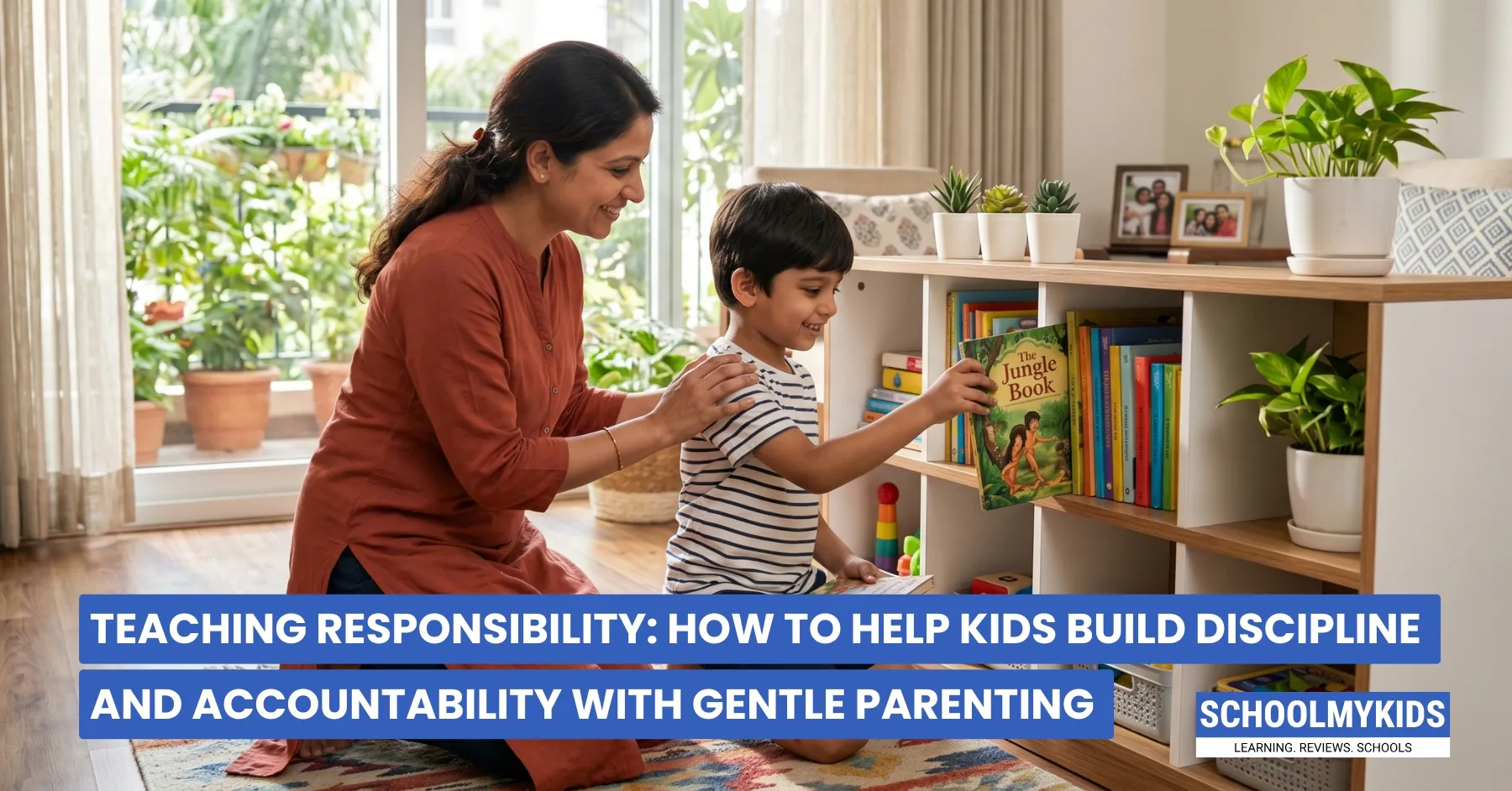
Every Indian parent wants their child to grow into a responsible, self-reliant adult. But somewhere between homework battles, screen time arguments, and daily chaos, we wonder, “Am I doing this right?” The answer might be simpler than you think. Gentle parenting, when applied with consistency, is one of the most effective approaches for teaching responsibility in kids without breaking their spirit or your relationship with them.
This guide offers practical and research-backed gentle parenting strategies designed for Indian families. You will discover how to nurture responsibility in children through empathy, clear boundaries, and suitable daily tasks that fit our busy multigenerational homes and demanding academic world.
What is Gentle Parenting and Why Does It Work for Indian Families?
Gentle parenting is not permissive parenting. Many Indian parents confuse the two. Permissive parenting means no boundaries. Gentle parenting means firm boundaries delivered with empathy and respect.
It works exceptionally well for Indian families because:
Indian households are relationship-driven and emotionally expressive
Children respond better to warmth paired with structure than fear-based authority
Joint families and multigenerational homes benefit from a consistent, respectful communication model
Positive discipline reduces sibling rivalry and comparison-related stress
Gentle parenting does not mean your child gets away with everything. It means they understand why certain behaviour is expected, which builds genuine accountability rather than surface-level obedience.
Updated insights from 2025 studies on authoritative parenting styles confirm that this balanced method supports stronger self-regulation in children. For Indian families, it helps manage academic stress while honouring important values such as family respect and shared duties.
The Real Difference Between Discipline and Punishment
Before we discuss positive discipline, we must separate two concepts that most parents use interchangeably.
Parameter | Punishment | Positive Discipline |
|---|---|---|
Goal | Stop bad behaviour immediately | Teach long-term responsible behaviour |
Method | Fear, shame, physical consequences | Natural consequences, logical reasoning |
Child’s response | Obedience out of fear | Understanding and self-regulation |
Long-term result | Rebellion, low self-worth | Accountability and emotional maturity |
Relationship impact | Distance and resentment | Trust and open communication |
The goal of child discipline should never be control. It should be guidance. When Indian parents shift this mindset, the entire dynamic at home changes positively.
Age-Wise Responsibility Building: What to Expect From Your Child
One of the biggest mistakes parents make is expecting adult-level accountability from a seven-year-old. Responsibility must be taught in stages that match a child’s brain development.
Age Group | Developmentally Appropriate Responsibilities |
|---|---|
3 to 5 years | Put toys away, carry their own small bag, water plants, help sort vegetables |
6 to 8 years | Make their bed, pack their school bag, feed pets, set the dinner table |
9 to 11 years | Manage homework schedule without constant reminders, help with grocery lists, prepare simple items like dalia or sandwiches, fold their clothes |
12 to 14 years | Handle pocket money carefully, manage their own timetable, take ownership of grades, assist with safe online tasks such as booking appointments |
15 years and above | Contribute to household planning, manage personal deadlines, support younger siblings, learn basic budgeting with safety awareness |
When you assign responsibilities that match your child’s developmental stage, success comes naturally. That success builds the self-confidence required for deeper accountability as they grow.
Why Natural Consequences Support Learning in Indian Homes
Natural consequences allow children to experience outcomes directly and build accountability without harming the parent-child connection. If a child forgets their project materials, the feedback from school provides a stronger lesson than repeated reminders. This method reduces daily nagging, which fits our fast-paced routines. Reliable child development information shows it improves decision-making skills by the teenage years. Always keep safety in mind and choose mild, suitable outcomes.
8 Gentle Parenting Strategies That Actually Build Accountability
1. Replace Commands With Choices
Instead of saying “Do your homework now,” say “Do you want to finish homework before dinner or right after?” This simple shift builds decision-making skills and parental guidance becomes a conversation, not a command.
2. Use Natural Consequences Consistently
If your child forgets their water bottle repeatedly, resist the urge to run it to school. Let them experience mild discomfort. Natural consequences are the most powerful teachers of accountability in kids. They are not cruel. They are honest.
3. Create a Visual Family Responsibility System
Indian children often respond well to colourful and clear visual tools. Make a simple weekly chart for the fridge or family group with tasks, names, and fun stickers. Include parents in the list too. This approach builds daily routines naturally and promotes fairness across joint family members.
4. Acknowledge Effort Over Outcome
Praising a child for trying hard rather than only for scoring well builds internal motivation. This is the foundation of self-discipline. When children know effort is valued, they stop avoiding challenges.
5. Model the Behaviour You Want to See
Children absorb everything. If you want a child who keeps their word, keep yours. If you want a child who admits mistakes, admit yours. Parenting tips built on modelling are more powerful than any lecture.
6. Have Weekly Family Check-ins
A ten-minute weekly conversation where every family member talks about what went well and what they would do differently creates a culture of accountability at home. This is especially powerful in Indian joint families where multiple authority figures often give conflicting messages.
7. Avoid Over-Rescuing
Indian parents, especially mothers, have a deeply nurturing instinct. However, over-rescuing prevents children from developing problem-solving skills. Let your child struggle a little. Struggle builds character and genuine responsibility.
8. Link Responsibilities to Indian Values and Personal Growth
Connect daily tasks to meaningful values. For instance, explain how helping at home shows care for elders in line with our cultural traditions. Tie study habits to future independence for college or career. This helps children see accountability as purposeful rather than a burden.
How the Indian School System and Gentle Parenting Can Work Together
India’s CBSE, ICSE, and state board systems are academically demanding. Many parents feel that gentle parenting cannot coexist with rigorous academic expectations. This is a myth.
Raising responsible children who take ownership of their studies is actually more achievable through positive discipline than through pressure-based parenting.
Here is how both can align:
Set academic goals together rather than imposing them
Break large tasks into daily habits to reduce overwhelm
Connect study routines to values, not just marks
Celebrate consistency, not just exam results
Encourage children to speak to teachers directly when they face academic challenges instead of always relying on parents to intervene
Blend in NEP 2020 life skills by letting children track their own projects and activities outside academics.
Hold calm talks about exam pressure to develop resilience instead of relying on comparisons with relatives or classmates.
This prepares students for college environments where self-management is non-negotiable.
Common Gentle Parenting Mistakes Indian Parents Make
Even well-meaning parents slip up. Here are the most common errors and how to fix them:
Mistake | Why It Backfires | What to Do Instead |
|---|---|---|
Inconsistent rules among different family members | Leads to confusion especially in joint families | Organise a short family discussion to agree on common expectations |
Over-explaining when emotions are high | Leaves the child feeling overwhelmed | First recognise their feelings, then calmly state the boundary |
Jumping in to fix every small setback | Limits growth in problem-solving ability | Guide with questions such as "What do you think you can try next?" |
Giving attention mainly to academic results | Raises fear of making mistakes | Recognise daily efforts and progress in all areas of life |
Combining Gentle Parenting with Traditional Indian Family Values
Indian parents sometimes worry that gentle parenting conflicts with respect for elders. In reality, it can deepen these values. Guide children to understand that true respect includes taking ownership of their tasks so that grandparents and elders feel less burdened. This creates better harmony in joint families and raises confident children prepared for life in modern India.
Benefits of Building Responsibility with Gentle Parenting
Children often gain higher self-esteem, stronger ownership of their studies, reduced arguments at home, and closer family bonds. Over time, they grow into resilient young adults who handle challenges well in competitive settings.
Key Takeaways
Gentle parenting is not soft parenting. It is structured, empathetic parenting with firm boundaries.
Building responsibility in kids must be age-appropriate and consistent.
Positive discipline works better than punishment for long-term accountability.
Indian family values like respect, hard work, and community align naturally with gentle parenting principles.
Modelling responsible behaviour is the most underrated parenting tool available to every parent.
Raising responsible children requires patience, but the results are children who are confident, self-reliant, and emotionally mature.
Frequently Asked Questions (FAQs)
Q1. What is the best age to start teaching responsibility to kids?
You can begin as early as age three with simple tasks like putting toys away. The earlier children learn that their actions have consequences, the more naturally accountability develops over time as they grow.
Q2. Is gentle parenting effective for disciplining children in Indian households?
Yes. It proves effective as it maintains family respect while developing inner discipline. This style lowers rebellion often seen in very strict methods and supports emotional well-being during academic demands.
Q3. How do I make my child accountable without being harsh?
Use natural consequences, give age-appropriate choices, and have calm conversations after misbehaviour. Avoid shouting or shaming. Instead, ask your child to reflect on what happened and what they would do differently next time.
Q4. What is the difference between gentle parenting and permissive parenting?
Gentle parenting includes clear expectations, consistent boundaries, and logical consequences. Permissive parenting has few or no boundaries. Gentle parenting teaches children responsibility. Permissive parenting avoids conflict at the cost of structure.
Q5. How can working parents in India practice gentle parenting with limited time?
Consistency matters more than quantity of time. Even fifteen focused minutes daily, using a responsibility chart, a calm bedtime conversation, or a weekend check-in, creates the structure children need to build discipline and accountability steadily.
Q6. How can gentle parenting address screen time challenges?
Create clear family rules together, such as no devices during meals. Apply natural outcomes like adjusted play time if responsibilities remain unfinished. This builds self-control in the digital era without ongoing conflicts.
Building responsible children is not a single conversation. It is a daily practice. Every small moment where you choose connection over control, explanation over punishment, and patience over reaction is an investment in who your child will become.
Start small. Stay consistent. Trust the process.







Be the first one to comment on this story.