Introduction: If the School Was “Good,” Why Does Life Feel So Confusing?
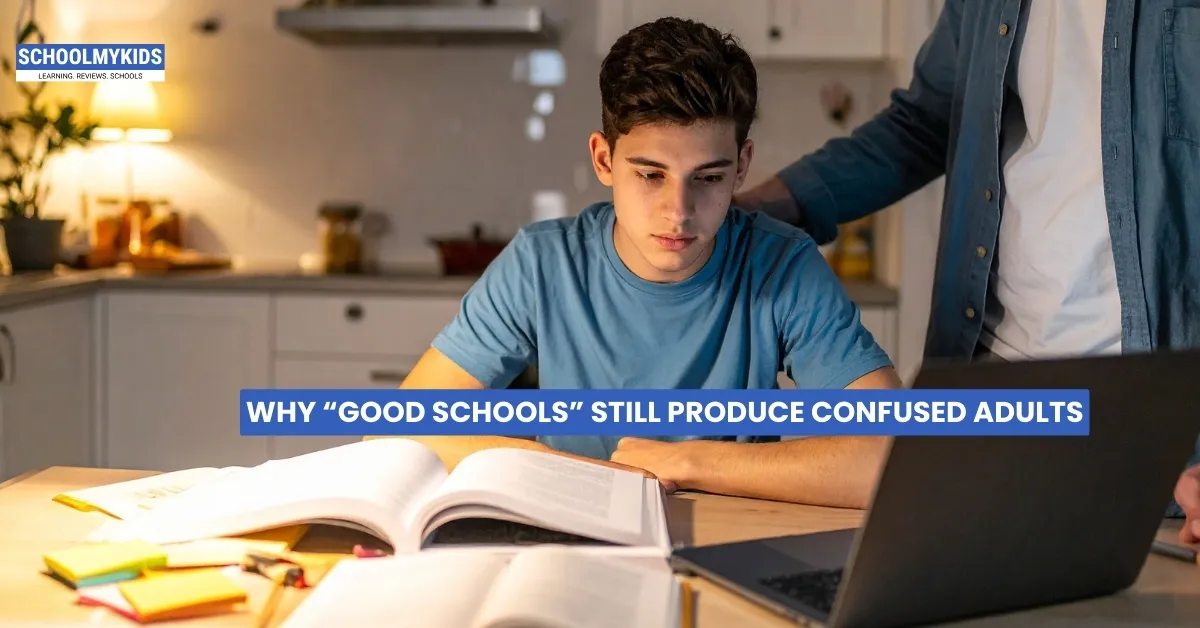
You followed the rules. You went to a “good school.” Maybe even a very expensive one with smart uniforms, smart boards, and smarter marketing. You scored decently, memorized diligently, and did what you were told. And yet, years later, many students from these good schools grow into adults who feel strangely lost. Unsure about careers. Afraid of making decisions. Good at exams, bad at direction. This isn’t an individual failure. It’s a system problem that students rarely notice until it’s too late.
What We Mean by “Good Schools”
The Narrow Definition of “Good”
Most people define a good school by results. Board scores. Rankings. College placements. Discipline. Neat classrooms. These metrics look impressive on paper and in brochures. Parents feel reassured. Students feel pressured. But none of this guarantees clarity about life beyond exams.
What Gets Ignored in the Process
What rarely gets measured is whether students understand themselves. Whether they can think independently. Whether they know how to make choices without a syllabus guiding them. Schools optimize for visible success, not internal clarity.
How Confusion Quietly Builds During School Years
Obedience Is Rewarded More Than Thinking
From an early age, students learn that compliance brings praise. Ask fewer questions. Follow instructions. Write what’s expected. This creates excellent rule-followers, not independent thinkers. When structure disappears after school, confusion rushes in.
Decisions Are Always Made for Students
Subjects are chosen based on marks. Timetables are fixed. Goals are predefined. Students rarely practice choosing for themselves. By the time real decisions arrive, like careers or values, they’ve never trained that mental muscle.
Mistakes Are Penalized, Not Explored
Good schools often punish mistakes harshly. Wrong answers cost marks. Failure carries stigma. Students learn to avoid risk. Later, when life demands experimentation, they freeze. Confusion thrives where curiosity was once suppressed.
The Exam-Centric Trap
Learning Becomes About Survival
In many good schools, learning isn’t joyful or exploratory. It’s tactical. Students study to survive exams, not to understand the world. Once exams end, motivation collapses. Without external pressure, many students don’t know what to pursue.
Intelligence Gets Misdefined
Students start believing intelligence equals marks. Emotional skills, communication, adaptability, and self-awareness are sidelined. When adult life demands these ignored skills, confusion feels personal, even though it was predictable.
Why Schools Don’t Teach Real-Life Clarity
Clarity Is Messy and Hard to Standardize
Self-awareness doesn’t fit into a syllabus. Purpose can’t be tested in three hours. Schools prefer what’s measurable. Unfortunately, life doesn’t care about neat assessment rubrics.
Teachers Are Also Products of the Same System
Many teachers were trained in exam-focused environments themselves. They pass on what they know. This isn’t cruelty. It’s inheritance. A system reproducing itself, even when it no longer serves students fully.
What Confused Adulthood Looks Like
Fear of Making the “Wrong” Choice
Adults from good schools often overthink decisions. They’re used to correct answers. Life offers none. Without certainty, paralysis sets in. Confusion becomes chronic.
External Validation Replaces Internal Direction
Grades once provided feedback. Now, likes, salaries, and job titles take over. Without internal metrics, adults keep chasing approval instead of meaning.
Skills Don’t Match Reality
Many adults realize they’re great at studying but terrible at working with ambiguity, people, or change. This mismatch fuels anxiety and dissatisfaction.
What Actually Helps Students Avoid This Fate
Space to Think, Not Just Perform
Students need unstructured thinking time. Discussions without right answers. Projects where the process matters more than marks. These experiences build clarity slowly but reliably.
Encouragement to Explore Identity
Schools rarely ask students who they are, only what they scored. Reflection, journaling, debates, and exposure to different paths help students understand themselves before life forces the question.
Redefining Success Early
When students learn that success includes adaptability, curiosity, and emotional resilience, adulthood feels less confusing. They stop expecting certainty and start building direction.
The Hard Truth for Students
A Good School Isn’t a Complete Education
This part stings, but it matters. A good school can open doors. It cannot hand you purpose. Students who wait for institutions to provide clarity will wait forever.
Responsibility Eventually Shifts to You
At some point, students must unlearn parts of their schooling. Question inherited definitions of success. Experiment awkwardly. Build clarity through action, not permission.
Conclusion: Confusion Isn’t Failure, It’s a Signal
Confused adults aren’t broken. They’re unfinished. Good schools often prepare students for exams, not for self-directed lives. That gap explains the confusion. The solution isn’t blaming schools or students. It’s recognizing what was missing and choosing to build it later. Clarity doesn’t arrive through perfect systems. It grows when students learn to think, choose, and adapt beyond the comfort of being told what’s right.






Be the first one to comment on this story.