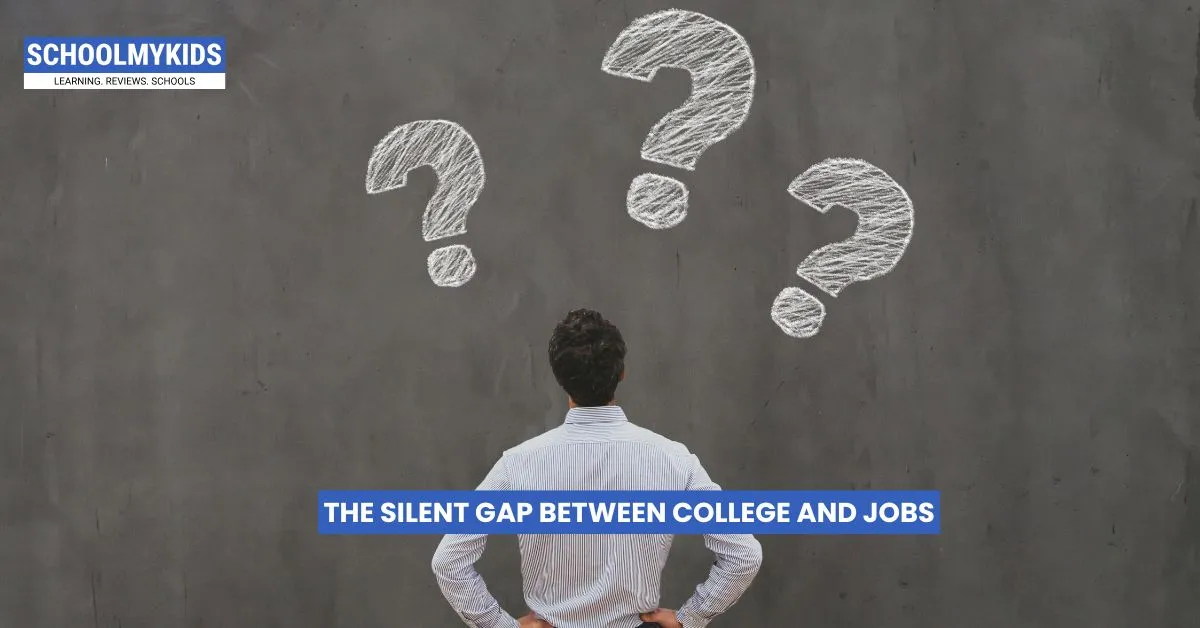
Where Education Quietly Stops Preparing Students
For most students, college comes with a promise that is rarely spoken out loud but deeply believed: study well, earn a degree, and a job will follow. Not immediately, maybe not perfectly, but eventually.
Then college ends.
And suddenly, students realize something unsettling. They are qualified on paper but unprepared in reality. This moment is confusing, embarrassing, and often lonely. The system does not warn students about it. It simply lets them fall into the gap and figure things out on their own.
What This Gap Actually Looks Like
The gap between college and jobs is not just about unemployment. It is about a mismatch.
Knowledge Without Application
Students know theories, definitions, and formulas. But when asked to apply them to real problems, they freeze.
Job interviews demand clarity, communication, and decision-making. College exams demand memory and structure. These are not the same skills, yet students are judged as if they should magically transfer.
Confidence Without Direction
Many graduates feel confident that they “studied hard.” But they are unsure where that effort fits in the real world.
They ask questions like:
- What roles am I actually suited for?
- How do I explain my skills?
- Why does everyone else seem to know the rules?
This confusion is rarely discussed openly, which makes students assume the problem is personal.
Why Colleges Rarely Address This Gap Honestly
Colleges are good at delivering curriculum. They are less comfortable dealing with outcomes.
Degrees Are Easier to Measure Than Readiness
Syllabi can be completed. Exams can be conducted. Results can be published. Job readiness is messy, subjective, and harder to standardize.
So institutions focus on what is easier to manage, not what is more useful.
Placement Statistics Hide More Than They Reveal
Placement numbers often represent a small portion of students. The rest quietly navigate internships, short-term roles, unrelated jobs, or long periods of uncertainty.
This silence creates unrealistic expectations for incoming students.
The Skills Students Are Rarely Taught
The gap widens because certain skills are assumed rather than taught.
Communication and Explanation
Knowing something is not enough. Students must explain ideas clearly, adapt language, and defend reasoning. This is rarely practiced in exam-driven classrooms.
Problem Framing
Jobs require identifying problems, not just solving predefined ones. College questions tell students exactly what to solve. Real work does not.
Learning How to Learn Independently
Once college ends, there is no syllabus. Students who relied entirely on structured instruction struggle to self-direct.
The Emotional Impact of the Gap
This transition hits harder than most people admit.
Self-Doubt and Comparison
Graduates scroll through social media, watching peers announce jobs, promotions, and achievements. Silence begins to feel like failure.
Even capable students start questioning their intelligence and worth.
Pressure Without Guidance
Families ask reasonable but stressful questions. “What next?” “Why not a job yet?” Students often do not have answers because no one taught them how to plan this phase.
What Actually Helps Bridge the Gap
The solution is not more degrees or endless certifications.
Early Exposure to Real Work
Internships, projects, volunteering, and part-time roles expose students to how knowledge is used, not just tested.
Even small experiences reduce shock later.
Skill Translation, Not Skill Accumulation
Students need to learn how to translate what they know into value. Explaining how a subject trained their thinking is more important than listing topics studied.
Accepting Non-Linear Starts
First jobs are often imperfect. They are meant to teach context, not define a lifetime career. Treating early roles as learning spaces reduces anxiety and paralysis.
The Responsibility Is Shared, Not Individual
The gap exists because education systems evolved slower than job markets.
Students are not failing. They are navigating a transition that no one clearly explained.
Colleges need to talk honestly about this phase. Parents need to adjust expectations. Students need permission to explore without shame.
Redefining Success After College
The end of college is not the finish line. It is the start of applied learning.
Degrees open doors, but skills, adaptability, and clarity keep them open.
When students understand this early, the gap does not disappear, but it becomes navigable.
And that changes everything.






Be the first one to comment on this story.