Why Studying Often Feels Productive Without Being Effective
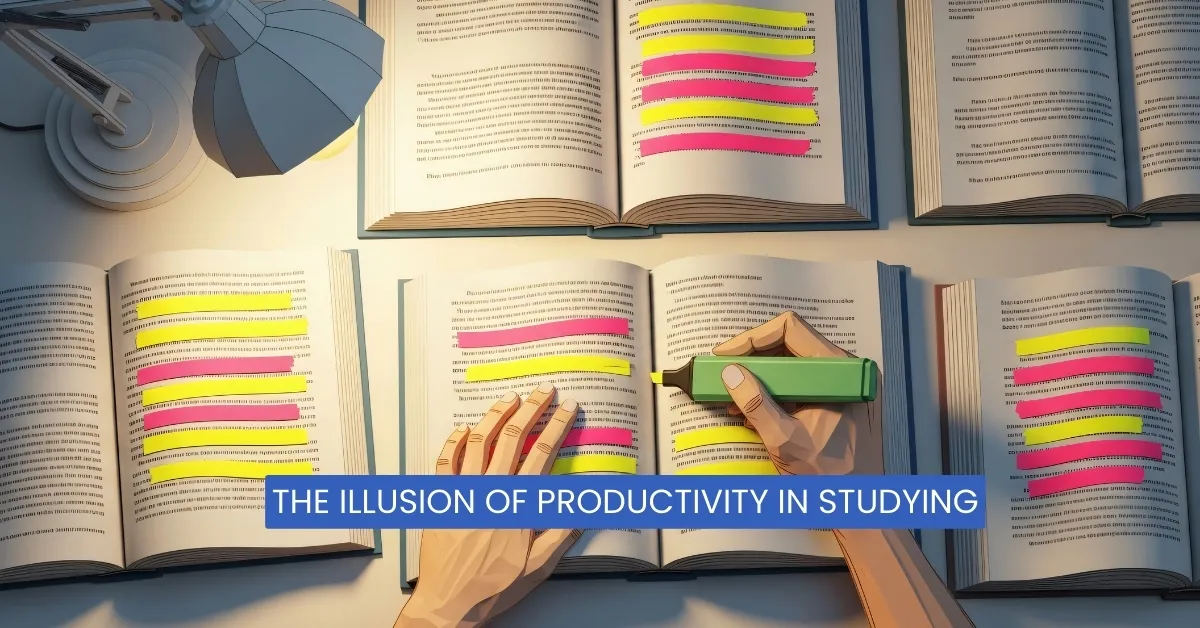
Many students finish long study sessions feeling drained, satisfied, and convinced they worked hard. Hours passed. Pages were read. Notes were written. Highlighters were sacrificed.
Then the test arrives, and performance doesn’t match effort.
This isn’t bad luck. It’s the illusion of productivity.
Studying has a unique problem: it allows people to feel busy without actually changing what the brain can do. The actions look serious. The learning is shallow.
The effort happened. Progress didn’t.
What “Looking Productive” Actually Looks Like
Visible Activity vs Cognitive Work
The brain confuses movement with mastery.
Common productivity illusions include:
- Rereading notes repeatedly
- Highlighting large sections of text
- Copying answers neatly
- Watching lectures passively
- Making overly aesthetic notes
These actions feel productive because they are visible. But visibility is not learning.
Learning is invisible. Until it’s tested.
Comfort Masquerading as Discipline
Illusion-driven studying feels comfortable. No confusion. No struggle. No risk of being wrong.
Real learning is uncomfortable. It exposes gaps. It slows you down. It makes you feel stupid temporarily.
Students often avoid discomfort and mistake comfort for effectiveness.
Why the Brain Loves the Illusion
Familiarity Feels Like Understanding
When students reread material, it feels familiar. Familiarity creates confidence.
But familiarity is not recall. Recognition is not understanding.
The brain says, “I’ve seen this before,” and mistakes that for “I can use this.”
Busyness Reduces Guilt
Busy studying relieves anxiety. Even if it’s ineffective, it feels morally correct.
Students aren’t lazy. They’re self-soothing.
The illusion exists because it reduces guilt faster than it improves learning.
How the Education System Reinforces the Illusion
Volume Is Rewarded Over Depth
Students are praised for:
- Long study hours
- Thick notebooks
- Extensive syllabi coverage
They’re rarely praised for:
- Explaining concepts clearly
- Asking sharp questions
- Identifying what they don’t know
So students optimize for what’s visible.
Silence Is Mistaken for Understanding
In classrooms, quiet students are often assumed to be following along.
Confusion is invisible unless questioned. The illusion survives because no one interrupts it.
The Difference Between Productive and Performative Studying
Performative Studying:
- Looks serious
- Feels busy
- Avoids mistakes
- Produces notes, not skill
Productive Studying:
- Feels slow
- Feels uncomfortable
- Reveals gaps
- Improves recall and transfer
One protects the ego. The other builds competence.
How to Spot the Illusion Early
Ask yourself:
- Can I explain this without looking?
- Can I solve a new problem with this?
- Would I be okay being tested on this now?
If the answer is no, productivity was performative.
Why High Achievers Still Fall for It
They’re Good at Playing the Game
High achievers often survive on illusion longer because:
- They memorize fast
- Exams reward patterns
- Early success hides shallow foundations
The crash comes later, when problems demand reasoning instead of recall.
That’s why capable students sometimes feel blindsided in advanced stages.
How to Replace Illusion With Real Learning
Use Active Recall Ruthlessly
Close the book. Write what you remember. Speak it aloud. Solve without looking.
If it’s hard, that’s the point.
Study Until You Fail (Then Fix That)
Failure during studying is productive. Failure during exams is expensive.
Seek mistakes early. They’re signals, not threats.
Measure Output, Not Time
Stop asking: “How long did I study?”
Start asking: “What can I now do that I couldn’t before?”
Time spent means nothing without skill gained.
The Emotional Cost of the Illusion
Illusion-driven studying leads to:
- Chronic stress
- Self-doubt
- Burnout
- “I work so hard but still fail” thinking
Students blame themselves instead of the method.
That’s unfair. And unnecessary.
A Hard but Liberating Truth
Studying that feels good often teaches the least.
Studying that feels hard usually teaches the most.
The illusion of productivity survives because it’s comfortable, socially rewarded, and emotionally safe.
Real learning is none of those things.
But it works.
And once students experience the difference, they stop chasing busyness and start chasing clarity.
That’s when effort finally pays off.







Be the first one to comment on this story.