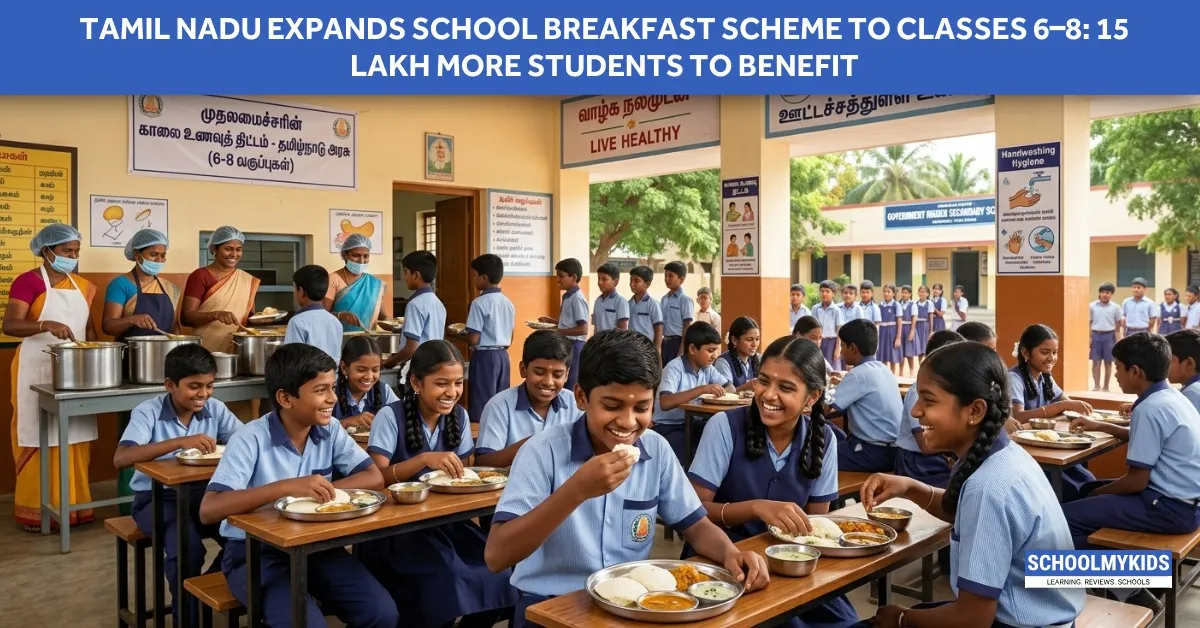
Tamil Nadu's Chief Minister C. Joseph Vijay is set to launch the expanded Perunthalaivar Kamarajar Breakfast Scheme on September 22, 2026. The programme will now cover Class 6, 7 and 8 students.
Until now, only Classes 1 to 5 received free breakfast at school. From September 22, middle-school students will too. That means 15.30 lakh more children in government and government-aided schools.
The formal launch is scheduled at a government school in Thiruvanmiyur, Chennai, where the Chief Minister will serve breakfast to students.
Why This Matters: Not Just Free Food
You’re a Class 6 student. Your parents are working. They wake up early. But mornings are rushed. Sometimes you leave home without eating. You sit in class feeling hungry. You can’t focus. Math class becomes impossible. English lesson goes in one ear and out the other.
This happens to thousands of students. Hunger affects focus. Focus affects learning. Learning affects marks. Marks affect the future.
The breakfast scheme solves this specific problem. You come to school. There’s food waiting. You eat. Your stomach isn’t bothering you. You can actually pay attention in class.
For families struggling financially, this takes pressure off. One meal less to arrange at home. One thing less to worry about.
The Numbers: How Many Schools And Students
Around 15,454 government and government-aided middle schools across Tamil Nadu now participate. That’s spread across the entire state, not just one city.
15.30 lakh students. That’s 1.53 million kids in middle school getting breakfast every school day.
For context, that’s the entire population of some states getting a meal at school. It’s massive.
One practical note: the expansion will not begin immediately in Chengalpattu and Tiruppur districts. The Model Code of Conduct is in force there because of the ongoing Assembly by-elections, so those two districts will join a little later.
What Students Actually Get: Not Just Bread And Butter
The breakfast isn’t minimal. It’s designed to be nutritious.
Typical offerings include:
Various forms of upma (rava, sevai, rice or wheat) with vegetable sambar
Vegetable kichadi or khichdi
Pongal (ven pongal or rava pongal) with sambar
A sweet item such as rava kesari, semiya kesari or sweet pongal on Fridays
Millet-based versions at least twice a week
These are the items listed in the government’s current guidelines. The meal is designed to deliver roughly 293 to 294 calories with protein, iron, and calcium. Schools may rotate within the approved list, but the core remains simple South Indian breakfast foods.
The idea is that by the time your first class ends mid-morning, you're not starving. You can focus through the rest of the day.
How Your School Gets Food: The Logistics
Schools don’t cook everything from scratch daily. Many have partnering vendors who prepare food in bulk and deliver it. Some larger schools have their own kitchens with cooks on staff.
In rural areas and most smaller towns, members of self-help groups prepare the food at or near the school. In Chennai and other municipal areas, food comes from larger integrated kitchens run by the Greater Chennai Corporation or the Directorate of Municipal Administration. Hot breakfast is meant to be served between 8 a.m. and 9 a.m. according to the latest guidelines.
The state provides the budget. Individual schools manage how it’s spent. Some schools prioritize certain foods. Some rotate menus to avoid boredom.
Your school’s headmaster decides the menu (usually with input from parents and teachers).
The Money Behind It: How Much This Costs
The state government allocated an additional Rs 217.63 crore for this expansion.
The total budget for the breakfast scheme now is Rs 724 crore annually.
To put that in perspective: that’s the entire annual budget of some districts spent just on breakfast for students.
This is state money. Taxpayers are funding this. It’s not charity from corporations or NGOs. It’s a government commitment to feed schoolchildren.
Why Classes 6-8 Specifically: Why Not Earlier?
Classes 6, 7, and 8 are tricky years. Students are older. They need more nutrition than younger kids. They’re also at risk of dropping out more than younger students.
If a family is struggling, they might pull their kid out of middle school to work. The breakfast scheme helps keep kids in school during these critical years.
Also, younger kids (Classes 1-5) already had the scheme. Middle school was left out. This expansion evens it out.
Earlier evaluations of the primary-school breakfast scheme by the Tamil Nadu State Planning Commission found higher attendance, better classroom attention and improved ability to recall lessons. Extending the same support into the middle-school years is expected to help in the same way.
The Reality For Students: What This Means For You
You don’t need a note from parents. You don’t need to “qualify” somehow. If you study in Class 6, 7, or 8 in a government or government-aided school in Tamil Nadu, the breakfast is for you.
It is usually served between 8 a.m. and 9 a.m., before classes start or during the morning break, depending on the school’s schedule. You eat. You go to class.
Teachers in schools that already run the primary scheme have noticed that students who eat breakfast concentrate better. Fewer discipline issues. Less absenteeism. Better overall performance.
What Teachers Are Saying: From The Ground
Teachers in schools that already run the primary scheme report that students are more alert in morning classes. Less restlessness. Better participation.
Some students come to school specifically early now because they know breakfast is coming. It’s an incentive to attend.
The scheme also reduces the pressure on teachers to deal with hungry, distracted, grumpy students. Everybody wins.
For Families: What This Changes At Home
Families now have one fewer meal to arrange on school days. For poor families, this matters. For many low-income families, food is one of the biggest monthly expenses. Removing the need to prepare breakfast on school days eases that load.
Parents report less stress about sending kids to school on an empty stomach. They know their child will eat.
Some families use the budget saved on breakfast for other things like study materials, school fees, and healthcare. It’s a practical relief.
What Parents Can Do Next
Ask the class teacher or headmaster when breakfast will start in your school and what the daily menu looks like.
If the food is cold, late, or poor quality for several days, raise it politely with the headmaster first.
For unresolved issues, contact the District Social Welfare Officer or the District Collector’s office. Schools are required to maintain hygiene and serve hot food between roughly 8 a.m. and 9 a.m.
No application or income certificate is needed. Every Class 6–8 student in a government or government-aided school is automatically eligible.
Potential Issues: Being Realistic
Quality varies by school. Some schools handle it well. Others mess up. Food might come cold. The menu might be boring. Some students might not like the food on certain days.
If there’s a problem at your school, talk to your class teacher or principal. Schools are required to maintain standards. If breakfast is consistently bad, parents should complain. Things improve when people speak up.
Food allergies or strong preferences might be an issue. Tell your school if your child cannot eat certain ingredients. Most schools try to accommodate this.
Key Takeaways
Breakfast scheme expanded September 22, 2026 to Classes 6-8
15.30 lakh students across 15,454 schools now eligible
Budget: Rs 217.63 crore additional allocation
Breakfast is nutritious, not minimal (upma, kichadi, pongal, millets, and a sweet item on Fridays)
Helps students focus and reduces dropout risk
Free for all Class 6-8 students in government schools
Quality varies; speak up if there are issues
FAQs
Q1: Is the breakfast really free or do parents need to pay?
Completely free. No fee. No hidden charges. It’s funded by the state government. If anyone asks for money at your school, tell your parents. That’s not allowed. The scheme is designed specifically for families who can’t afford breakfast at home.
Q2: What if my school hasn’t started serving breakfast yet?
The scheme is being launched on September 22. Schools needed time to arrange vendors, set up kitchens, and train staff. Most schools should start soon after. If your school has not begun yet, ask your principal when it is starting. Do not assume it will not happen. It is a government mandate.
Q3: What if I don’t like the breakfast being served?
Talk to your class teacher. If enough students dislike the menu, schools sometimes adjust. You’re not being ungrateful by saying you dislike something. Feedback helps schools improve. Some students genuinely can’t eat certain foods due to allergies or preferences. Work with your school to find alternatives.
Q4: Does eating the breakfast mean my school is admitting my family is poor?
No. The scheme isn’t means-tested. Every Class 6-8 student gets breakfast. Rich kids, middle-class kids, poor kids; everyone eats. It’s not about identifying who’s poor. It’s about ensuring no kid sits hungry in class. Nobody is shamed or singled out.



Be the first one to comment on this story.