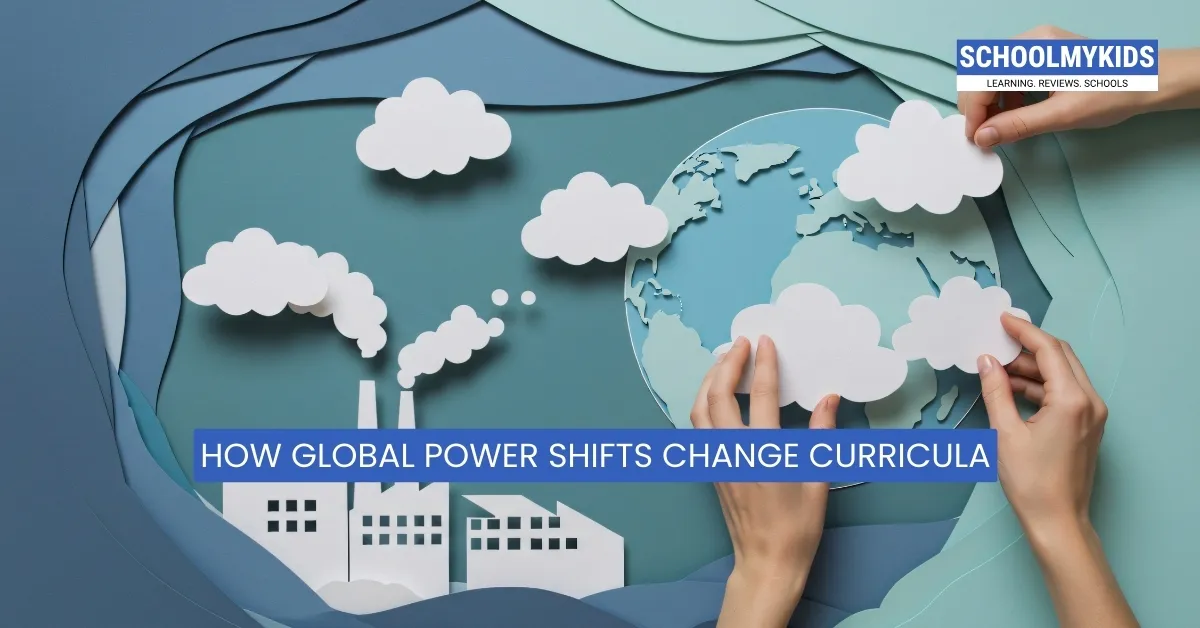
Curricula Are Not Just About Knowledge
On paper, school curricula exist to educate. In reality, they also signal what a society considers important, respectable, and legitimate.
What gets taught.What gets minimized.What gets omitted entirely.
These choices don’t happen in isolation. They track power. When global power shifts economically, politically, or culturally, education systems quietly recalibrate.
Not overnight. Not loudly. But inevitably.
Why Power and Education Are Always Linked
Education Shapes Worldview, Not Just Skills
Curricula decide:
- Which histories are centered
- Which ideas are normalized
- Which perspectives are framed as “standard”
This shapes how students understand the world and their place in it.
Countries don’t just educate workers. They educate citizens who must navigate global realities. When those realities change, curricula follow.
Global Influence Demands Narrative Control
Power isn’t only military or economic. It’s narrative.
Rising powers want their stories understood. Declining powers try to preserve theirs. Education is where long-term narrative control is built.
That’s why curriculum changes lag behind headlines but eventually align with them.
Economic Power Shifts and Skill Priorities
From Industrial to Digital to Strategic Skills
When global economic power shifts, skill priorities change.
As manufacturing declined and technology rose, curricula emphasized:
- STEM
- Coding
- Data literacy
- Problem-solving
As geopolitical competition intensifies, newer emphases appear:
- Supply chains
- Energy security
- Climate science
- Cybersecurity
- Strategic languages
Subjects don’t disappear. They get reframed.
Labor Markets Pull Curricula Forward
Education systems may resist change, but labor markets don’t.
When industries shift globally, pressure builds to align schooling with employability. That pressure eventually forces curriculum updates, even if reluctantly.
Political Power Shifts and Historical Narratives
History Is the First Battlefield
When global power realigns, history curricula change first.
What was once framed as:
- “Discovery” becomes “colonization”
- “Expansion” becomes “occupation”
- “Civilizing missions” become “exploitation”
These shifts don’t mean one version is propaganda and the other is truth. They mean perspective changes with power.
As new regions gain influence, their histories demand recognition.
Whose Story Is Central Changes Over Time
Dominant powers tend to universalize their experience. As power disperses, curricula slowly diversify.
Students begin learning:
- Multiple viewpoints
- Regional histories
- Global interconnections
This often sparks backlash because shared narratives feel stable, and stability feels safe.
Language and Cultural Power
Languages Rise and Fall With Influence
Languages taught in schools reflect economic and diplomatic relevance.
As global centers of trade, technology, and culture shift, language priorities adjust:
- Some languages gain prominence
- Others lose institutional support
This isn’t cultural judgment. It’s a strategic adaptation.
Cultural Content Signals Relevance
Literature, case studies, examples. These subtly shift toward regions with influence.
Students notice when examples feel outdated or disconnected from current realities. Curricula respond slowly.
Science, Ethics, and Global Power
What Questions Science Education Emphasizes
Scientific facts don’t change with power. Research priorities do.
As global challenges evolve, curricula emphasize:
- Climate systems
- Public health
- Sustainability
- Ethics of technology
- Global cooperation
These reflect power-linked concerns about survival, competitiveness, and responsibility.
Why These Changes Are Always Controversial
Education Feels Personal
Curriculum changes feel like identity changes. Parents fear loss of tradition. Teachers fear instability. Politicians fear backlash.
Power shifts challenge comfort zones. Education makes that challenge visible.
Neutrality Is an Illusion
Calls for “apolitical education” often mean preserving the current narrative.
But every curriculum is political in the sense that it reflects values. The question is not whether values exist, but whose they are and whether they’re examined honestly.
How Students Experience These Shifts
Most students don’t notice curriculum changes as “power shifts.” They experience them as:
- New topics
- Revised textbooks
- Different exam emphasis
- Changed examples
But over time, these changes shape how they interpret the world.
Education doesn’t announce global change. It normalizes it.
A Clear Pattern to Remember
Global power shifts change curricula in three predictable ways:
- Skills emphasized evolve
- Histories are reinterpreted
- Cultural relevance is redistributed
The process is slow, contested, and uneven. But it happens.
A Grounded Conclusion
Curricula are mirrors held up to the world, not just textbooks handed to students.
When global power shifts, what societies need their children to understand shifts too. Education adjusts not because it wants to be political, but because it cannot avoid reality.
The real question isn’t whether curricula will change.It’s whether students are taught to notice why they do.
Understanding that makes education less about memorizing facts and more about recognizing context.
And in a changing world, that awareness matters more than ever.


Be the first one to comment on this story.