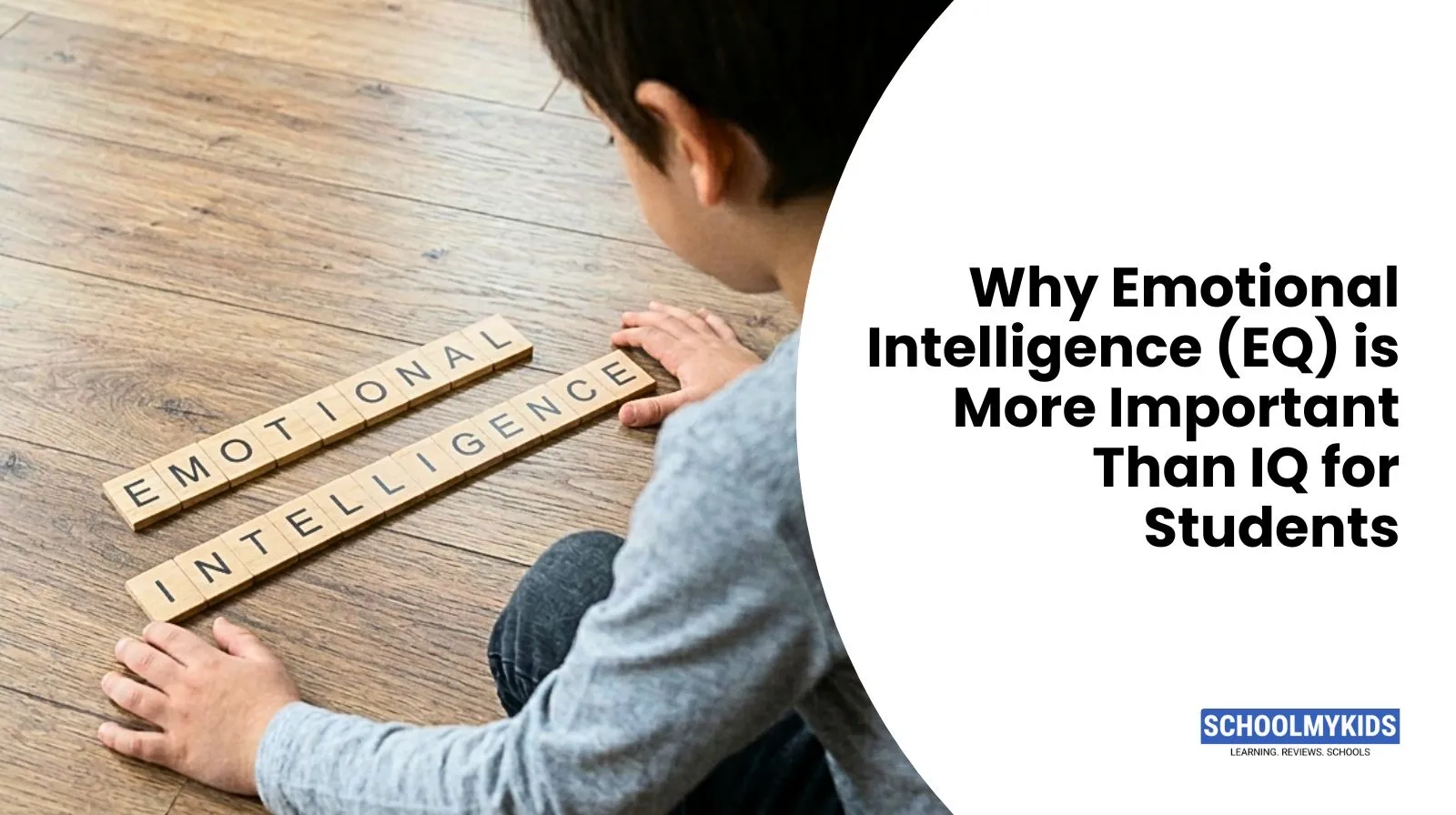
Your child comes home with perfect test scores but struggles to make friends. Another student barely passes exams yet leads group projects confidently. What makes the difference? The answer lies not in their IQ, but in their emotional intelligence.
For decades, Indian parents and educators have focused heavily on academic marks and standardized test scores. We celebrate high IQ as the ultimate measure of success. But new research and real-world outcomes tell a different story. Emotional intelligence for students is increasingly recognized as an important contributor to long-term success, well-being, healthy relationships, and professional achievement.
This guide explains why emotional intelligence for students is increasingly viewed as a critical factor in academic success, personal well-being, and future career growth.
What is Emotional Intelligence for Students?
Emotional intelligence for students is the ability to recognize, understand, manage, and express emotions effectively while also understanding the feelings of others. It helps students build healthy relationships, cope with challenges, communicate effectively, and succeed both academically and socially.
Understanding IQ and Emotional Intelligence (EQ)
What is IQ?
IQ, or Intelligence Quotient, measures logical reasoning, mathematical ability, language skills, and pattern recognition. It’s what traditional tests evaluate. A high IQ helps students solve math problems faster and understand complex concepts.
IQ tends to remain relatively stable over time, although cognitive abilities can still be influenced by education, environment, health, and learning experiences throughout life. It tells us how quickly someone can process information, not how they’ll use that information in real relationships or careers.
What is Emotional Intelligence?
Emotional intelligence refers to the ability to recognize, understand, and manage your own emotions while recognizing and influencing the emotions of others. Unlike IQ, emotional intelligence can be developed and strengthened throughout life. The modern understanding of emotional intelligence was developed through the work of psychologists such as Peter Salovey and John D. Mayer and later popularized by Daniel Goleman.
The concept of EQ includes five core components: self-awareness, self-regulation, motivation, empathy, and social skills. These abilities determine how students handle stress, cooperate with peers, navigate challenges, and build meaningful relationships.
The Critical Difference: Why EQ Matters More Than IQ
Research suggests that emotional intelligence contributes to academic achievement, leadership, teamwork, and long-term well-being. While IQ remains important for learning and problem-solving, emotional intelligence helps students manage emotions, build relationships, stay motivated, and respond effectively to challenges. Studies have found that EQ can predict academic performance even after accounting for intelligence and personality factors.
In many real-world situations, students with strong emotional intelligence often perform better in teamwork, leadership, stress management, and relationship building than equally capable students who struggle with emotional skills.
Here’s why emotional intelligence for students creates real advantages:
Students with high EQ manage academic pressure without breaking down. They ask for help when struggling, recover from failures quickly, and maintain focus during exam season. Those with low emotional intelligence become overwhelmed, avoid challenges, and develop anxiety around performance.
In group projects, the emotionally intelligent student reads the room, understands teammates’ concerns, and communicates effectively. They become natural leaders. Meanwhile, the highly intelligent student who lacks EQ might alienate others despite having better ideas.
After graduation, employers report that they hire for skills but fire for attitude. Emotional intelligence for students directly translates to workplace success, leadership potential, and career advancement. Your child’s ability to manage relationships, handle criticism, and stay calm under pressure matters far more than their school marks.
The Five Core Components of Emotional Intelligence Skills
Understanding these five pillars helps parents and educators recognize and develop EQ in students.
Self-Awareness
This is recognizing your own emotions and understanding how they influence your thoughts and actions. A self-aware student knows when they’re frustrated, anxious, or excited. They understand their learning style, strengths, and areas needing improvement.
Parents can develop self-awareness by asking children questions like: “What emotions are you feeling right now?” or “Why do you think you reacted that way?” This simple practice helps children become more aware of their emotions and improves their ability to express feelings in healthy ways.
Self-Regulation
Also called self-management, this means controlling emotional impulses and adapting your behavior appropriately. A student with good self-regulation studies despite wanting to watch videos, handles criticism without getting defensive, and manages anger constructively.
This doesn’t mean suppressing emotions. It means responding thoughtfully rather than reacting impulsively. When your child feels angry, they pause, take a breath, and then respond, rather than shouting immediately.
Motivation
Intrinsic motivation, driven by personal goals and values rather than external rewards, is central to EQ. Emotionally intelligent students pursue learning because they find it meaningful, not just for grades or parental approval.
Students with strong motivation set their own goals, persist through difficulties, and take ownership of their learning. They develop a growth mindset where challenges become opportunities rather than threats.
Empathy
The ability to understand and respond to the feelings of others shapes how students interact with peers, teachers, and family members. Empathetic students recognize when classmates are struggling, include left-out peers, and offer genuine support.
This doesn’t mean accepting wrong behavior, but rather understanding the emotions behind it. An empathetic parent might recognize their child’s rudeness stems from feeling overwhelmed, not disrespect.
Social Skills
Effective communication, collaboration, conflict resolution, and relationship building form the foundation of strong social skills. Students with developed social-emotional learning skills navigate friendships, work effectively in teams, and resolve disagreements constructively.
These skills influence classroom participation, peer relationships, leadership opportunities, and future professional success.
Emotional Intelligence and Social Emotional Learning (SEL)
Many schools now incorporate social-emotional learning (SEL) into classroom activities. SEL focuses on helping students develop self-awareness, emotional regulation, empathy, responsible decision-making, and relationship skills.
Research suggests that students who participate in well-designed SEL programs often demonstrate better classroom behavior, stronger relationships, improved emotional well-being, and higher academic engagement. For Indian parents, SEL does not require a separate curriculum at home. Everyday conversations, cooperative activities, and reflective discussions can reinforce the same skills naturally.
When emotional intelligence and academic learning develop together, students are better prepared for both examinations and real-world challenges.
How to Develop Emotional Intelligence in Your Child
Unlike IQ, emotional intelligence can be actively cultivated. Here are evidence-based strategies for parents and educators.
Create a Feelings-Safe Home Environment
Children develop EQ when emotions are acknowledged, not dismissed. Instead of saying “Don’t cry” or “Stop being angry,” try: “I see you’re upset. Tell me what happened.” This validates emotions while teaching emotional awareness.
Model Emotional Intelligence
Children learn by watching. When you stay calm during frustration, acknowledge your mistakes, or show empathy toward others, you teach EQ directly. Parents with high emotional intelligence model how to handle emotions maturely.
Teach Emotion Identification
Help children label specific emotions beyond basic happy or sad. Use emotion charts, emotion wheels, or simple conversations. “Are you frustrated, disappointed, or embarrassed?” Naming emotions precisely builds self-awareness and regulation.
Practice Problem-Solving Together
When your child faces a conflict, guide them through: What happened? What emotions came up? What choices do you have? What would happen with each choice? This develops emotional regulation and critical thinking simultaneously.
Encourage Diverse Activities
Sports, arts, music, and group activities develop emotional intelligence in practice. These settings require managing frustration, accepting feedback, working with others, and handling both success and failure.
Limit Screen Time
Excessive device use reduces opportunities for face-to-face interaction and emotional skill development. Prioritize real conversations and social experiences.
Emotional Intelligence vs IQ in Real Situations
Scenario | Low EQ, High IQ Student | High EQ Student |
|---|---|---|
Receives critical feedback on essay | Gets defensive, argues with teacher | Listens, asks clarifying questions, revises approach |
Disagrees with group project idea | Insists their way is correct | Understands others’ perspectives, finds compromise |
Faces exam failure | Feels helpless, blames external factors | Analyzes what went wrong, creates improvement plan |
Friend seems distant | Ignores it or gets angry | Asks what’s wrong, offers support |
Feels overwhelmed by workload | Procrastinates, ignores problem | Breaks tasks into steps, seeks help early |
Frequently Asked Questions About Emotional Intelligence for Students
Q1: Can emotional intelligence be tested or measured?
Yes, several validated EQ assessments exist for children and adolescents. However, unlike IQ tests, EQ assessment focuses on self-reported emotional experiences and social skills rather than right-or-wrong answers. Some schools now use these assessments alongside traditional testing.
Q2: At what age should parents start developing EQ in children?
EQ development starts in infancy. Even toddlers benefit from parents naming emotions and responding empathetically. In school years, conscious EQ-building activities become increasingly important. The adolescent years are critical, as peer relationships and emotional challenges intensify.
Q3: How does emotional intelligence for students improve academic performance?
Students with strong EQ manage test anxiety better, maintain focus longer, recover from mistakes faster, and persist through difficult concepts. They also participate more in class, seek help when needed, and study more effectively. These factors directly improve grades.
Q4: Can a child have high IQ but low EQ?
Absolutely. Many gifted students struggle socially or emotionally. They may understand complex subjects but feel isolated, struggle with perfectionism, or lack practical communication skills. Developing their EQ becomes especially important.
Q5: How do parents know if their child needs help with emotional intelligence?
Signs include difficulty making or keeping friendships, extreme reactions to minor problems, avoiding challenges, being overly self-critical, difficulty expressing feelings, or inability to understand others’ perspectives. If these patterns persist, consider consulting a school counselor or child psychologist.
Q6: Can emotional intelligence help reduce exam stress?
Yes. Students with stronger emotional intelligence are often better able to recognize signs of stress, use healthy coping strategies, seek support when needed, and maintain perspective during examinations. While EQ cannot eliminate academic pressure, it can help students respond to challenges more effectively and recover more quickly from setbacks.
Why Emotional Intelligence Matters in the Age of Artificial Intelligence
Academic knowledge is more accessible than ever. Students can find information instantly through technology and AI-powered tools. However, skills such as empathy, emotional regulation, teamwork, ethical decision-making, and effective communication remain uniquely human strengths.
As workplaces increasingly value collaboration, adaptability, and leadership, emotional intelligence becomes an essential life skill. Students who can understand emotions, work with diverse groups, and manage stress are often better prepared for future careers than those who rely only on academic performance.
Key Takeaways for Parents and Educators
Emotional intelligence for students contributes significantly to long-term success alongside cognitive ability, education, and life experiences.
EQ comprises self-awareness, self-regulation, motivation, empathy, and social skills
Unlike IQ, emotional intelligence can be developed at any age
Create home environments where emotions are acknowledged and discussed
Model emotional intelligence through your own behavior and choices
Teach children to identify, name, and manage emotions constructively
Encourage activities that naturally develop social emotional learning
Balance academic achievement with emotional and social development
Conclusion
Academic achievement is important, but emotional intelligence plays an equally valuable role in helping students succeed in school, relationships, and future careers. The student who understands their emotions, manages stress, empathizes with others, and builds strong relationships will navigate life’s challenges far more successfully than the brilliant student lacking these skills.
As parents and educators in India, let’s shift our focus. Instead of asking only “What was your score?” ask “How are you feeling about your learning?” Instead of celebrating only academic achievement, recognize emotional growth and kindness.
Start today. Have one meaningful conversation with your child about their feelings. Notice their emotional responses. Support their social interactions. These small steps build the emotional intelligence for students that becomes their greatest advantage in education and beyond.






Be the first one to comment on this story.