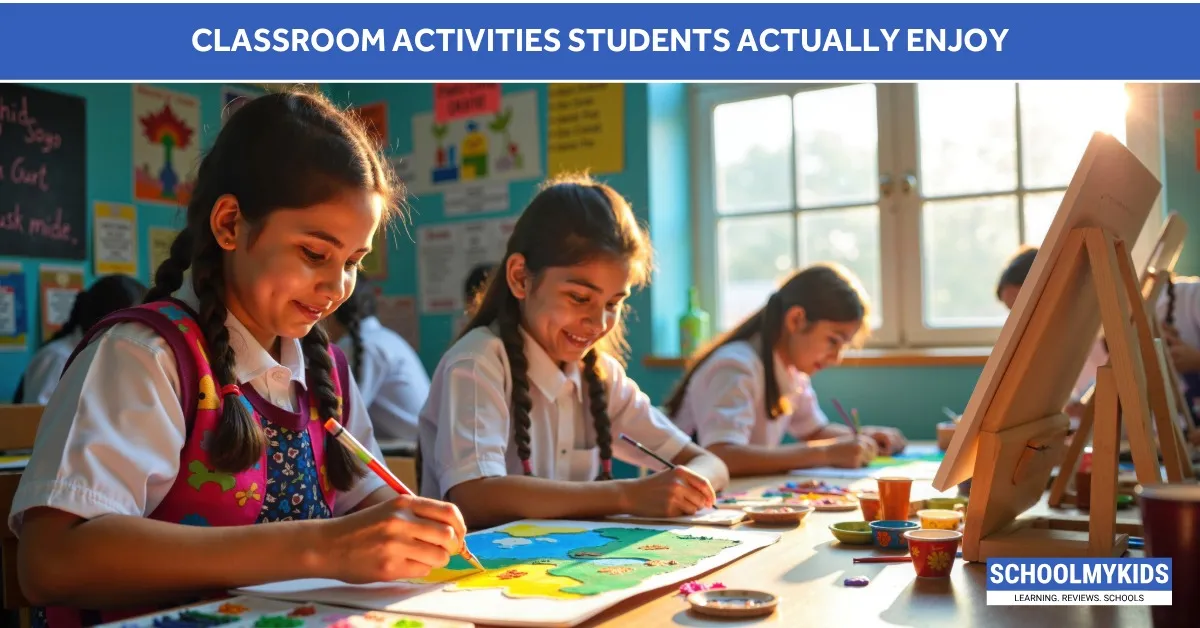
Mrs. Sharma Stopped Lecturing for 50 Minutes.
She’d been teaching English the same way for years. Talk. Students listen. Some write notes. Most don’t. That pattern repeated every single day until one afternoon a student raised his hand and asked something that changed everything.
“Why does everything have to be boring, ma’am?”
That question bothered her for days. She kept thinking about it. One week later, she tried something different. She split her 50-minute class into two parts. First 20 minutes teaching. Next 30 minutes doing. Actual activities. Discussion. Making things.
The sleepy kids woke up. The daydreamers paid attention. The back benchers suddenly had opinions.
This wasn’t about expensive equipment or fancy technology. It was about letting students do something besides sit.
How Different Classes Actually Learn Best
The way kids learn changes as they grow. A seven-year-old needs something completely different from a fifteen-year-old. Teachers who understand this see better results.
Grade Level | Attention Span | What Works | What Doesn’t Work |
|---|---|---|---|
Class 1-2 | 5-10 minutes | Movement, touch, multisensory activities, songs, physical play, hands-on building | Silent sitting, long explanations, reading for comprehension |
Class 3-4 | 15-20 minutes | Group activities, simple projects, peer teaching, creative tasks, games with learning embedded | Pure worksheets, excessive note-taking, individual quiet work |
Class 5-6 | 20-30 minutes | Group projects, problem-solving tasks, building models, discussion-based learning | Copy-paste assignments, memorization-focused teaching, passive listening |
Class 7-8 | 30-40 minutes | Debate, discussion, research projects, peer explanation, real-world problems | Rote memorization, teacher-centered lectures, disconnected content |
Class 9-10 | 40-45 minutes | Lab work, project-based learning, case studies, collaborative problem-solving | Exam-focused teaching, theory without application, high-pressure drills |
Class 11-12 | 45-50 minutes | Group discussions, peer teaching, real applications, concept-building through practice | Speed-based learning, disconnected exam prep, competition-heavy approach |
Class 1 and 2: When Sitting Still Feels Impossible
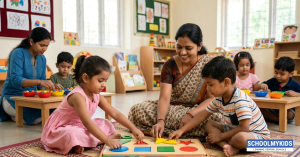
A teacher in Mumbai realized something obvious that adults forget: Seven-year-olds can’t sit quietly for 20 minutes. Their brains don’t work that way yet. They need movement. They need their hands doing something.
She started doing this with letter learning. Stop explaining after five minutes. Then kids make the letters with their bodies. Stand tall like the letter A. Bend at the waist like C. Stretch arms out like T.
After that, they touch actual letters printed on paper. They trace letters in sand. They say the sound while moving. Three senses at once. Eyes seeing. Hands feeling. Mouth speaking.
It looks messy. Sounds chaotic. But kids learn faster this way. They remember the letters because their entire body remembers the action.
Story time happens on the floor, not in rows. Kids sit in a circle. She shows a picture. Waits. Kids shout answers. “What do you see?” Someone yells “dinosaur.” Another shouts “tree.” She writes their words on the board. They watch their ideas become a story.
Activity | What Happens | Why It Works | Outcome |
|---|---|---|---|
Letter Body Movement | Kids stand/bend/stretch to form shapes of letters | Multi-sensory engagement (visual, kinesthetic, auditory) | Better letter retention, faster alphabet learning |
Story Circle with Pictures | Show picture, kids shout observations, teacher writes their words | Student ownership of content, seeing their ideas become text | Increased participation, ownership of learning, vocabulary growth |
Number Clapping | Clap while counting, count steps in class, count classroom objects | Real-world application, auditory-kinesthetic connection | Number concept internalization, better counting accuracy |
Sand Tracing | Kids trace letters/numbers in sand with fingers | Tactile feedback, muscle memory building | Smoother handwriting development, better retention |
The kids who never raised hands suddenly participate. When they see their word on the board, they’re invested.
Class 5: The Group Project That Changed Everything
A Science teacher assigned something simple. “Make something that moves using things from home. That’s it.”
One group built a seesaw from a pencil and cardboard. Another made a spinning wheel from an old CD. Another created a catapult from popsicle sticks and rubber bands.
The teacher realized something shocking. Kids learned more about levers and balance in two hours at home than in four weeks of textbook lessons. Because they were building, not reading.
Now she does this monthly. Sometimes it’s a bridge that holds weight. Sometimes a city model. Kids argue, negotiate, fail, rebuild. That failure-rebuild cycle is where real learning happens.
The shy kid who never speaks suddenly explains to group members why the bridge collapsed. Teaching peers makes them feel competent. Suddenly they matter.
Class 8: When Marks Start Feeling Too Important
Eighth graders know marks matter now. That pressure kills curiosity. A History teacher noticed her class had become robots. Kids copying notes. Nobody asking questions. Just existing until the period ends.
She tried something different. Gave them a problem instead of facts to memorize. “The British came to India with a tiny army. How did they actually control such a huge place?”
Kids had to think. Geography. Supply lines. Alliances with local rulers. Cultural divisions. They worked in groups. Debated. Some got heated.
A girl who’d never spoken stood up. “You’re wrong because…” She explained a whole theory.
Two weeks of thinking. No tests during this time. No marks counted. Just thinking.
Then she gave them a test. They scored higher than any previous batch. Understanding beats memorization.
Learning Method | Time Investment | Marks Impact | Long-term Retention |
|---|---|---|---|
Pure Memorization of Facts | 4 weeks of lectures | Immediate exam improvement | Forgotten within weeks |
Problem-Based Discussion | 2 weeks of debate and group work | Higher exam performance | Retention lasts months, sometimes years |
Concept-Building Activities | Mix of activity and teaching | Sustained improvement | Deep understanding persists |
Class 10: When Board Exams Create Pressure
CBSE Board exams make everything feel urgent. Tenth graders worry constantly. Teachers rush to finish syllabuses. Activities seem like luxuries nobody can afford.
But one Chemistry teacher found balance. She teaches theory in lectures. Then once weekly, students actually do the lab. They mix chemicals. They watch reactions. They mess up sometimes. They figure out why.
A student who’d scored 32 on his first exam thought he was “bad at Chemistry.” Six months of lab work later, he scored 72. Same content. Different delivery.
When learning involves hands and eyes, not just ears, understanding deepens.
She also solved the organic chemistry memorization problem. Instead of students trying to memorize reaction sequences, they built physical models using clay and beads. They arranged atoms in 3D space. Suddenly reaction mechanisms made sense.
Class 12: When Everything Feels Time-Crunched
Twelfth graders prepare for JEE, NEET, CUET. Every minute feels precious. Classes feel rushed. How can activities fit?
One Math teacher noticed something. Students doing solo practice problems got stressed. The ones doing group problem-solving where they explained reasoning to each other seemed calmer. Their marks weren’t worse. Sometimes better.
She started having students work problems in pairs. They discuss their thinking. Not to get marks. Just to understand.
Study Approach | Stress Level | Performance | Understanding Depth |
|---|---|---|---|
Solo problem-solving | High stress | Good marks but anxiety-based | Surface-level, focused on answers |
Group explanation-based | Lower stress | Similar or better marks | Deeper understanding, less anxiety |
Teacher-led drilling | High pressure | Quick test performance, quick forgetting | Memorization, not retention |
Peer teaching model | Moderate stress | Sustained performance | Long-term retention, confidence building |
The anxious kid? Discussing problems calms him more than solo work. The girl who thought she wasn’t good at Math? Explaining it to a peer made her realize she actually understood.
Why This Actually Works (The Research Part)
A big study from 2014 looked at 225 STEM classes. Classes where students spent most time doing and discussing, rather than just listening, had better exam scores. The improvement was significant, an average of 0.47 standard deviations higher. Failure rates under traditional lecturing were 1.5 times higher (about 34 percent versus 22 percent under active learning).
It’s not magic. It’s just how brains work. You remember what you do more than what you hear.
ASER 2024 data shows something interesting. 82.2 percent of rural Indian teenagers aged 14-16 know how to use smartphones. But only 57 percent of those who could use one used it for education that week. Seventy-six percent used it for social media.
That gap tells you something. Students can engage with content when it interests them. Schools need to compete with that engagement level. You can’t win with lectures.
Key Takeaways
Student engagement increases dramatically when classes include hands-on activities mixed with teaching, rather than pure lectures
ASER 2024 shows 82.2 percent of rural Indian teenagers can use smartphones, yet only 57 percent of those who can use one use them for education while 76 percent use them for social media
Class 1-2 students require multisensory activities involving movement, touch, and physical construction
Group-based learning in Class 5-8 improves retention and helps shy students develop confidence
Project-based learning in higher classes reduces exam anxiety while improving actual understanding
2014 meta-analysis of 225 STEM studies showed active-learning classes had a 0.47 standard deviation improvement on exam scores compared to lecture-based teaching
Failure rates under traditional lecturing were 1.5 times higher (roughly 34 percent versus 22 percent) in the same meta-analysis
Time constraints, resource limitations, and large class sizes prevent wider adoption despite strong evidence of effectiveness
Peer teaching and group discussion reduce student anxiety and build genuine confidence in understanding
Frequently Asked Questions About Classroom Activities
Q1: Don’t these activities waste time when exams are coming?
Actually, students learning through activities often score higher on exams because they understand concepts rather than memorize them. Two weeks of lab work frequently produce better results than four weeks of passive lectures.
Q2: What if my school doesn’t have materials for projects?
Use what exists. A cardboard box, string, pencils, paper. The best projects often use scrap materials. Kids actually become more creative with limited resources than with expensive equipment.
Q3: How do teachers manage group work with 40 kids in one room?
Start small. Even one activity per week makes a difference. Divide the class into manageable groups. Not every single class needs to be activity-based. Adding just one day per week changes things.
Q4: Don’t activities slow down syllabus completion?
Sometimes students learn in one week of activities what takes four weeks of lectures. The syllabus gets covered, just through different methods. Plus, understanding lasts. Memorization from lectures gets forgotten after exams.
Q5: What if students don’t cooperate during group work?
Set clear roles before starting. Make expectations explicit. Some groups struggle initially, but after a few attempts, most students recognize that group work actually feels easier than sitting silently in lectures where they’re lost.



Be the first one to comment on this story.