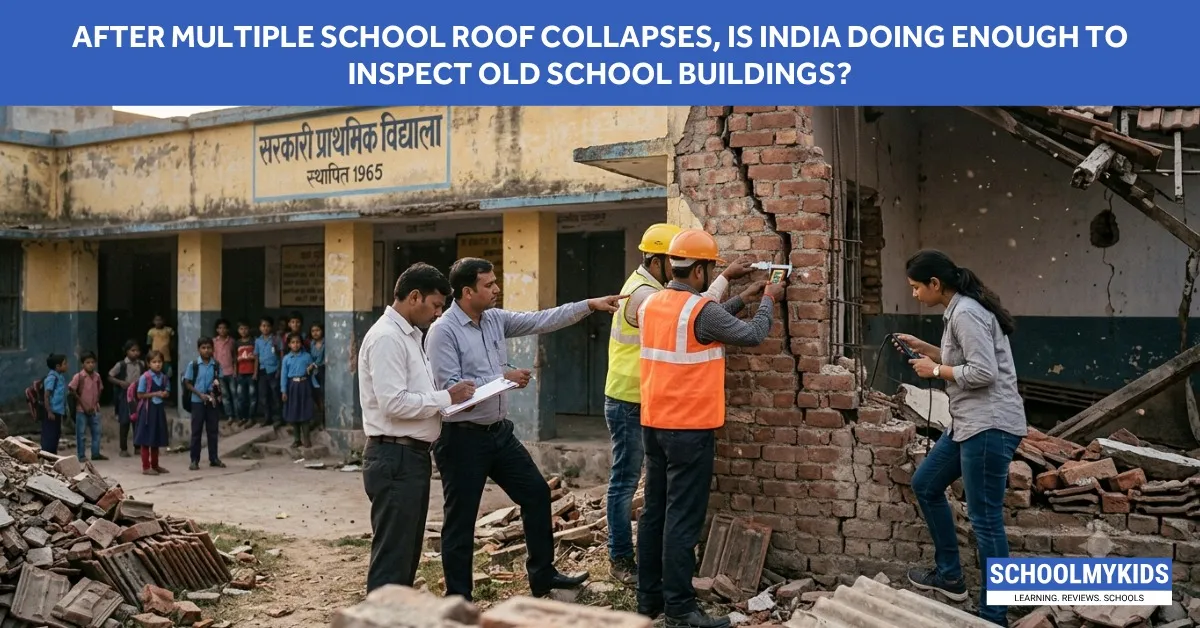
In the past year, multiple school buildings partially or completely collapsed across India. Some during school hours. Some during holidays. All preventable with proper inspection.
Several incidents in Madhya Pradesh saw roofs and ceilings give way during monsoon rains. Students were inside in some cases. Injuries occurred. Deaths were avoided in multiple reported events. Similar structural failures have been reported in other states, including cases where walls or ceilings collapsed and buildings had to be shut after visible damage was finally noticed.
These are not random accidents. They point to repeated failures in how old school buildings are checked and maintained.
The Scale Of The Problem: How Many Buildings Are Actually Unsafe
Nobody has exact numbers for every unsafe structure. Official data from UDISE+ shows India has around 1.47 million recognised schools. A significant portion of government school buildings are 30-50 years old. Many were built poorly even when new.
State surveys and official records confirm that large numbers of government school buildings need major repairs. Cracks in walls. Leaking roofs. Unsafe electrical wiring. Crumbling foundations. These are not minor cosmetic issues. These are structural dangers.
Yet inspections happen rarely. In some states, buildings get inspected once every few years. In others, inspections do not happen at all unless something goes wrong.
Why Inspections Aren't Happening: The Real Reasons
Funding Issues: Inspections require resources. Hiring structural engineers, testing materials, and carrying out repairs all cost money. Available budgets at the state level are often stretched across many competing needs.
Administrative Processes: The process involves multiple steps. A report is filed, approvals are sought, and funds are allocated. This can take months, during which the condition of a building may continue to change.
Competing Priorities: School systems must balance many demands at once — textbooks, teacher recruitment, learning outcomes, and infrastructure. Building maintenance sometimes receives less immediate attention amid these pressures.
Accountability Structures: When a serious incident occurs, investigations usually follow. Clear and consistent mechanisms that encourage preventive action across levels are still developing in many places.
What An Inspection Actually Involves: What Should Happen
A proper building inspection is not just looking around.
Structural engineers should examine the foundation. Check if it is settling or cracking. Test the concrete quality. Look at how the building is shifting over time.
Electrical systems need checking. Old wiring can start fires. Overloaded circuits are dangerous.
Plumbing needs inspection. Lead pipes are toxic. Sewage leaks contaminate water.
Roofing should be tested. How much longer will it hold? Is water seeping inside?
Fire safety systems need to work. Exits must be clear. Fire extinguishers must be functional.
A thorough inspection takes time. It costs money. But it prevents tragedies.
Most schools do not get this level of inspection. They get a visual check by someone with limited expertise. That person checks a box. The building gets certified. Until something collapses.
Who's Responsible
Responsibility for school building safety is shared across several levels of the system.
Principals are usually the first to notice visible problems and are expected to report them. District education officers oversee schools in their area and are meant to ensure regular checks take place. State education departments handle funding and larger repair decisions. Local municipal bodies are involved in certain safety clearances and building standards.
In practice, these roles often overlap or leave gaps. A problem reported at the school level may take time to move through administrative channels. Funding decisions sit at a higher level. Different authorities may each assume another is taking the lead. As a result, action is sometimes delayed even when issues have been flagged.
This is less about individual failure and more about how the system is currently organised. Clearer lines of responsibility, faster response mechanisms, and better coordination between these levels would help close the gaps.
What The Government Says Versus Reality
Governments have announced several initiatives over the years, including the National School Safety Program, building audit schemes, and emergency repair funds.
These programmes outline important goals on paper. Implementation, however, often faces constraints of funding, staffing, and scale. When only a limited number of engineers are available for a large number of schools, coverage remains incomplete and progress is gradual.
The gap between announced plans and on-ground delivery continues to be a challenge in many states.
What Parents Can Actually Do: Practical Steps
Check Your School's Building:
Walk around. Look for cracks in walls. Check the ceiling. Is the roof sagging? Are doors misaligned? These are signs of structural problems.
Ask Questions:
Ask the principal: “When was the last structural inspection?” Ask for the inspection report. If they cannot produce one, that is a red flag.
Document Everything:
Take photos of any damage you notice. Keep records. If something happens, documentation matters.
Connect With Other Parents:
Start a parents’ safety committee. Collective pressure is more effective than individual complaints.
File Complaints:
If you find problems, report to the District Education Officer. Also file a complaint with the Municipal Corporation. Send emails. Get reference numbers. Create a paper trail.
Consider Safety:
If the school feels unsafe, seriously consider moving your child. No exam score is worth a collapsed building.
The Budget Reality: Why This Keeps Happening
India’s combined public spending on education (Centre and states) stands at around 4.1% of GDP. The National Education Policy 2020 recommends 6%. Within education budgets, most money goes to salaries. Teachers need to be paid. That is non-negotiable.
What is left for infrastructure is limited. This is not enough for the scale of older buildings that need proper maintenance and repairs.
The choice often appears simple: pay teachers or fix buildings. Schools prioritise teachers for teaching quality. But buildings need fixing too.
International Standards: What Other Countries Do
Several countries maintain regular structural safety audits for school buildings. Older structures are checked more frequently. If a building fails inspection, students are moved until it is made safe.
India could strengthen its own systems along similar lines. It requires money and political will. Both remain limited.
The Long-Term Fix: What Needs To Happen
This problem will not be solved with announcements alone. It needs:
Real Money: Budget allocation specifically for school building repairs. Not vague promises. Actual funds released and spent.
Systematic Inspections: Regular inspections for all schools. Engineers doing thorough checks. Not just looking around.
Accountability: When buildings are unsafe and nothing is done, there should be consequences.
Transparency: Inspection reports should be public. Parents should know if their school building is safe.
Upgrades: Old buildings that cannot be made safe should be demolished and rebuilt to modern standards. Or given major renovations. Not just temporary patchwork.
What You Should Know If Your Child Studies In An Old Building
First, do not panic. Many old buildings are still safe. Age alone does not mean danger.
But do investigate. Ask about inspections. Look for visible problems. Trust your instincts.
If something feels wrong, it probably is. A cracked wall is not normal. A leaking roof is not something to ignore.
Your child’s safety matters more than any school’s reputation. If a school cannot keep the building safe, that is a fundamental failure.
Key Takeaways
Multiple school building collapses have occurred across India in the past year
Official data shows around 1.47 million recognised schools, many of them older structures needing attention
Large numbers of government school buildings require major repairs according to state surveys and official records
Inspections remain infrequent and often happen only after problems become visible
Underfunding and weak accountability are core issues
Parents need to stay vigilant about building conditions
Stronger inspection systems and dedicated repair funding are needed
Moving Forward
Your child will spend thousands of hours in their school building. That building should be safe. It is a basic requirement. Not a luxury.
Until governments commit real resources and enforce strict standards, collapses will keep happening. Until parents collectively demand safety, change will stay slow.
Both need to happen. Governments need to do their job. Parents need to hold them accountable.
Your child’s life depends on it.
Sources for key figures:
UDISE+ 2025-26 (Ministry of Education) for total number of schools.
PRS Legislative Research and related budget analyses for education expenditure as share of GDP (approximately 4.1%).
State government surveys and parliamentary replies for data on buildings needing major repairs.






Be the first one to comment on this story.