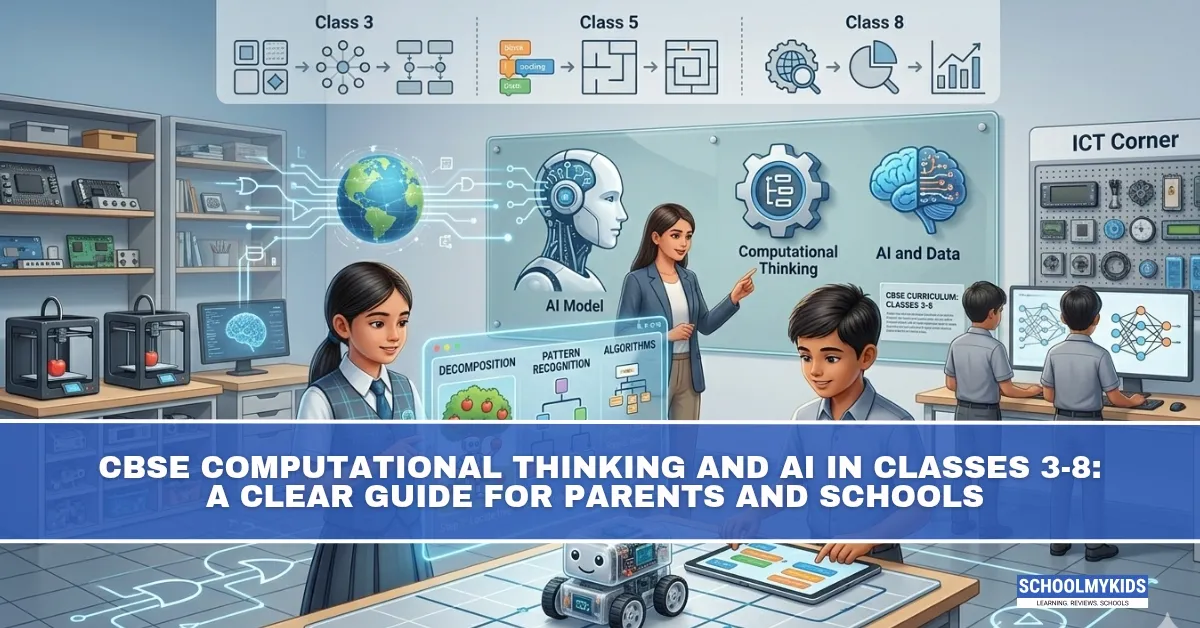
In April 2026, CBSE made an announcement that most parents missed. Starting this academic year, every student from Class 3 onwards is learning computational thinking and artificial intelligence. Not optional. Not an after-school club. Part of the official curriculum.
This reaches a vast number of students across approximately 28,000 to 33,000 CBSE-affiliated schools nationwide. The curriculum was built by faculty from IIT Madras, IIT Gandhinagar, Azim Premji University, and NITTTR Bhopal. This isn’t experimental. This is official, structured, and mandatory.
But most parents still don’t understand what computational thinking actually means or what their child will be doing in class.
What Computational Thinking Actually Is
Forget the image of an 8-year-old writing code. That’s not what this is.
Computational thinking is a structured approach to problem-solving. Breaking a large problem into smaller pieces. Recognizing patterns. Finding the rules that connect those pieces. Building a step-by-step solution that either a person or a machine can follow.
Think about how a child organizes a task. “I need to make a cake. First, gather ingredients. Second, mix them. Third, bake. Fourth, cool.” That’s computational thinking. Breaking down a complex task into logical steps.
Now extend that to every problem the student encounters. How do you organize a classroom? Computational thinking. How do you solve a math problem? Same approach. How do you write a story with a clear beginning, middle, and end? Same structure.
CBSE’s curriculum builds this thinking systematically from Class 3.
The Actual Curriculum Breakdown
Classes 3-5:
Students work through puzzles, games, visual problem-solving activities. Logic-based exercises. Nothing requires a computer.
Examples might include: “If you have four coins and need to make change for a rupee, what combinations work?” or “What pattern do you notice in these numbers?” or “How would you organize books in a library?”
Teachers observe and evaluate continuously. Not by tests. By watching how the student approaches problems. Do they break it down? Do they spot patterns? Do they explain their thinking?
Assessment is qualitative. Teachers use interactive worksheets, observation, and activity completion to track progress. The goal isn’t perfect answers. It’s developing the thinking process.
Time commitment: 50 hours per year. That's one hour per week embedded in subjects like Mathematics and The World Around Us. Integrated into regular math, science, and social studies classes, not an extra subject.
Classes 6-8:
Still puzzle and game-based at the start, but now moving toward AI concepts. Project-based learning. Real-world problems. “Design a solution for plastic waste” or “How would you organize your school’s data?” or “What are the ethical issues in facial recognition technology?”
Students work with block-based coding (like Scratch) to build simple programs. They analyze data and explore AI tools. They work in groups on interdisciplinary projects.
Assessment shifts to a mix: written tests, practical exams, thematic projects, reflective journals, peer evaluations. Teachers evaluate based on problem-solving ability, creativity, logical reasoning, and ethical thinking.
Time commitment: 100 hours per year. This includes advanced computational thinking, introductory AI concepts, and interdisciplinary projects. Still woven into existing subjects but with more dedicated focus.
What Integration Means
AI and computational thinking aren’t taught as separate subjects. There’s no extra class or extra burden on the timetable.
Instead, it’s woven into math, science, social studies, even English. A math teacher incorporates computational thinking when teaching geometry or problem-solving. A science teacher integrates it when students design experiments. An English teacher uses it when students structure stories or arguments.
This means classes look different. Less lecture. More problem-based activity. Students working through puzzles and real scenarios. Teachers facilitating rather than just delivering content.
For schools without computer labs, the primary classes can function without technology. Puzzles, logic games, and problem-solving happen on paper. Computer access matters more for Classes 6-8 but isn’t absolutely essential for basic computational thinking.
Who Actually Developed This
The CBSE didn’t create this from scratch. An expert committee chaired by Prof. Karthik Raman of IIT Madras was formed in late 2025. It included faculty from IIT Madras, IIT Gandhinagar, Azim Premji University, NITTTR Bhopal, MNIT Jaipur, Dhirubhai Ambani School, and other institutions.
Teacher input was part of the design. Mathematics and computer science educators from schools were consulted about what’s realistic to teach and assess.
The curriculum aligns with NEP 2020 and the National Curriculum Framework for School Education 2023. It’s not a one-off initiative. It’s part of a larger national shift toward AI literacy.
Key Learning Outcomes
By the end of Class 8, students should understand:
Computational thinking fundamentals: Decomposition (breaking big problems into small ones), pattern recognition (spotting what repeats), abstraction (identifying what matters), algorithmic thinking (step-by-step logic).
Practical skills: Using block-based coding tools. Collecting and analyzing data. Creating visual representations. Researching online safely.
AI awareness: What AI is and isn’t. How it works at a basic level. Where it shows up in daily life. Real applications.
Ethics: Why ethical considerations matter with AI. This covers bias in algorithms, privacy and data protection, and responsible technology use.
These aren’t advanced concepts. They’re foundational literacy for a world where AI is everywhere.
Parents should also note the strong emphasis on ethical AI use. This includes awareness of data privacy, bias in algorithms, and safe online practices. Such focus helps protect children while building responsible digital habits from an early age.
How It Gets Assessed
Classes 3-5:
Teachers observe how students approach problems. Do they ask clarifying questions? Do they try breaking the problem down? Do they test their ideas? Informal, continuous observation. Interactive worksheets showing their thinking. No report cards with “Computational Thinking: A” or “B.” Just documentation of progress.
Classes 6-8:
More structured assessment. Written tests checking conceptual understanding. Practical exams where students solve problems in real time. Projects showing application of concepts. Journals where students reflect on their learning. Peer evaluations where classmates assess group work.
The key: it’s competency-based, not memorization-based. Marks come from ability to apply knowledge and think through problems, not ability to recall definitions.
What Teachers Need To Do
CBSE declared “Computational Thinking and Understanding AI” as the central training theme for 2026-27. Translation: teacher training is happening.
CBSE Centres of Excellence are running regional workshops. Teachers can register and participate. CPD credits (Continuing Professional Development) get awarded for completing training.
The idea is that teachers don’t need to be programmers or AI experts. They need to understand CT (computational thinking) and AI literacy enough to facilitate student learning. The curriculum provides detailed teacher handbooks. Official resources are available.
Schools are expected to nominate teachers for training and support them in implementing new pedagogy.
Implementation Timeline
2026-27 (This Year):
Classes 3-8 implement the new curriculum following its official launch in early April 2026. Schools begin implementation.
2027-28 onwards:
Continued rollout. The first cohort that studied computational thinking from Class 3 moves to middle school with more advanced material.
2028 Board Exams:
Class 9 and Class 10 board exams might include questions assessing computational thinking and AI concepts. Formal computational thinking and AI subjects are expected later in Classes 11-12.
What Parents Should Actually Do
Talk to your school about their implementation plan. Ask which classes are already teaching CT this year. Some schools are ahead of the curve. Others are still preparing.
Don’t panic about your child needing coding skills. Computational thinking happens without code. Coding is just one tool. Puzzles, games, and real problem-solving accomplish the same goals.
Ask about assessment methods. Confirm that CT is being evaluated through activities and projects, not just written exams. If your school is still giving traditional tests for CT, that’s not aligned with the curriculum.
Look for resource materials. CBSE has released official student and teacher handbooks. Workbooks aligned to the curriculum are available. Your school should be using these.
Encourage your child to think through problems step-by-step. Ask “How would you break that down?” and “What pattern do you notice?” These conversations reinforce CT thinking at home.
Key Takeaways
CBSE officially launched the computational thinking and AI curriculum for Classes 3-8 starting 2026-27. This reaches students across its network of affiliated schools.
Computational thinking is about breaking problems into pieces, spotting patterns, and building step-by-step solutions. Not coding.
Classes 3-5 get 50 hours yearly of puzzle and game-based learning. Classes 6-8 get 100 hours with more project-based, real-world focus.
Assessment is competency-based through activities, projects, and observations, not traditional tests.
Curriculum is integrated into existing subjects, not an extra class. No additional burden on school timetables.
Expert committee included IIT Madras, Azim Premji University, and other institutions. Aligns with NEP 2020 and NCF-SE 2023.
Real Questions Parents Are Asking
Does my child need coding experience to do well in this curriculum?
No. Coding is introduced in Classes 6-8 using block-based tools like Scratch, which are designed for beginners. Computational thinking skills developed through puzzles and problem-solving do not require prior coding knowledge.
Will this add stress or make school harder?
Not if schools implement it correctly. It is integrated into existing classes using activities students already find engaging, such as puzzles, games, and projects. It is not supposed to add workload. It is supposed to enrich existing learning.
What if my school hasn’t started this yet?
Schools are supposed to start in 2026-27, which is this year. If your school hasn’t mentioned it, ask administration about their implementation timeline. They should have a plan.
Is this mandatory or optional?
It’s mandatory for all CBSE schools. Students can’t opt out. It’s part of the official curriculum, not an elective.
How do I know if my child is actually learning CT properly?
Look for evidence of problem-solving activities, not just traditional lessons. Ask your child to explain how they solved a puzzle or approached a project. If teachers are assessing through observations and projects, not just tests, that’s a good sign.
Will this affect board exams?
Not immediately. Classes 3-8 have integrated CT now. Board exams (Class 10 and 12) will gradually incorporate CT and AI concepts, but formal CT and AI become standalone subjects only in Class 11-12.
What if my school doesn’t have computers?
Classes 3-5 can teach CT fully without technology. Classes 6-8 benefit from computer access but can function without it for basic concepts. CBSE recommendations suggest computer labs, but it’s not an absolute prerequisite.
Is this replacing traditional subjects?
No. CT is integrated into math, science, social studies, and English. Traditional content is still taught. CT is an additional thinking framework applied to that content.
Conclusion
This curriculum shift represents a fundamental change in how Indian schools approach problem-solving and thinking. Not memorization. Thinking. For students who start in Class 3 this year, CT becomes woven into everything they learn.
Parents don’t need to become AI experts to support this. Understanding that CT is about systematic thinking and problem-solving is enough. The schools and teachers are being trained to facilitate the rest.








Be the first one to comment on this story.