Why Science Classes Often Kill Curiosity
Science is supposed to explain how the world works. Yet many students experience it as a list of formulas, definitions, and steps to memorize. Questions are tolerated only if they help finish the syllabus faster.
“Just learn this for the exam.”
“We’ll explain later.”
“That’s out of scope.”
Over time, students stop asking why and focus only on what to write. Thinking shrinks. Performance may survive. Understanding doesn’t.
Socratic questioning exists to reverse this damage.
What Socratic Questioning Actually Means
Not Arguing, Not Showing Off
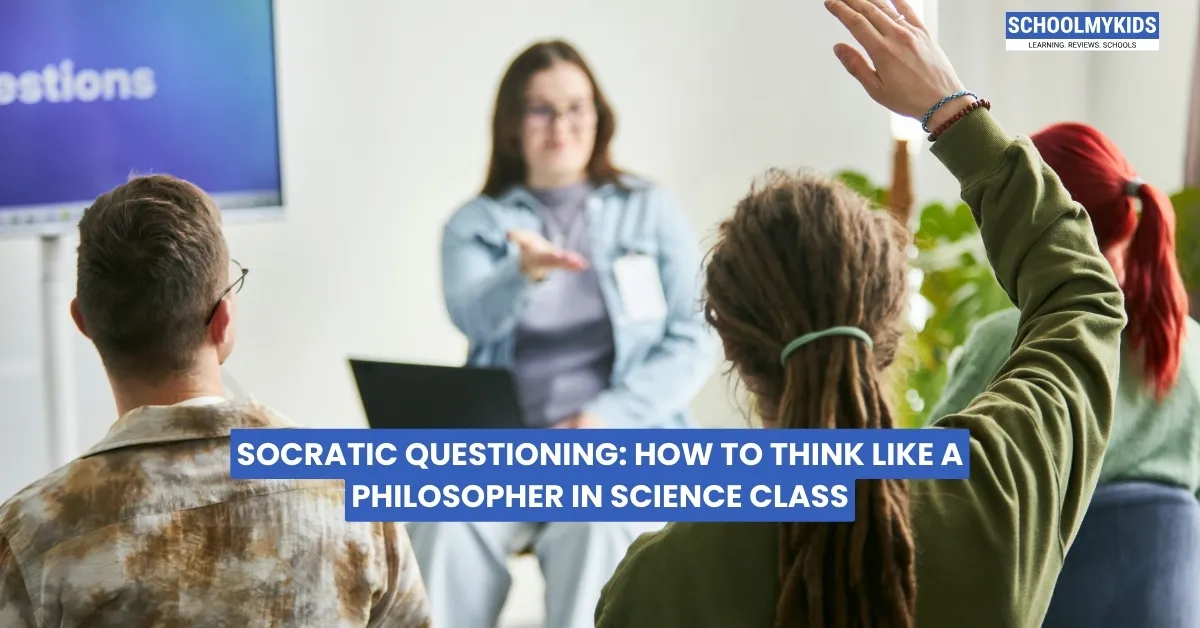
Socratic questioning is not about challenging teachers or sounding clever. It is a disciplined way of thinking through questions that expose assumptions, logic, and consequences.
It replaces passive acceptance with active inquiry.
Instead of asking for answers, students ask questions that shape answers.
Thinking in Layers, Not Lines
Most classroom questions are linear: “What is the formula?”“What is the definition?”
Socratic questions are layered:
- Why does this work?
- What assumption is this based on?
- What happens if this condition changes?
- How do we know this is true?
This turns science from memory into reasoning.
Why Socratic Questioning Fits Science Perfectly
Science Is Built on Questions
Every scientific law exists because someone questioned what others accepted. Gravity, evolution, atomic theory. None began with memorization.
Socratic questioning mirrors how science actually progresses.
Students who ask better questions understand concepts faster and forget them slower.
It Reveals Gaps Early
When students question assumptions, confusion surfaces immediately. That prevents false confidence.
Not understanding something early is cheaper than not understanding it in exams.
Core Types of Socratic Questions for Science Students
Clarification Questions
These test understanding:
- What do we mean by “energy” here?
- Is this definition always true or only in this case?
They prevent memorizing words without meaning.
Assumption Questions
These expose hidden beliefs:
- What are we assuming stays constant?
- Does this formula assume ideal conditions?
Many scientific mistakes come from ignored assumptions.
Evidence Questions
These demand proof:
- How was this conclusion reached?
- What experiment supports this?
Science without evidence is storytelling.
Implication Questions
These extend thinking:
- If this is true, what else must be true?
- What happens if this variable increases?
These questions connect chapters instead of isolating them.
Counterexample Questions
These test limits:
- When does this rule fail?
- Are there exceptions?
Understanding limits deepens mastery.
How Students Can Use Socratic Questioning Daily
While Studying Alone
After learning a concept, ask:
- Can I explain this without notes?
- Why does each step exist?
- What would break if I removed this step?
If answers are vague, understanding is incomplete.
During Problem Solving
Instead of jumping to formulas:
- What is actually happening physically?
- Which principle applies and why?
This reduces careless errors dramatically.
In Class Without Being “That Student”
Students fear annoying teachers. The solution is timing and tone.
Ask focused questions: “Is this formula derived assuming no friction?” “How would this change in a non-ideal case?”
These questions show engagement, not defiance.
Why Schools Don’t Emphasize This (Enough)
It Slows the Syllabus
Questioning takes time. Systems optimized for coverage discourage it.
But speed without understanding creates fragile learning.
It Challenges Authority Comfort
Socratic questioning decentralizes authority. That makes some environments uncomfortable.
Yet real education requires discomfort.
Common Student Misunderstandings
“This Is Only for Philosophy”
Wrong. Science without questioning becomes rote technique. Philosophy without evidence becomes speculation.
The best scientists think like philosophers with data.
“It Will Confuse Me More”
Confusion is not failure. It is a signal.
Temporary confusion prevents permanent misunderstanding.
How Parents and Teachers Can Encourage This
- Praise questions, not just correct answers
- Allow “why” discussions without rushing closure
- Reward reasoning even when answers are incomplete
Thinking should be visible, not punished.
A Practical Way to Think About Socratic Questioning
Socratic questioning is not about having more questions. It is about having better ones.
When students learn to question assumptions, examine evidence, and explore implications, science stops being something to remember and starts being something to understand.
Formulas become tools. Concepts become explanations. Exams become manageable side effects.
Thinking like a philosopher in science class does not make you slower. It makes you harder to fool.







Be the first one to comment on this story.