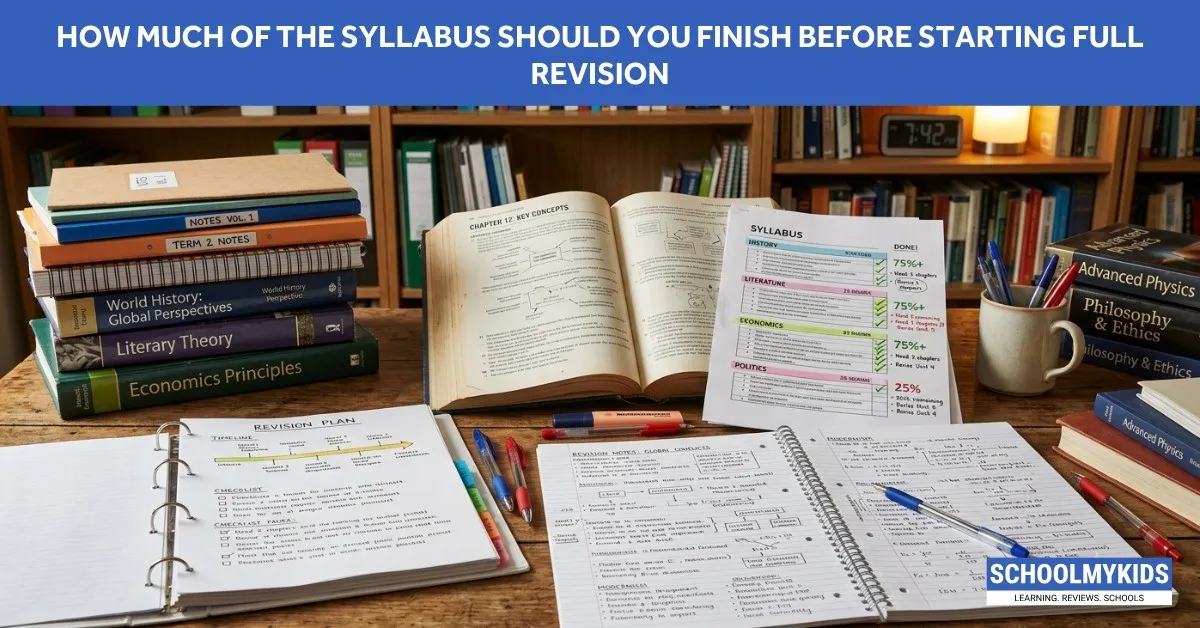
It’s late August. Your half-yearly exam is mid-September. You’re still reading new chapters. Your brain is going, “Wait, shouldn’t I be reviewing what I already studied?”
Yes.
But let’s see what actually happens. You finish a new chapter. You think, “Okay, I’ll revise this later.” Then you start another new chapter. By September 1st, you’ve covered most of the syllabus, but you haven’t actually revised anything. You’re stuck in “learning mode” when you should be in “cementing what you learned” mode.
That’s not poor planning. That’s how Gen Z brains actually work under the system you’re in.
The Actual Math That Matters For Half-Yearly Exams
Your half-yearly exam covers roughly 40-50 percent of the year's syllabus (the April to September portion in most Indian school boards). Everything from April through September. That's roughly 5 months of content compressed into one exam.
This is what the timeline looks like if you’re smart about it:
Now (mid-August): You’re at roughly 80 percent of the half-yearly syllabus. Some chapters are complete. Some you haven’t touched.
By September 1st: You should be at 95-100 percent of what will be tested. Finished all content.
September 1-10: This is pure revision. No new chapters. Just going through what you already learned.
September 10 onwards: Taking mock exams in exam conditions. Identifying weak areas. Clearing doubts on those weak areas specifically.
Week before exam: Light review. Confidence building. Not learning anything new.
The critical date: Finish all syllabus by September 1st. Not September 5th. Not the weekend before exam. September 1st.
Why The “Still Studying New Content” Trap Happens
You probably have 3-4 chapters you haven’t fully covered yet. Your brain knows this. So it keeps giving you anxiety about those uncovered chapters. That anxiety makes you want to finish them.
Meanwhile, you have 10 chapters you studied 2-3 weeks ago that are already fuzzy (classic forgetting curve territory; without review, a large chunk of new learning fades within days to weeks). Your brain isn’t anxious about those because they seem “done.”
So you prioritize finishing new chapters over revising old ones. Which is backwards. The fuzzy chapters will be forgotten by exam time if you don’t revise them now.
Also, finishing new chapters feels productive. You’re making progress. Revising feels repetitive. Your brain doesn’t feel like you’re accomplishing anything even though revision is where learning actually sticks.
The Real Strategy: Blend Learning And Revision Now
This is what actually works starting immediately:
Week 1 (Now): Each day, study one new chapter. Finish the new chapter thoroughly. Then spend the last hour revising a chapter from 2-3 weeks ago.
Week 2: Same pattern. One new chapter. One hour revising older chapters.
Week 3: This is your push week. Finish any remaining new chapters while revising everything.
By September 1st: All new content done. All chapters touched at least twice (once learning, once revising).
September 1-10: Pure revision. Multiple passes through every chapter.
The key insight: You’re not choosing between learning and revision. You’re doing both. But the ratio flips over time. Now it’s 80 percent learning, 20 percent revision. By September 1st, it’s 0 percent learning, 100 percent revision.
The “70-80 Percent Done” Problem
Some teachers and websites say “finish 70-80 percent of syllabus then start revision.”
That advice is sort of right but also frustrating because it doesn’t account for how human brains actually work. If you finish 80 percent and haven't revised anything, the first 40 percent is already fading from memory (forgetting curve again).
Better advice: Complete 70-80 percent of new content by August 25th. From August 25th onwards, anything new you learn gets immediately followed by revision of older material that week.
This way by September 1st you’re at 100 percent coverage with 60 percent of your material having been revised at least once.
What “Full Revision” Actually Means (And When It Starts)
"Full revision" doesn't mean reading chapters one more time. It means active retrieval:
Testing yourself on each chapter (no looking at answers while answering)
Solving sample questions and past exam questions
Writing out answers like it’s the actual exam
Identifying which topics you keep getting wrong
Focusing extra time on those weak topics
That’s intensive. That’s different from “reviewing notes.” Research keeps showing that testing yourself (even without feedback at first) strengthens long-term memory more than restudying the same material. Active testing beats passive re-reading for lasting recall (Roediger and Karpicke, 2006).
You can start this the moment you finish a chapter. Not weeks later. Finish Chapter 5, spend 30 minutes the next day testing yourself on Chapter 5. That’s early-stage revision.
But “full syllabus revision” (revising everything at least twice) realistically starts September 1st because you can’t revise material you haven’t finished yet.
The Mock Exam Moment
When do you know you’re ready to take a full mock exam? When you’ve finished 90 percent of the syllabus and done at least one revision pass on 70 percent of it.
For half-yearly, that’s probably September 5th.
Taking a full mock exam before you’ve finished new chapters is counterproductive. You’ll just find tons of gaps and feel worse. But once you’ve finished new content, mock exams become your best friend.
They show exactly what you need to revise harder.
Key Takeaways
Half-yearly exam covers 40-50% of annual syllabus (April-September content in most boards)
Complete all new content by September 1st, not later
Blend new learning with revision starting now (80/20 ratio)
Flip the ratio by September 1st (0% new, 100% revision)
“Full revision” means testing, practice questions, identifying weak areas
Full syllabus revision realistically starts after all new content is done
Take first mock exam by September 5th when 90% syllabus is done
Week before exam is confidence-building, not learning
Frequently Asked Questions
Q1: I haven’t finished 3 chapters. Is it too late to finish them and revise?
No. You have until September 1st. Finish those chapters this week. Even if rushed. Then September 1-10 is pure revision. You’ll be fine.
Q2: Should I finish everything perfectly or just cover everything roughly?
Covering everything roughly is better than covering most things perfectly. You can’t revise what you haven’t seen. Get through everything once, even if imperfectly. Revision makes it perfect.
Q3: Can I start full revision before finishing all syllabus?
Yes, you can revise chapters you’ve finished while still learning new chapters. But don’t take full mock exams until 90% done.
Q4: What if my teacher hasn’t finished teaching some chapters?
Learn from NCERT directly if needed. Don’t wait. Half-yearly exams test whatever was supposed to be covered, whether your teacher finished or not.
Q5: Is one revision pass enough or do I need multiple?
Multiple is better, but one thorough revision is better than none. Minimum two passes (learning + revision). Ideally, 3 passes (initial learning, revision week 1, revision week 2) if you have time.







Be the first one to comment on this story.