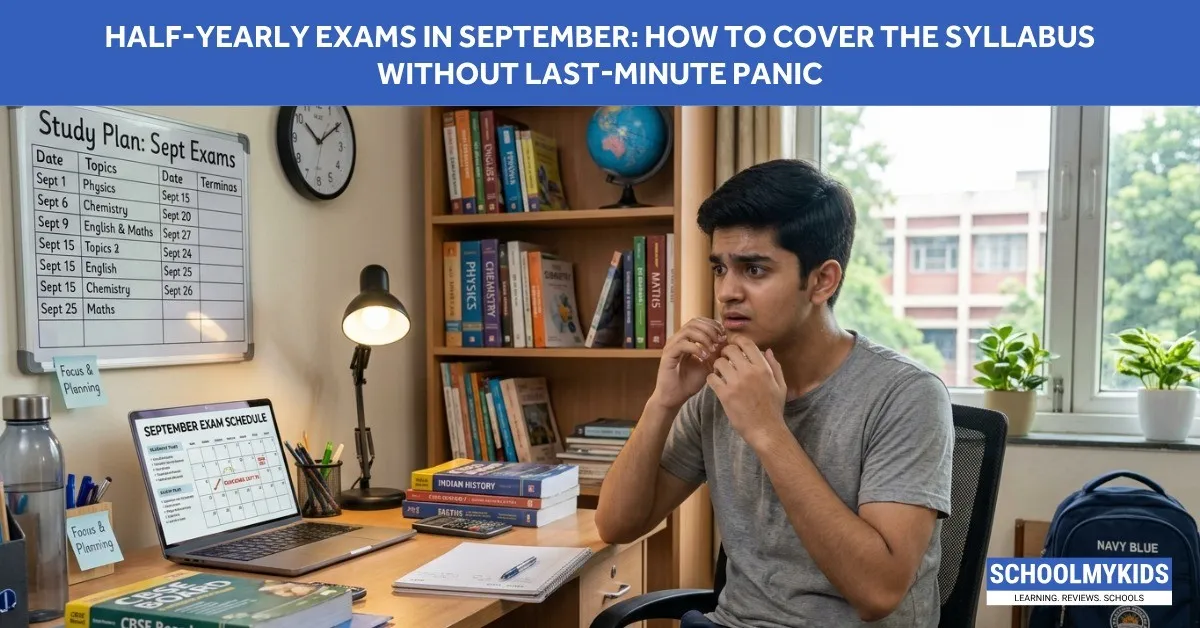
It's mid-August. Your half-yearly exams are in September. You haven't started seriously yet. Your brain is going, "Why am I like this?" and you're imagining a future where you're cramming at 2 AM on exam eve, regretting every waking hour.
That panic feeling? It's real. But it's not because you're lazier than other students. It's because of how your brain is actually wired right now, combined with how distracting your environment is.
A 2025 study of 1,628 students across eight Tier-1 Indian cities found that nearly 70 percent showed moderate to high anxiety levels, with over 70 percent reporting emotional distress. Not mild stress. Actual stress that messes with focus. And most of you haven't even started studying yet.
Why You're Actually Stuck (It's Not Just Laziness)
Your phone is next to you. Probably right now. Your Instagram notifications are firing. Your Discord server is chatting. Your friend sent a video you need to see immediately. Your brain gets interrupted roughly every 3-4 minutes.
That's not laziness. That's your attention system being hijacked.
Meanwhile, your brain is also doing something specific about exams. It knows they're coming. It's creating background anxiety about it. So your brain simultaneously wants you to study and wants you to distract yourself from the anxiety about studying. You end up doing neither well.
Then there's the syllabus thing. Half-yearly exams cover roughly 40-50 percent of your annual syllabus. Everything from April to September. That's five months of content. If your school is efficient. Some subjects might have more. It feels like too much.
Combined, it creates the perfect situation for panic. You feel behind. You feel anxious. You distract yourself. Then suddenly it's September 1st and you realize you're actually way behind.
What Actually Happens In Half-Yearly Exams (And Why Timing Matters)
Half-yearly exams in India are conducted by individual schools. Your teacher prepares the question paper based on whatever was covered in the first half. There's no standardized exam like board exams.
This is actually better for you than you think. It means the exam is designed specifically for your pace of syllabus coverage. Your teacher knows exactly what you covered by September. She'll test that.
The catch: You need to actually know it. Not "recognize it when you see it." Actually know it. Because half-yearly marks get added to your final result in many schools. It's not like "study hard and pass, then forget." It's "study smart now because these marks often feed into internal assessment that counts toward your final record."
The Real Timeline (Not The Panic Version)
Let's do the math that actually matters.
If your half-yearly is in mid-September, you have roughly 5-6 weeks starting from now (mid-August). That's 35-42 days. Sounds like enough time? It is. But only if you distribute your studying across those weeks instead of doing it all in the last week.
What panic looks like: Week 1-4 you do basically nothing. Week 5 you start studying seriously. By exam week you're sleep-deprived, stressed, and retaining barely 30 percent of what you're trying to cram.
What actually works: Week 1 you cover one chapter. Week 2 you cover one chapter and review the previous one. Week 3-4 you keep moving forward. Week 5 you start reviewing everything. Week 6 you're solving past papers and clarifying doubts, not learning new content.
Same time. Wildly different outcomes.
The Digital Distraction Problem (And How To Actually Fix It)
You know your phone is a distraction. Everyone knows. But "just put your phone away" doesn't work because your brain has been trained for five years to check it constantly.
Your phone's notifications trigger a dopamine release. Your brain now expects that hit. When you put the phone away, you get withdrawal-like symptoms. Not addiction exactly. But your brain is literally struggling.
So, let’s see what actually works with your wiring instead of against it:
Put your phone in another room. Not just face down. Another room. Physical distance breaks the psychological pull. Studies show cognitive capacity improves when the phone is left in another room compared with keeping it nearby (even face-down and silent).
Use a timer for study sessions. 25 minutes studying, 5 minutes break. During the break, you can check your phone guilt-free. Your brain knows it's coming, so it stops fighting you during study time.
Tell someone your schedule. Tell a parent or friend. Say "I'm studying 4-5 PM with no phone." Now you have social accountability. That sounds cheesy, but it works because your brain cares more about social reputation than about checking Instagram.
The Actual Study Strategy
First two weeks: Read each chapter once. Don't make notes yet. Don't try to memorize. Just read and understand. Your brain is building the framework of knowledge.
Week 3-4: Make notes as you reread. But not everything. Just the parts you didn't understand from the first read. Your notes should be questions you had, not summaries of the chapter.
Week 5: Solve problems. Write answers to past exam questions from your school (ask your teacher for old half-yearly papers). Don't check answers immediately. Write out full answers like it's the exam. Then check.
Week 6: Review answers you got wrong. Understand why you got them wrong. Take a mock exam in exam conditions (timed, no phone, full hours).
This is spread-out learning. Your brain consolidates information when you revisit it multiple times with gaps in between. One week of intense cramming doesn't hit this.
The Real Problem Nobody Talks About: You're Actually Anxious
Over one-third of upper secondary students report high stress levels before exams. Fear of failure is the biggest trigger, affecting nearly half. Future uncertainty ranks close behind.
This stress is neurologically real. It impairs your focus. It makes you want to escape studying by distracting yourself. It keeps you awake when you need to sleep.
Addressing stress isn't "think positive." It's practical stuff:
Exercise 30 minutes daily. Not because it's healthy (though it is). Because a single bout of moderate aerobic exercise genuinely reduces test anxiety and improves focus for hours afterward. That's how your brain works.
Sleep 8 hours. Night before exam, sleep at your normal time. Don't stay up to study. Sleeping actually helps memory consolidation more than last-minute cramming.
Talk to your parents about the stress. Not to get them to reduce pressure (though that'd be nice). Just to say "I'm feeling anxious." Saying it out loud reduces it measurably.
Key Takeaways
Half-yearly exams cover 40-50% of annual syllabus up to September
Nearly 70% of students in Tier-1 Indian cities show moderate to high anxiety levels before exams
Syllabus coverage looks impossible until you divide it into weekly chunks
Digital distraction is neurological, not moral weakness
Spread-out learning over 5-6 weeks produces substantially better long-term retention than cramming
Phone in another room genuinely breaks the distraction cycle
25-minute focused sessions work better than 2-hour unfocused ones
Mock exams in exam conditions improve actual exam performance by 15-25%
Exercise and sleep are study strategies, not just wellness
Frequently Asked Questions From Panicked Students
Q1: It's already August 15 and I haven't started. Can I still do this without panicking?
Yes. You have at least 4 weeks. That's enough to cover 40-50% of syllabus if you focus. Start today. Seriously today. Not tomorrow.
Q2: My phone is literally next to me right now. Do I have to actually move it to another room?
Try it and you'll see. Physical distance makes a huge psychological difference. It's scientifically proven that having it nearby reduces focus even when off.
Q3: What if I'm already in "panic mode"? Is it too late?
Even panic mode benefits from distributed learning better than cramming. Start the spreading strategy now. You'll still do better than if you wait two weeks and then cram.
Q4: My school hasn't given old half-yearly papers. What do I study from?
Ask your teacher directly. Ask classmates. Check your textbook practice problems. Solve those in exam conditions. That's your mock exam material.
Q5: The syllabus is genuinely huge. How do I know what's important?
Your teacher emphasized things in class. Those are important. Things that were in assignments. Important. Things in examples in the textbook. Important. Don't try to memorize every line equally.





Be the first one to comment on this story.