December is the time when your preparation for board exams should take a more focused direction. If you are a student of Class 10 or Class 12, you may have the following two questions in your mind right now: “How much portion of the syllabus should I have covered by now?” and “What should be my daily study plan to score well in the Board exams 2027?”
Let us first have a look at the examination schedule. The CBSE Board released the 2027 Class 10 and Class 12 date sheets on 6 November 2026. For both classes, the first examination is scheduled for 16 February 2027 at 10:30 am. Class 10 Board exams end on 9 March, while Class 12 Board exams end on 9 April. The Board released the date sheets 101 days before the commencement of the first board examination of 2027.
This gives the students a major advantage. Now, they can plan their revision based on the actual examination dates.
Before you make your timetable, there are a few things you should know. A Class 10 student preparing for Mathematics, Science and Social Science needs a different strategy from a Class 12 student preparing for Physics, Chemistry, Biology, Accountancy or Economics. The way you practise questions and revise chapters is also different.
Now, let’s consider each plan separately.
Class 10 Board Exam Study Plan for 60 Days
Class 10 is an important class, as this is the first year that most students experience a full board examination. You may understand most of the chapters, but still have problems answering all the questions in the required time, i.e., within 3 hours. Some students also lose marks because they know the answers but do not present them properly.
Your December preparation is very important to overcome these issues.
Before you start, check where you stand
Take a notebook and make a list of all the chapters under the name of the subject. After that, mark each chapter as:
Strong chapter: You are confident about the chapter and can answer the questions without help.
Weak chapter: You do not understand the chapter properly and, therefore, cannot answer the questions independently.
Needs revision: You have studied the chapter previously but do not remember important definitions, formulas, dates, etc.
It is important not to mark a chapter as a ‘strong’ chapter just because you have read it once. To check whether you really understand the chapter, try to answer at least 5-10 questions from it.
December: Complete unfinished chapters and repair weak areas
The first half of December should be dedicated to completing unfinished chapters. If your school has finished completing the syllabus, take this opportunity to review the more difficult topics.
For Maths, practise questions every day. Pay more attention to chapters such as Algebra, Geometry, Trigonometry, Statistics and Mensuration. Do not merely read solved examples. Close your book and attempt similar questions.
Divide your time for Science between Physics, Chemistry and Biology. For Physics, pay attention to numerical problems and the application of laws and concepts of electricity. For Chemistry, practise chemical equations. For Biology, revise important processes and diagrams.
Reading an entire chapter in Social Science can be time-consuming. Instead, select key/important points, do some map work, and learn to write answers relevant to the question. Learn the concepts in Civics and Economics before attempting to memorise the definitions.
A common mistake: Students tend to postpone Hindi and English, thinking they are easy. Don’t do this. Practise reading and writing answers to literature questions. Pay attention to literary genres, styles and figures of speech. Do practice for English and Hindi grammar at least twice a week.
All this should be done by the end of December. By then, you should have reviewed the weak chapters, started addressing sample questions and completed the syllabus at least once.
January: Follow examination conditions while answering sample questions
In January, change your study habits. Instead of concentrating on reading chapters, focus on sample questions.
Sample Question Papers and Marking Schemes for Class 10 subjects for the academic session 2026-27 have been released by CBSE (notification dated 21 September 2026). They can be downloaded from the CBSE Academic website (cbseacademic.nic.in).
Solve them thoroughly without taking help from the answers.
Analyse your answers against the marking scheme to see where you lost marks, even if you understood the concept. You may have to fill in various steps or write down other important points to answer a question worth three or more marks.
Keep a mistake notebook. List down all the reasons why you got a question wrong, in detail.
Revise this notebook every once in a while. It’ll help you more than solving new question papers without reviewing your mistakes.
Solve one or two question papers thoroughly every week. Increase the number only if you are able to review each paper thoroughly.
February: Revise as per the exam dates
Your actual date sheet is in front of you. Give importance to your first paper. Other papers should also be prepared for in advance rather than left until the last minute.
Remember, CBSE introduced two board examination opportunities for Class 10 from 2026. Students need to appear in the first board examination, and eligible students can appear in the second board examination for improvement in performance in up to three subjects (from Science, Mathematics, Social Science and languages), as per the rules of the Board. The second board examination opportunity should not be treated as an opportunity to take the first board examination lightly. The main focus of the student should be to attempt the first board examination to the best of their abilities.
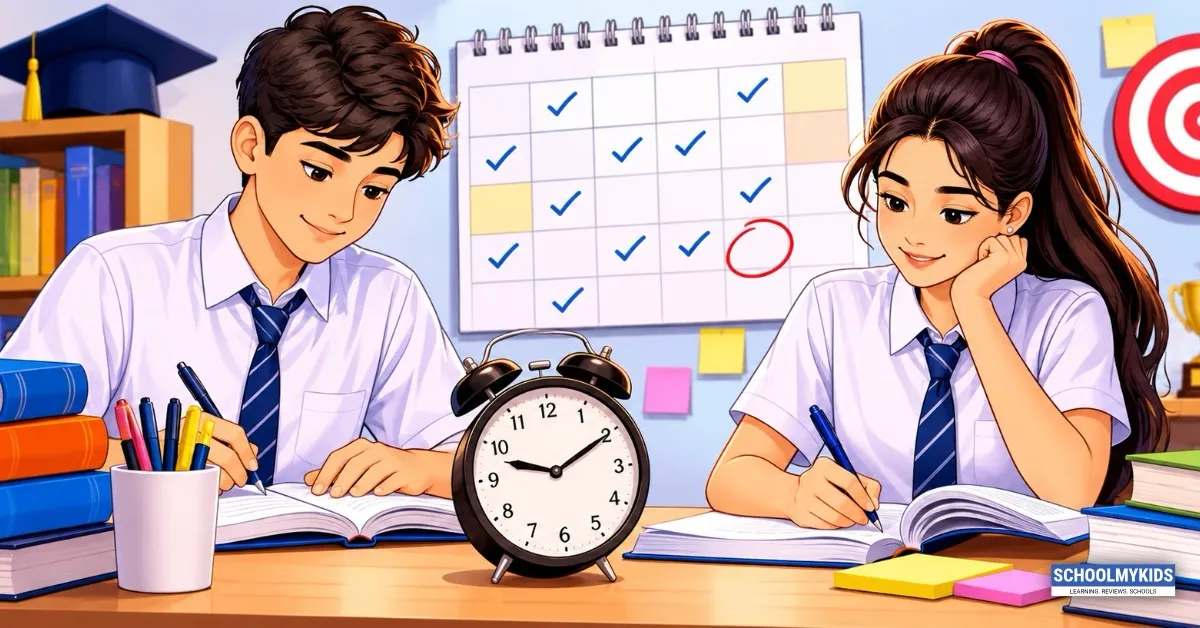
What should your daily timetable look like?
You don’t have to study for 12 hours in a day to prepare well for board examinations. A practical and realistic timetable is the most useful thing for you.
Let’s try preparing a practical and realistic timetable for yourself.
Study Session | What to do |
|---|---|
Morning | Mathematics or Science numericals |
Afternoon | Revision of Social Science/Language Subjects |
Evening | Recall formulas and mistakes and/or question paper solutions |
Cutting down on your sleep to study more can negatively impact your concentration and memory.
Try to attend all classes. Keep a gap of 30-45 minutes between sessions for meals and breaks, and try to sleep for at least 8 hours.
One last thing. Don’t compare your preparation with your friends who say they have completed 5 sample papers in a day. What is important is whether you can answer questions by yourself and where you go wrong.
Class 12 Board Exam Study Plan for 60 Days
Class 12 preparation requires a more subject-specific approach. Unlike Class 10, students have different streams, and the level of difficulty for revision depends on the subject combination.
A Science student preparing for Physics, Chemistry and Mathematics may require long hours of numerical practice. A Commerce student may require frequent Accountancy practice and Economics revision. Humanities students may need to balance concepts and revision with the practice of writing structured, well-supported answers.
There is another important concern. A lot of Class 12 students are currently preparing for entrance examinations (JEE, NEET, CUET, etc.) while simultaneously preparing for their board examinations. Your board preparation, especially for the first paper, should remain your priority.
December: Strengthen concepts and prepare for practicals
Accountancy requires a lot of practice with journal entries and adjustments. Practice preparing financial statements and working on other prescribed topics should be done by Commerce students. For Business Studies, prepare answers with appropriate headings and brief explanations, and practise evaluating case-based questions. For Economics, both conceptual clarity and numerical practice are required.
For Humanities, understanding historical events, political concepts, geographical processes, etc., and prescribed readings is mandatory. Long-term memorisation of chapters should be avoided, and practice in writing concise answers within the word limit should be done instead.
December, besides regular practice, is also the time to check practicals, assessments and projects conducted by the school. If you study in a winter-bound school, practical examinations, projects and internal assessments are scheduled from 9 November to 19 December 2026. For regular-session schools, they run from 1 January to 13 February 2027. Start preparing accordingly. Sample Question Papers for Class 12 are available on the CBSE website. Use these papers to practise answering in the prescribed format and learn the expected way of expressing answers.
January: Practise sample papers and improve answer-writing
For subjects like History, Political Science and Business Studies, practise writing answers in a sequence. Use appropriate headings, and support your points with relevant information. Keep introductions short.
A good tip for students appearing for entrance exams: Do not give up on your preparations for JEE, NEET or CUET. However, do not give most of your time to these preparations if your board syllabus requires revision. Board exams have their own question patterns, and writing answers is a skill that requires practice.
Try solving at least one complete sample paper for a major subject every week. Analyse the paper before answering the next one.
February: Prepare for each paper separately
The Class 12 board exams begin on 16 February 2027 and continue until 9 April 2027. Unlike Class 10, this means your preparation should not end after the first 60 days. February should be devoted to the first few examinations while you continue revising other subjects.
Note the gaps between your actual examinations. Longer gaps can be used for revision of chapters and shorter gaps for formulas, definitions, diagrams, important questions and previous mistakes.
For example, you can complete most of the revision for Physics before its examination if you have Physics and Chemistry papers close together. Don’t rely on the gap after Physics to cover Chemistry chapters.
A Few Mistakes Class 12 Students Should Avoid
Ignoring NCERT: Especially in Biology and Chemistry, don’t depend completely on coaching notes/reference books.
Neglecting answer-writing practice: Knowing an answer and writing it in the examination are two different skills.
Ignoring practicals: Practical examinations, projects and viva contribute to the final performance in a subject.
Equal study of all subjects: Spend more time on subjects that need attention and are also scheduled to be examined earlier.
Ignoring health: Revision becomes less effective with irregular meals, lack of sleep and excessive late-night studying.
How to Make Your 60-Day Board Exam Preparation More Effective
Students of Classes 10 and 12, especially, can benefit from the following practices.
Put your phone away during study sessions. Breaking your focus to send or check messages can become a bad study habit. If you must have your phone nearby to set a timer, put it in Focus mode so you are not distracted by notifications.
Practise active recall. Explain a topic to yourself in your own words, or write important formulas or dates from memory. After doing so, evaluate how well you remember the concept or formula. Active recall strengthens your memory of a concept or formula and helps identify where you may be retaining incorrect information. Research shows that retrieval practice produces stronger long-term retention than re-reading.
Do not hoard study materials. Your basic study materials (NCERT textbooks, school notes, sample question papers and marking schemes) are more than sufficient to build a strong foundation for your preparation. Extra study materials may lead you astray and waste your time.
Write by hand. Because the board exams evaluate your ability to write answers, it is vital that you practise writing. Writing answers strengthens their presentation and accuracy. It also improves your writing speed.
Keep one lighter revision session each week. Use this time to go over difficult chapters, clear your doubts and catch up on topics you were unable to complete.
Final Advice for Students Preparing for the 2027 Board Examinations
In 60 days, or two months, you can cover a lot of ground in your board exam preparation, especially if you feel behind right now.
However, understand that not everyone can work with the same timetable. You will have to modify it according to your requirements.
Class 10 students should work on completing their syllabus and strengthening their basics. They should practise sample papers and solve previous years’ question papers. Class 12 students should focus on revising their subjects and also find time for their practicals, projects and other activities related to their streams.
Do not focus on the number of hours you study. Rather, see how many chapters you have understood, how many questions you can now answer and how many mistakes you have stopped making.
You can always improve your preparation.