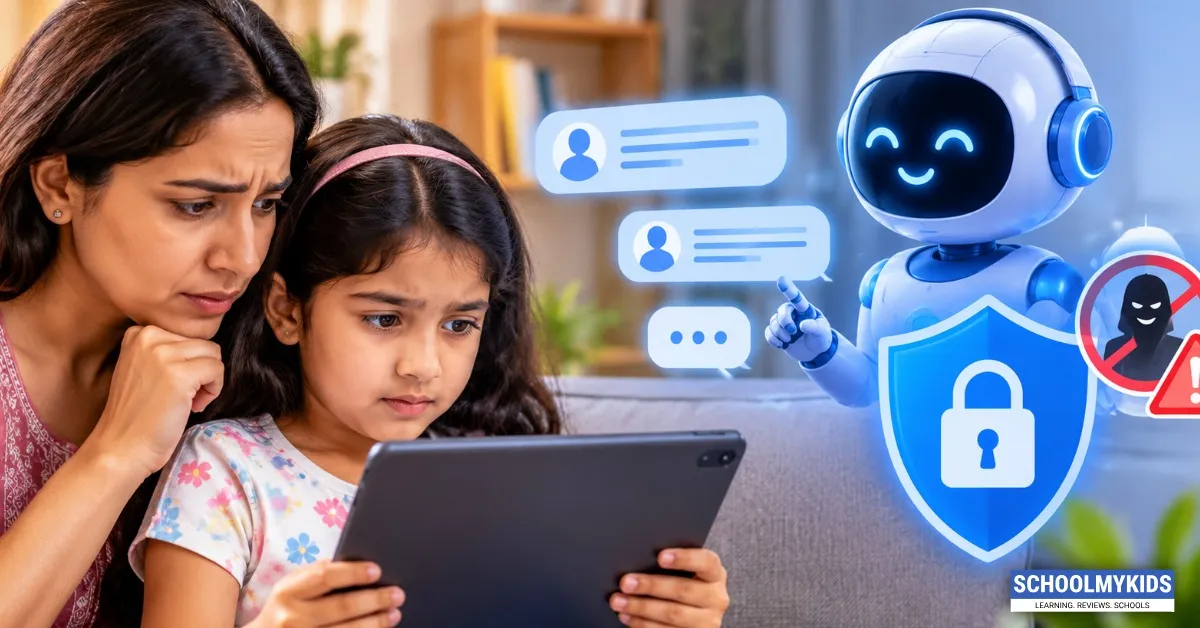
Your kid is on their phone doing homework. As usual. But are they searching for information or notes or past year questions? Watching those fast-track revision videos?
What if they’re having a conversation with an AI chatbot instead?
Children now use various AI tools, including ChatGPT, Google Gemini and Meta AI, for homework, watching reels, Pinterest inspiration, and oftentimes just to get answers to their daily questions. Some children even talk to these chatbots to express their loneliness and discomfort about talking to certain people around them.
Now, the question comes: ‘Are your children safe using AI chatbots?’
Whether a child is safe using a particular AI chatbot depends on various factors, including the child’s age and the way they use the tool. While learning can be simplified with the help of AI, children may also be exposed to inappropriate content and have their data compromised. There are risks associated with every AI tool that your child may use.
You need to be informed of these risks to guide your child and help them learn how to use these tools responsibly. Remember, it is not necessary that you completely ban the use of these tools in your house.
Why Are Children Using AI Chatbots?
AI chatbots have become a reliable source of information for many children.
A kid may ask ChatGPT to explain a challenging concept of Biology to them, and another may use Google Gemini to better understand a maths problem or simply to create a school project.
Children also use chatbots to talk about problems that they may be having with their friends and family. Because chatbots respond instantly and seem less judgmental than humans, children sometimes think they are better to talk to about their problems. Children can see chatbots as more approachable than their parents or friends. This is because, to them, chatbots may seem less judgmental than society, even though AI tools do not understand or respond to emotions in the same way as humans do.
According to Common Sense Media’s June 2026 Census on AI Use by Tweens and Teens, just over two-thirds (67%) of children aged 9 to 17 in the U.S. have used AI chatbots. Their October 2026 Tech and Media Use Census found 65% of the same age group use AI tools in free time. Their use extends beyond academic tasks, with children turning to chatbots for different reasons. Although this data is not specific to India, it raises concerns for parents around the world.
What Are the Risks of AI Chatbots for Children?
AI chatbots can respond to a wide range of questions, which may make children feel that they can ask them almost anything.
These are five concerns for Indian parents.
1. Children May Form an Emotional Attachment to the Chatbot
Due to their design to respond like friendly companions, children may start speaking to AI chatbots as they would to a human friend. Children who do not have many friends outside the home may start talking to chatbots to satisfy their emotional need for conversation and companionship.
You must be concerned if your child spends too much time talking to chatbots and seems to have a strong emotional bond with these tools.
2. Chatbots Can Give Incorrect Advice
A confident-sounding response does not necessarily mean it is correct. AI chatbots can also give bad and wrong advice to children. This is very concerning because children may trust AI chatbots more than human judgment. They may also accept incorrect answers from chatbots when doing their schoolwork.
Explain to your child that they should not rely on AI for answers without checking whether the information is correct.
3. Children Can See Disturbing Content
Children could see numerous types of graphic and disturbing content, including violent descriptions and depictions of sexual content and suggestions of harmful and self-destructive behaviour on these platforms.
Even platforms with special teen safeguards cannot guarantee that every unsuitable response will be blocked.
In its October 2026 assessment, Common Sense Media’s Youth AI Safety Institute rated ChatGPT for Teens an “Unacceptable Risk.” It found major gaps in parental notifications for self-harm, suicide and disordered-eating conversations, and that the system often failed to direct teens in crisis to professional help or a hotline. These show the limitations of a ‘Teens’ version of an AI platform.
You should not assume that teen versions of AI platforms are completely safe or that their built-in protections will prevent every risk.
4. Children’s Personal Information Is at Risk
Young users may not understand that talking to a chatbot to ‘chat’ or ‘search’ means that the information they share can be collected and stored by the company.
Children can and may disclose personal information about themselves and their family, including school name and address, and personal photographs.
Clarify to your children that sharing personal and sensitive information with a chatbot is similar to posting personal and sensitive information on a public site. Explain to them that an AI ‘chat’ is not the same as sharing information with a teacher, counsellor or other trusted adult.
5. Children May Rely on AI Too Much
Students may assume answers given by a chatbot are correct. They may also depend on AI to complete assignments instead of using it to understand concepts, practise questions and develop their own ideas.
Relying too much on AI chatbots often results in kids simply stopping to even bother thinking about situations and problems, and it is one of the most dangerous habits kids can develop.
Are ChatGPT, Gemini and Meta AI Safe for Children?
Age restrictions and parental controls vary across different services. It’s recommended that you review each service your children use.
ChatGPT
According to OpenAI, children under 13 should not use ChatGPT. Teens between 13 and 17 years need parental consent to use the service.
In August 2026, OpenAI introduced ChatGPT for Teens with additional safety features and controls for parents. Teens who state that they are between 13 and 17 years old, or whose accounts are identified by OpenAI’s age-prediction system as belonging to someone under 18, are automatically placed in the ChatGPT for Teens experience.
OpenAI provides several parental controls, including the ability to manage certain settings and schedule quiet hours. Currently, linking their accounts does not give parents the ability to read their children’s conversation history.
Google Gemini
Parents can use Google Family Link to give children under 13, or under the applicable age in their country, access to Gemini. Google states that its content filters may not always be effective and recognises that some potentially inappropriate content may still be accessible to users.
For younger users, Google provides some additional controls.
Meta AI
Although Meta AI is available in the apps including Instagram and Messenger, as well as in a standalone app, parents can view conversation topics discussed with Meta AI by teen users of these services in the last seven days. However, parents cannot see the exact prompts their children send or the responses they receive from Meta AI.
Parents can view these insights through the Meta Family Center after setting up supervision.
Please note that changes can and will occur to platform features and age restrictions. Consult the latest version for details.
What Does Indian Law Say About Children’s Online Privacy?
India has enacted the Digital Personal Data Protection Act, 2023, and notified the Digital Personal Data Protection Rules, 2025.
Under the Act, a child is defined as someone below the age of 18. Organisations covered by the law must obtain verifiable consent from a parent or legal guardian before processing a child’s personal data, unless an exemption applies.
These provisions will come into force at a later date. The main provisions relating to children’s personal data, including Section 9 of the Act, are scheduled to come into force on 13 May 2027. The Act also restricts the processing of children’s personal data in ways that are likely to have a detrimental effect on their well-being. It prohibits tracking, behavioural monitoring and targeted advertising directed at children, subject to applicable exemptions.
How Can Parents Keep Children Safe While Using AI Chatbots?
When should you, as parents, be concerned and what should you do to ensure your children’s safety while using AI chatbots?
It is not necessary to be an expert in AI to help your children identify and avoid potential risks associated with its use. Maintaining a few simple behaviours can go a long way in accomplishing this goal.
1. Ask What Your Child Uses AI For
Ask your child if they have used ChatGPT, Gemini or similar applications for schoolwork, entertainment or social interaction. Carry on a conversational approach to this topic as children are less likely to feel threatened and more likely to share their thoughts on the topic.
2. Check Age Requirements and Parental Controls
Check minimum age requirements for AI chatbots before letting your child use them. If the app allows you to set parental controls, go through the available settings with your child and explain what they do.
If your family shares a device, check whose account is signed in. Children using a parent’s account may not be protected by age-appropriate controls.
3. Set Rules About Personal Information
Discuss what kinds of information your child should never give to an AI chatbot. This should include their home address, school, phone number, passwords and private photos. As a general rule, if they would not share something publicly on social media, they should not share it with a chatbot either.
4. Teach Children to Verify AI Answers
Remind them to check answers to CBSE/ICSE questions given by the chatbot against textbooks or other reliable sources.
Children can use AI to understand concepts and practise questions, but they should not depend on it to create completed assignments for them.
5. Have a Discussion on Emotional Safety
Explain that chatbots are not a substitute for real friends, doctors or counsellors. Let them know they can come to you to talk about anything and everything. Reassure your child that you will not take their phone away simply because they are honest about an uncomfortable experience with a chatbot.
6. Maintain a Healthy Balance
AI should not take the place of real-world activities and interests.
You need to pay attention if your child starts preferring conversations with AI over interactions with family and friends, especially if this affects their sleep, schoolwork or relationships.
What Should You Do If Your Child Has an Uncomfortable AI Experience?
First, stay calm and listen. Do not remove their device and do not blame your child for what happened. Find out what happened and if your child feels threatened or unsafe in any way. Preserve the evidence and report the interaction if necessary.
Report the incident through the National Cyber Crime Reporting Portal if you believe your child has been sexually exploited or has experienced online abuse. The Child Helpline 1098 is also available to assist children in need. In case of an immediate emergency, dial 112.
A mental health crisis should never be managed by a chatbot. If your child is distressed or talks about plans to harm themselves, seek immediate help from a mental health professional.
Frequently Asked Questions
Are AI chatbots safe for children in India?
AI chatbots can help children learn, explore ideas and create content. However, they can also provide misleading information or expose children to inappropriate content. Their safety depends on the child's age, the platform's safeguards and how the tool is used. Parental guidance remains important.
What Age Should Children Be Allowed to Use AI Chatbots?
There is no single age at which every child is ready to use AI chatbots. Parents should consider their child's maturity and follow the platform's minimum age requirements. Younger users may need adult guidance to use these tools safely and for learning.
Can Parents Monitor Their Children’s Conversations With AI?
This varies depending on the platform. For example, parents who link their accounts with a teen's ChatGPT account cannot read their child's conversations. Google Family Link allows parents to manage a younger child's access to Gemini, but it does not provide access to their conversations. Meta AI offers topic insights to parents who have enabled supervision, but they cannot see the exact prompts or responses.
Should Parents Prevent Their Children From Using AI Chatbots?
Rather than imposing an outright ban, parents can set limits appropriate for their child’s age, check and adjust safety settings, and teach them to use AI responsibly. Younger children may need more adult guidance, while older children can gradually take on more responsibility.
Conclusion
AI chatbots are quickly becoming part of children’s learning and digital environments. Students are using them to understand difficult subjects and explore new ideas and concepts. But there are also potential dangers with these chatbots that warrant parental concern.
You don’t have to decipher every AI function to help your child. Begin by learning which AI applications your child uses, adjusting the privacy and safety settings, and explaining the importance of questioning AI-generated answers.
The most important thing is to keep the line of communication open. This will create an environment where your child feels comfortable enough to come to you to talk about their online experiences, and won’t have to feel anxious or guilty for having done something wrong.
Most children would benefit more from your guidance than from additional restrictions.
Sources and Further Reading
Common Sense Media – Common Sense Media Census: AI Use by Tweens and Teens (2026)
Common Sense Media – The 2026 Common Sense Media Census: Tech and Media Use by Tweens and Teens
Common Sense Media Youth AI Safety Institute – Assessment of ChatGPT for Teens (October 2026)
OpenAI – Introducing ChatGPT for Teens (18 August 2026)
OpenAI – Parental Controls and related safety pages
Google – Guide to Gemini for younger users / Family Link
Meta – Family Center insights for Meta AI use by teens
Digital Personal Data Protection Act, 2023 and Digital Personal Data Protection Rules, 2025 (Gazette of India)
National Cyber Crime Reporting Portal (cybercrime.gov.in)
Child Helpline 1098 (Government of India)