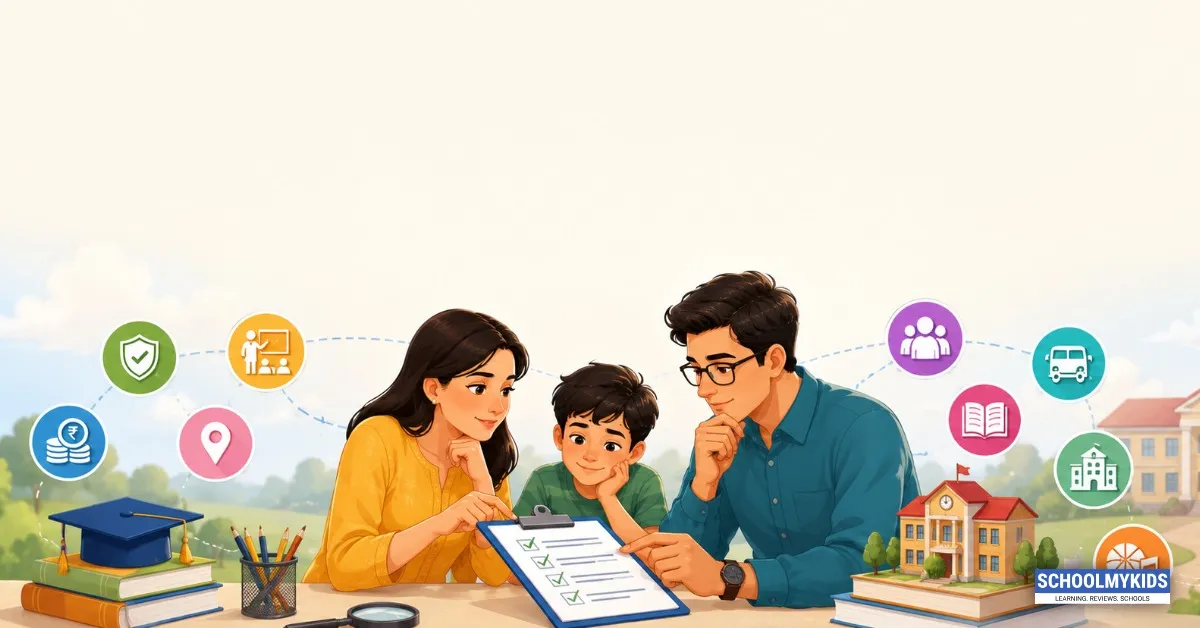
Choosing a school for your child is one of the major decisions a parent will ever make. You could be in the early stages of your research and already checking websites and comparing school fees. You might already have a shortlist of 3 to 4 schools you want to visit.
But what makes a school right for your child?
Let’s say you come across a school that is within a few kilometres of your home and has air-conditioned classrooms, a swimming pool, and a nice website. You think this school is the best and are about to fill out the application. You then find out that the school bus takes 1 hour to get to your house, the fees are more than you expected, and your child will be in a class with little individual attention from teachers.
Would you send your child there?
You’ve got to do some research before visiting a school. A school may put on a good show during its admission tour, but you have to look behind the curtains. Beyond the buildings, advertisements and promises.
This is a checklist of 12 things you should look for before setting up a visit to a school.
How to Choose a School for Your Child: 12 Things to Check Before You Visit
1. Check the School's Recognition and Affiliation
Check if the school has recognition and affiliation from the board it claims to be under.
For example, if you are looking for a CBSE school, you can always visit the official CBSE SARAS portal (saras.cbse.gov.in) and search for the school by name or affiliation number. Once there, you can check if the school has proper affiliation and what level (Secondary or Senior Secondary) it is affiliated to. Remember, a school that is only up to Class 10 may not have the affiliation required to offer Classes 11 and 12, let alone the same quality and continuity as a school that is affiliated up to Class 12.
In case you are considering a state board school or CISCE, you can always check its recognition and affiliation through the respective official websites.
The internet is filled with official websites of various boards, and you can easily check if the school you are considering is recognised by the concerned board or not.
2. Understand Which Curriculum and Board Will Suit Your Child
Each board has its own curriculum, method of evaluation and style of learning. You need to choose according to the needs of your child and your family situation.
For example, consider how easily your child will be able to continue their schooling should the family have to move due to your job. If you believe you will not have to relocate, look into state board schools as well.
Consider the type of academic career you want for your child. Is your child interested in appearing for various competitive exams? If yes, then take into account how the school helps students in relevant subject areas without putting undue pressure on them.
Do not make a decision about the board just because your neighbours and relatives feel it is the best. First, determine its teaching and assessment approach.
3. Find Out the Actual Cost of Schooling
The admission fee is just the starting point, and there can be a myriad of hidden costs later. For example, the school can levy separate charges for transport, books, uniforms, activities, annual events, and other school facilities. Before visiting the school, check its fee structure on its website. The CBSE Board has made it mandatory for schools to disclose their fee structure under the Mandatory Public Disclosure requirements (Appendix IX of the Affiliation Bye-Laws).
Make a list of the following fees:
Admission and registration fees
Monthly and quarterly tuition fees
Annual charges
Transport fees
Books, notebooks and uniforms
Activities, sports and examination fees
Ask whether fees are revised every year and whether any charges are compulsory or voluntary. Also, find out about the refund policy.
A school that is within your means for the first year should be within your means for the following years too.
4. Check Distance and Daily Travel Time
Just because a school is 8 km away does not mean it is a 15-minute drive.
What is the traffic like during school hours?
In Delhi-NCR, a short distance can turn into a really long journey during peak hours.
You need to look into bus routes and the estimated travel time from your house to the school. Try to check the route during school hours to get a realistic travel time.
When looking into school safety, you also need to look into logistics. How will your child get to extra classes, sports practice and after-school activities?
A long daily commute can leave your child drained and tired before they even reach home. Don’t choose a school based on distance alone.
5. Look Beyond the School's Safety Promises
Do not rely only on safety promises made by the school.
If the school is affiliated with CBSE, it must meet the board’s prescribed safety and other requirements.
Also, find out how the school:
Manages the entry and exit of students.
Identifies and manages visitors.
Manages CCTV in appropriate common areas.
Ensures safety on school buses and supervises children.
Provides emergency medical assistance.
Handles complaints of bullying and harassment and issues related to child protection.
The National Commission for Protection of Child Rights (NCPCR) has issued guidelines on school safety and security. The Guidelines on School Safety and Security and the updated Manual on Safety and Security of Children in Schools are available to the public on the NCPCR website, including parents.
You have the right to know whom you can contact in case your child reports bullying. Do not accept a general assurance about a zero-tolerance policy. Enquire about the mechanism in place for handling complaints.
6. Find Out About the Teachers
Check the qualifications and experience of the teaching staff. Know about the professional development programmes that are in place for teachers. Find out if the school has adequate teachers for its student strength.
Think about your child in a class of 40 or more students (CBSE’s standard section strength is 40, with limited exceptions up to 45 under documented special circumstances). Your child needs help in Mathematics but is too shy to put up their hand and ask questions. Will the teacher be able to identify the problem and assist?
You can find details about the teachers in the school’s mandatory public disclosure on its website.
7. Find Out How Many Students Are in Each Classroom
The number of students in a classroom can impact how much individual attention your child receives.
For example, your child may need more time to understand a lesson than other students. In a larger class, the teacher may not be able to identify this need.
Ask what the average class size is, especially for the lower classes. Also, find out if the school has additional teachers or support staff if required.
In general, a smaller class does not mean better teaching. What matters is whether the teacher is able to engage and communicate with the students enough to understand their needs and help them progress.
8. Understand How Children Are Taught and Assessed
Would you rather your child spend the school day memorising answers, or would you rather they be taught to ask questions and learn through discussion and other activities?
Find out what the school’s general attitude towards teaching is. Is teaching limited to the teacher demonstrating and students memorising? Is there enough opportunity for students to be involved in other activities? For younger children, is there enough opportunity for learning through play, art, and stories?
Is there enough opportunity for teaching students through practice, discussion, and projects?
Also, find out how the school assesses students. Does it communicate learning difficulties to parents? Are there enough activities for parents to understand their child’s learning? Does the school take enough measures to help students progress?
9. Check Whether the School Supports Children With Different Learning Needs
Not every child learns in the same manner. Some children take more time to learn a particular concept, while others need extra support academically and emotionally.
Check if the school employs a special educator, counsellor or support staff. Is the school equipped to help children with special needs and learning disabilities?
Will the school talk about what sort of classroom support your child needs if they have issues with reading and/or concentration? Is there a process to communicate with parents? Is there a review meeting scheduled to discuss the child’s progress?
Do not get deceived by schools that claim to be inclusive just because they have an ‘inclusive’ heading on their website. Check for concrete examples of support.
10. Check the Facilities Your Child Will Actually Use
Pictures of a school swimming pool, basketball court and a fully equipped science and computer room may give the impression that a school has ample facilities for students to use.
There may be a large school playground, but younger children may not get enough time to use it. A fully equipped science laboratory is useful only if students perform practical classes.
Check if the school has:
A library with books children can actually read.
Clean toilets and safe drinking water.
A playground and indoor space for other activities.
Functioning science and computer labs.
Facilities for children with disabilities.
Medical and first-aid facilities.
Do not get carried away by how many facilities the school has. Check if they are functional and whether your child will use them.
11. Understand How the School Communicates With Parents
What methods of communication does the school use? Are parent-teacher meetings (meetings to discuss a child’s progress) held regularly? Does the school inform parents about key activities? How do teachers reach out to parents if a child is having academic or behavioural problems?
Find out how the school accepts, handles and acknowledges complaints. Is there a formal process, or do parents have to repeatedly reach out to different staff members to get answers?
Does the school communicate information to parents that is not related to school fees and their child’s examination results?
12. Understand the School Environment and Culture
Will your child be emotionally comfortable in the school? Think about the school’s environment and culture before reaching a final decision.
Some schools have more of a cut-throat competitive environment, while some give more attention to collaborative activities, sports, and arts. Neither automatically makes a school good or bad. The main thing you should consider is whether the environment is suitable for your child.
Does your child need more of a structured environment? Or do they prefer a less structured one?
Also, consider how the school handles discipline. Does it reward and recognise respectful behaviour? Or does it rely on punishment and/or fear to discipline?
The main thing is that your child has to feel secure enough to learn and make friends. They should be able to ask questions and approach their teachers. A child’s experience at school should be valued as much as their academic performance. A school’s environment can promote a happy and secure child. You want your child to gain as much experience and knowledge.
Before You Visit the School: One Last Thing to Remember
After checking the above-mentioned 12 things, finalise 2 or 3 schools that you will be visiting. You do not have to visit every school in your area.
Make a list of the things you want to ask during your visit. Observe how the teachers and students interact in the classrooms. Speak to the admission team, and if you get the chance, speak to parents whose children study at that school.
Do not get worried if the school tells you that it has only a few seats left and that you have to make a decision right away. You are not choosing a school based on its name, building or popularity. The school should be a place where your child feels happy, comfortable and safe.
A school that suits your child’s needs is a good choice. A school that looks impressive is not necessarily the right choice.
Frequently Asked Questions
1. How do I choose the right school for my child?
Take into account your child’s age. What are your child’s learning requirements and interests? What is your child’s daily routine? Check the school’s recognition, curriculum, teachers’ training and qualifications, safety and care arrangements, class size, student-teacher ratio, fees and distance from your residence. Visit at least two to three schools before making a decision.
2. What should parents check before visiting a school?
Check the school’s recognition or affiliation, location, cost, transport facilities, infrastructure and other available information about teachers. Make a list of questions regarding safety, classrooms, teaching and learning, and teacher communication with parents. Take this list along with you on your visit.
3. Which school board is best for children in India?
Each child is unique, and there is no single best board for all children. The board should meet the child’s learning requirements and the family’s needs. For instance, your child may be planning to study abroad. In that case, you may opt for a board that is aligned with the learning requirements and assessment methods of the country where your child plans to study. Also, consider your family’s location and the teaching and learning approach that you prefer.
4. How can I check whether a school is CBSE-affiliated?
Refer to the CBSE SARAS website and check if the school’s affiliation is valid and covers the class your child will be studying in. Do not assume that a school is CBSE-affiliated based only on its claim that it follows the CBSE pattern.
5. How far should a school be from home?
There are several factors to consider when determining how far away your child’s school should be from your house. One, of course, is how long it takes to get there. Check the route your child will take and see how long the journey takes during school hours. Also, consider the traffic, bus routes and the time your child will spend travelling each day.
6. What questions should I ask during a school visit?
Many factors contribute to a quality school, such as teacher qualifications, the average class size, the school’s safety procedures, how the school fee is determined, how transportation is handled, the methods of student assessment, how the school supports students who need additional assistance, and the school’s policy on parent-teacher communication. You should also ask to see the school’s library, classrooms, playground, toilets and other facilities.
7. How important is class size when choosing a school?
The individual attention a student receives can vary depending on the school and its class size. If a student needs additional help, it is important to find out the average class size, how teachers or the school address the needs of students who require additional help, and what other factors can affect the attention each student receives. A smaller class size alone does not guarantee individual attention.
8. Should I choose a school based on its facilities?
While good facilities are nice to have, a school should not be chosen based on its facilities alone. Find out if students use the school’s library, labs and sports facilities. Also check if the school’s toilets are clean and adequate and if clean drinking water is available in sufficient quantity.
References
CBSE SARAS portal: saras.cbse.gov.in
CBSE Mandatory Public Disclosure / Appendix IX
NCPCR Guidelines on School Safety and Security and Manual on Safety and Security of Children in Schools at ncpcr.gov.in
CBSE Affiliation Bye-Laws 2018 with 2025 amendments on CCTV and section strength