Your friend Rahul studied commerce in college. Now he’s working at an AI startup. His job title is “AI Training Specialist.” He trains language models. Makes good money.
Your cousin studied physics. Now she’s an ML researcher at a tech company. Her degree has nothing to do with what she does.
Your neighbor’s daughter studied statistics. Got hired by a company building recommendation algorithms. No Computer Science degree.
You’re wondering: so do I actually need a Computer Science degree to work in AI?
The short answer: no.
The longer answer: it depends on which AI job you want.
This matters because many students think they’re locked out of AI careers because they didn’t study Computer Science. They’re not. There are actual paths that don’t require that degree.
What AI Jobs Actually Exist
First, understand that “AI job” is broad. It covers many different roles.
Some people write code that trains AI models. That’s a coding job that happens to be in AI. Some people teach AI systems by providing good data. That’s a data annotation job. Some people test AI systems to find problems. That’s quality assurance.
Some roles require deep coding knowledge. Others don’t need any coding at all.
Let’s break down what’s actually hiring right now in India and globally (as of late 2026).
Roles That Need Heavy Coding:
Machine Learning Engineer: This person writes code that builds and trains models. Develops algorithms. Optimizes systems. This role usually wants people with a strong programming background. Doesn’t have to be a Computer Science degree. But needs coding skills.
AI Research Scientist: This person explores new methods. Publishes papers. Works on cutting-edge problems. Usually wants an advanced degree (Masters or PhD). But not necessarily in Computer Science. Can be in math, physics, statistics.
Roles That Need Some Coding:
Data Engineer: Works with large datasets. Builds pipelines. Cleans data. Prepares it for models. Needs programming knowledge. But not necessarily deep Computer Science theory.
AI Product Manager: Works between engineers and customers. Understands what AI can do. Decides what to build. Minimal coding needed. Needs problem-solving and communication skills.
Roles That Need No Coding:
Data Annotator: Teaches AI systems by labeling data. “This is a cat.” “This is a dog.” No coding required. High school education is often enough.
AI Training Specialist: Works with language models. Tests responses. Provides feedback. Guides the AI toward better answers. No coding needed.
Content Creator for AI: Generates training data. Writes scenarios. Tests edge cases. Needs creativity, not coding.
Quality Assurance For AI Systems: Tests AI. Finds bugs. Documents problems. Requires analytical thinking, not coding.
There are dozens of jobs. Not all require a Computer Science degree. Not all require coding.
What Companies Actually Want From You - More Important Than Degree
This is what matters more than your degree:
You Can Do The Job:
This is the only thing that really matters. Can you actually do the work? That’s it.
A company doesn’t care if you studied Computer Science or commerce or arts. They care if you can deliver results.
If you’re applying for a data annotation job, they care that you can accurately label images. Not what your degree is.
If you’re applying for an ML engineer role, they care that you can write code that works. Not where you studied.
You Have Relevant Experience:
This beats a degree almost every time.
If you’ve built three machine learning projects on your own, that’s more valuable than a Computer Science degree with no projects.
If you’ve worked with large datasets before, that’s more relevant than a degree that’s never touched real data.
You Know The Right Skills:
For ML jobs: Python, TensorFlow, PyTorch, SQL, statistics.
For data jobs: SQL, Python, data visualization, big data tools.
For non-technical AI jobs: communication, problem-solving, domain knowledge.
You can learn these skills without a degree. Online courses. Self-study. Projects.
You Can Demonstrate Your Knowledge:
Build a portfolio. Put projects on GitHub. Write about what you learned. This proves you have skills.
Companies trust what they can verify. Your portfolio proves skills. Your degree just proves you attended college.
The Actual Paths People Take: Career Examples
Path 1: Self-Taught Coder To ML Engineer
Arjun studied commerce. Hated it. Taught himself Python through online courses. Built 5 projects. Put them on GitHub. Applied to jobs. Now works as a junior ML engineer at a startup. Makes in the ₹12-20 lakh range, depending on the company and city.
His Computer Science degree? Nonexistent. His skills? Excellent.
Path 2: Statistics Background To Data Scientist
Priya studied statistics in college. Learned Python afterward. Worked as a data analyst first. Now works as a data scientist at a large company. Her background in statistics was actually more useful than Computer Science would have been.
Her path: degree in statistics + self-taught coding + work experience. No Computer Science needed.
Path 3: Physics To AI Researcher
Vikram has a degree in physics. Did his Masters in physics too. Now researches neural networks at a research institute. His physics background actually helps because he understands the mathematical foundations of AI.
Path 4: No Degree At All
Shreya didn’t finish college. Took an online bootcamp in data science. Got certified. Applied to companies. Now works as a data analyst. Makes decent money. No degree at all.
These are typical paths people actually take. They exist. Many follow them.
What The Job Market Actually Looks Like
According to recent hiring data in India and globally (2025-2026):
Companies are hiring for AI roles aggressively. Demand is outpacing supply of qualified people in many specialisations. This is making employers more flexible about formal qualifications.
PwC’s Global AI Jobs Barometer (analysing nearly one billion job postings) found degree requirements for AI-related roles have fallen from 66% in 2019 to 59% for AI-augmented roles, and from 53% to 44% for AI-automated roles by 2024. In the US the drop for AI-automated jobs was even steeper (56% to 41%).
In India, NASSCOM and Indeed-linked reports plus TeamLease Digital’s FY2026-27 primer show strong demand growth and talent gaps of 53% or more in GenAI. Many postings now accept “Computer Science degree or equivalent experience.” The “or equivalent” wording appears regularly.
Startup companies rarely insist on a specific degree. They care about what you can build and ship.
Large tech companies (Google, Microsoft, Meta and similar) still lean more traditional and often prefer degrees, especially for core engineering roles. A strong portfolio can still open doors.
Entry-level AI jobs (data annotation, AI training / RLHF-style roles, quality assurance) are the most open to non-Computer Science graduates. These fields prioritise accuracy, domain knowledge and communication over formal Computer Science credentials.
Mid-level and senior technical roles still weight Computer Science or related quantitative backgrounds more heavily, but proven production experience regularly compensates.
Research scientist roles continue to prefer advanced degrees (Masters or PhD). The field does not have to be Computer Science. Physics, mathematics and statistics degrees are routinely accepted.
What You Should Do Right Now: If You Don’t Have a Computer Science Degree
Figure Out Which Role You Want:
Don’t just say “AI job.” Be specific. Data engineer? ML engineer? Data scientist? Something else?
Different roles need different skills. Figure this out first.
Learn The Relevant Skills:
For coding roles: learn Python. Learn necessary frameworks (TensorFlow, PyTorch, scikit-learn).
For data roles: learn SQL, statistics, data visualization.
For non-technical roles: develop communication and analytical skills.
Online platforms like Coursera, edX, Udacity have good courses. Some are free. Some cost money.
Build A Portfolio:
Don’t just complete courses. Build actual projects.
If you’re learning ML, build a project from start to finish. Train a model. Evaluate it. Put it on GitHub.
If you’re learning data engineering, build a data pipeline. Process real data.
Show your work. Portfolio matters more than a degree.
Get Some Experience:
Internship if possible. Even an unpaid internship for your first role is okay.
Freelance projects. Small startup jobs. Consulting. Any real work that looks good on your resume.
Network:
Go to meetups. Join online communities. Talk to people in the AI field.
People matter. Your network often leads to jobs.
A degree doesn’t give you a network. But meeting people in the field does.
Realistic Timeline: If You Start From Zero
Most people who successfully switch without a Computer Science degree take 6–12 months.
Months 1–3: Learn the core skills for your chosen role (Python + basic ML for technical roles, or domain + AI tools for non-coding roles).
Months 4–6: Build 3–4 solid portfolio projects and put them on GitHub.
Months 7–9: Start applying, do freelance or unpaid projects, network.
Months 10–12: Land the first role (often data annotation, AI trainer, junior data analyst or junior ML role at a startup).
People who already know Python or statistics usually move faster (4–8 months). People starting completely fresh usually need the full year.
Why Companies Started Relaxing Degree Requirements
Few years ago, Computer Science was scarce. Not everyone could study it. So if you had a Computer Science degree, you were valuable.
Now? Computer Science degree holders are everywhere. Every engineering college offers it. Supply increased massively.
Meanwhile, demand for AI roles exploded. Supply of people with the exact production skills needed has not kept pace. Companies realised they need to train people and accept non-traditional backgrounds.
Also, AI is a new field. Most people with AI skills are self-taught anyway. They didn’t learn AI in traditional college. They learned it through online courses and projects.
So companies realised: a degree doesn’t guarantee AI skills. A self-taught portfolio might actually be a better indicator.
This is why they started accepting “equivalent experience” instead of just a degree.
Why Your Degree Still Matters Somewhat
Even though a degree doesn’t determine everything, it still helps.
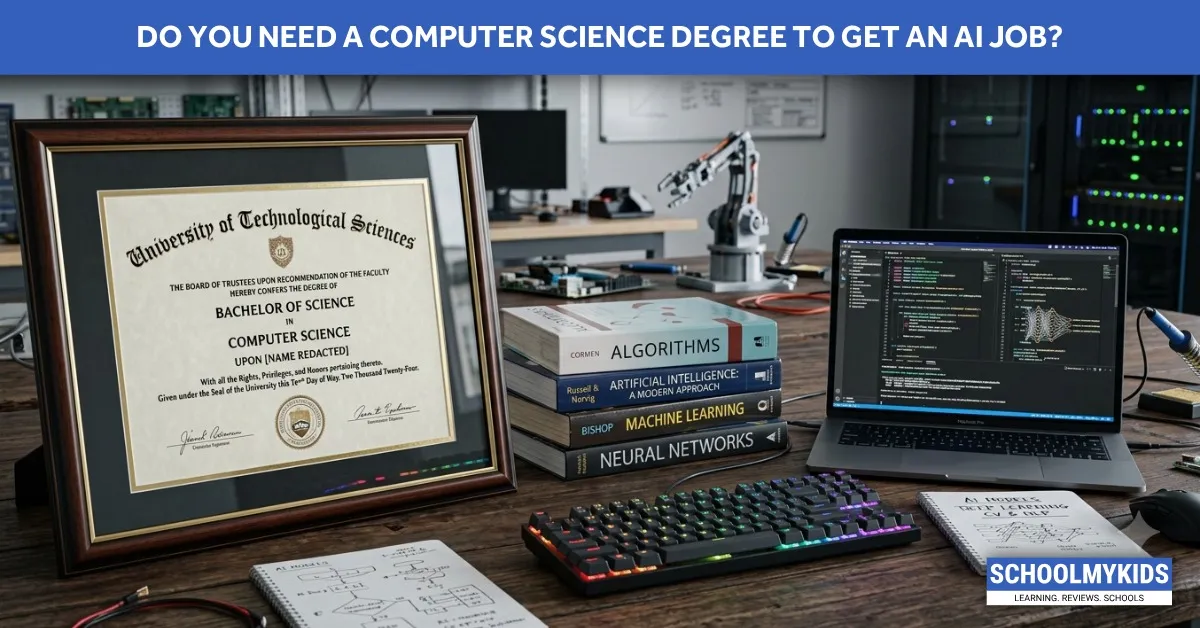
Computer Science degree gives you a foundation. Theory. Best practices. Formal education in algorithms and data structures.
You can learn all this yourself too. But it takes time. A degree accelerates learning.
Computer Science degree also looks good on a resume. It’s a recognized credential. Some companies still weigh it heavily.
So a degree is helpful. But not required. Not the only path.
Think of it this way: A Computer Science degree is one path. It’s easier. Everything is structured. You get a credential.
But the self-taught path is also viable. Harder. Less structured. But you save money and time.
Both paths work. Pick based on your situation.
Key Takeaways
Many AI jobs don’t require a Computer Science degree
Skills matter more than degree
Portfolio beats degree every time
Companies increasingly flexible about qualifications
Entry-level AI jobs most open to non-Computer Science people
You can learn necessary skills online
Real experience more valuable than classroom education
Network and community matter
FAQs
Q1: I studied commerce/arts/science. Can I still get an AI job?
Yes. Absolutely. Your degree doesn’t prevent you. What matters is that you develop relevant skills. Learn coding or statistics or whatever the role needs. Build projects. Get experience. Your degree will become less relevant as you build experience. By the time you’ve worked 3-5 years, your degree barely matters. Your experience matters.
Q2: Is a bootcamp good enough instead of a degree?
It depends on the bootcamp. A good bootcamp teaches practical skills employers want. You build projects. Get experience. You network with other people. That’s valuable.
But a bootcamp takes 3-6 months. College takes 4 years. Bootcamp is faster. College is deeper. For getting your first AI job, a bootcamp might be a faster path. For long-term career, degree might be better if you want to keep options open.
Q3: Should I pursue a CS degree if I really want to work in AI?
If you’re already in college and haven’t decided on a major, Computer Science is a good choice. It gives you a foundation and a recognized credential. But if you’re outside college, you don’t need a degree to get your first job. Learn skills, build a portfolio, get hired. You can always do a degree later if you want.
Q4: What’s the salary difference between degree and non-degree in AI jobs?
Early career, salary is usually similar if you have the same skills and experience. Over 5-10 years, degree holders might have a slight advantage in some companies. But someone with a strong portfolio and experience often earns more than a fresh Computer Science graduate. At senior levels, what you’ve accomplished matters more than the degree you have.







Be the first one to comment on this story.