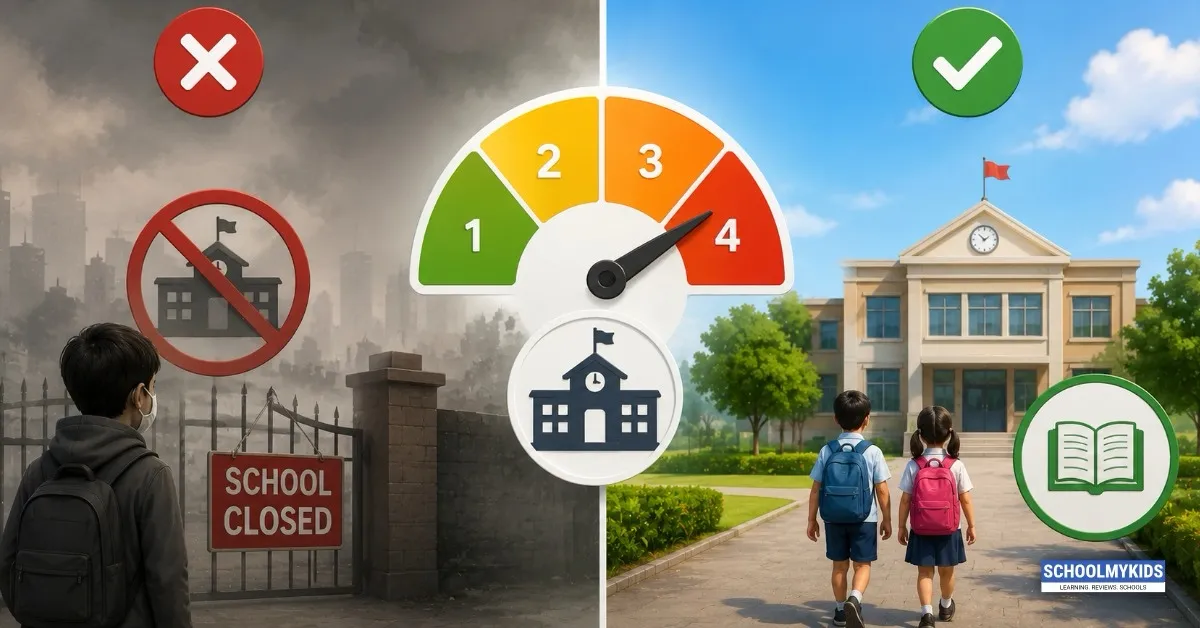
AQI 600 par bhi school khula kyun hai?
Every winter, a parent in Delhi-NCR asks this question, on a WhatsApp group, to a principal, or just to the sky while holding a child's hand outside a school gate at 7:45 AM.
The air is toxic. The numbers are terrifying. So why is the gate still open?
The answer has little to do with air and everything to do with rules. GRAP, the Graded Response Action Plan, is not a single switch that shuts schools when the air turns bad. It is a staged playbook with its own triggers, its own authorities, and its own school-level actions that only kick in at the upper stages. Most parents have never seen the actual schedule. They see the AQI number on a phone screen and assume the school should be closed. The reality is messier, more local, and different from state to state.
What GRAP Actually Is (And What It Is Not)
GRAP stands for Graded Response Action Plan. It is a pollution-control framework run by the Commission for Air Quality Management (CAQM) for Delhi and the surrounding NCR districts. It was born out of Supreme Court directions, first notified in 2017, and revised multiple times since. The revised schedule for the 2026-27 winter season was notified on 29 September 2026.
As air quality worsens, restrictions tighten in steps. Each stage is cumulative, meaning the rules from lower stages stay in force when a higher stage is invoked.
What GRAP is not is an automatic school-closure machine. It is a menu of possible actions. Schools are only one item on that menu. And even when schools appear on the menu, the order still has to come from a specific authority. GRAP sets out what can be done. It does not command on its own.
The Four GRAP Stages: What They Mean for Schools
The AQI thresholds and the broad school actions look like this. Keep the table. Stick it on the fridge if needed.
GRAP Stage | AQI Range | What Happens to Schools | Who Decides |
|---|---|---|---|
Stage I | 201–300 (Poor) | Normal school. Outdoor activity may be limited. No closure. | No special school order needed. |
Stage II | 301–400 (Very Poor) | Normal school continues. Outdoor activity limits may tighten. No mandatory closure or hybrid shift. | No school-closure order is mandated. |
Stage III | 401–450 (Severe) | Classes up to Class 5 move to hybrid mode in Delhi-NCR. Older classes usually continue in person unless a specific order says otherwise. | Delhi Directorate of Education, or the district magistrate in NCR districts. |
Stage IV | Above 450 (Severe Plus) | Wider discretion. Hybrid mode can be extended to Classes 6–9 and 11. Classes 10 and 12 usually continue in person, with priority given to board-year students. | Same authorities (DoE or district administration), with wider power to suspend or shift in-person classes. |
The exact classes covered can change with each notification. Always check the latest CAQM order and your school’s official communication, because the moment a new GRAP order drops, the class coverage can shift.
Myth vs Fact: What Parents Get Wrong
Myth 1: “AQI 600 means schools must close.”
Fact: No rule says AQI 600 triggers an automatic closure. GRAP Stage IV is invoked above 450, but even at Stage IV, the order must come from the education department or the district administration. Without that order, the school stays open. The AQI number is a trigger for the possibility of action, not the action itself.
Myth 2: “GRAP applies to all of India.”
Fact: GRAP is a Delhi-NCR-specific framework. It covers Delhi and specific NCR districts in Haryana, Uttar Pradesh, and Rajasthan. Mumbai does not follow GRAP. Mumbai has its own civic air-quality framework and relies on BMC orders. A viral WhatsApp forward about “GRAP-4 in Mumbai” is almost always fake.
Myth 3: “A school WhatsApp forward is enough to keep my child home.”
Fact: A forward without a memo number, a date, and a signing authority is not an order. Real closure orders appear on official websites and are usually circulated by the school through its official ERP, email, or SMS channel. So, ignore WhatsApp forwards lacking an official PDF, memo number, date, and signing authority.
Myth 4: “Online classes are always safer than physical school.”
Fact: The Supreme Court has expressed strong reservations about blanket school closures and forced online shifts. In early November 2026, a bench led by Chief Justice Surya Kant noted that physical classrooms offer better quality education and that online learning risks deepening the digital divide. The court said it would prefer to follow expert recommendations under the GRAP framework rather than anecdotal claims or parental anxiety alone.
Beyond Delhi: How Other States Handle Bad-Air School Days
Parents outside Delhi often search for the same answers. The rules are different, and local authorities matter more than any central framework.
State or City | Framework | What Usually Happens to Schools | Who Orders Closures |
|---|---|---|---|
Delhi | GRAP (CAQM) | Hybrid for Classes up to 5 at Stage III. Wider discretion at Stage IV. Classes 10 and 12 often stay in person. | Directorate of Education (DoE). |
Noida, Greater Noida (UP) | GRAP applies as part of NCR. | Schools often shift timings (e.g., 10 AM to 3 PM) rather than full closure. Hybrid mode possible at Stage III and above. | District Magistrate of Gautam Buddha Nagar. |
Gurugram, Faridabad (Haryana) | GRAP applies as part of NCR. | Hybrid for Classes up to 5 at Stage III. Deputy Commissioner can order targeted closures. | Deputy Commissioner. |
Haryana (statewide) | State pollution response, not GRAP alone. | Deputy Commissioners are authorised to temporarily suspend physical classes up to Class 5 when pollution spikes. | Deputy Commissioners. |
Mumbai | BMC’s own graded civic air-quality framework and Winter Action Plan 2026, not Delhi’s GRAP. | No automatic closure under Delhi’s rules. BMC can issue specific orders if AQI or weather demands it. Verification through @mybmc and helpline 1916. | BMC. |
Punjab | State winter and smog response, not GRAP. | Timing changes are the main tool. Schools shifted to a 9 AM start from 2 November 2026 under the winter schedule (primary till 3 PM, middle and senior secondary till about 3:20 PM). Full closures remain rarer and district-specific. | School Education Department or district authorities. |
Outside Delhi-NCR, GRAP does not rule. Local civic bodies and district administrations do. A parent in Mumbai cannot apply a Delhi rule to a Mumbai school. A parent in Noida cannot assume a Delhi DoE circular applies to a Noida school. The authority changes with the PIN code.
How to Verify a Closure Order Without Panicking
Most of the confusion comes from bad information, not bad air. So, this is a quick verification chain that works across states.
Step 1: Check CAQM’s “What’s New” and GRAP orders page for Delhi-NCR. If a stage is active, the order will be there.
Step 2: Check the Delhi Directorate of Education circulars for Delhi schools. For Noida and Gurugram, check the district magistrate’s office or the district administration’s verified social handles.
Step 3: Check the school’s official ERP, email, or SMS. Schools usually send a direct message when the mode changes.
Step 4: Ignore the forward. If a WhatsApp message has no PDF, no memo number, and no signature, it is not an order. Treat it as noise.
Mumbai parents have a shorter chain. Check @mybmc, call 1916, or look for a dated Government Resolution. No dated order on a verified channel means no closure.
What Parents Can Control (Even When Schools Stay Open)
Parents cannot change the AQI. They can change what happens around the school day.
A well-fitted N95 or KN95 mask filters PM2.5. Cloth masks and handkerchiefs do not, no matter how many layers are stitched in. Outdoor play and high-exertion sports should move indoors when local AQI readings climb. Air purifiers in bedrooms and study spaces help, but only if the windows stay shut during peak pollution hours and the filters are cleaned on schedule.
Children with asthma or other respiratory conditions need a care plan that the school knows about. A quick note to the class teacher about triggers and medication takes two minutes and can prevent a bad morning.
FAQs Parents Actually Type
Does GRAP Stage 4 automatically close schools in Delhi?
No. Stage IV gives authorities wider power to suspend in-person classes, but a specific order from the Directorate of Education or the district administration is still required. The stage alone does not close a school.
Is AQI 500 a school holiday in Delhi?
Not automatically. The AQI number is a trigger for GRAP stages, but school actions depend on the stage invoked and the order issued. A school can remain open at AQI 500 if no closure order has been passed.
Do GRAP rules apply to Noida and Gurugram schools?
GRAP applies to Delhi and specific NCR districts, including Noida, Greater Noida, Gurugram, Faridabad, and Ghaziabad. But the order to change school mode or close classes comes from the local district magistrate, not from CAQM directly.
Does Mumbai follow GRAP for school closures?
No. Mumbai does not follow Delhi’s GRAP. It has its own civic air-quality framework. School closures in Mumbai require a BMC order or a specific civic directive.
My child’s school is open but the AQI is 450. Can I keep my child home?
That is a family decision, not a legal violation. Schools often allow absence with a written note, especially for younger children or those with respiratory conditions. Check the school’s absence policy and inform the class teacher in writing so attendance records remain clear.
Conclusion
The GRAP school closure rules Delhi follows are not designed to shut schools at the first sign of bad air. They are designed to keep the city running while protecting the most vulnerable groups, and schools are only one part of that plan.
A closed school gate is not the only way to protect a child. A well-fitted mask, an indoor play plan, a clean-air corner at home, and a clear line of communication with the school do more on most bad-air days than a shutdown order that may never come. The rules are public and the authority is local. Most of the panic is optional.
Last updated: 7 November 2026. GRAP stages change frequently. Always check the latest CAQM order and your school’s official communication before acting on any WhatsApp forward.
References
CAQM Direction No. 104 (revised GRAP Schedule for NCR), 29 September 2026, available on caqm.nic.in.
Delhi Directorate of Education circulars issued after CAQM Stage III invocation on 6 November 2026.
Supreme Court observations from the hearing held in early November 2026.
Punjab School Education Department winter timings notification, effective 2 November 2026.
BMC Winter Air Pollution Mitigation and Enforcement Action Plan 2026.