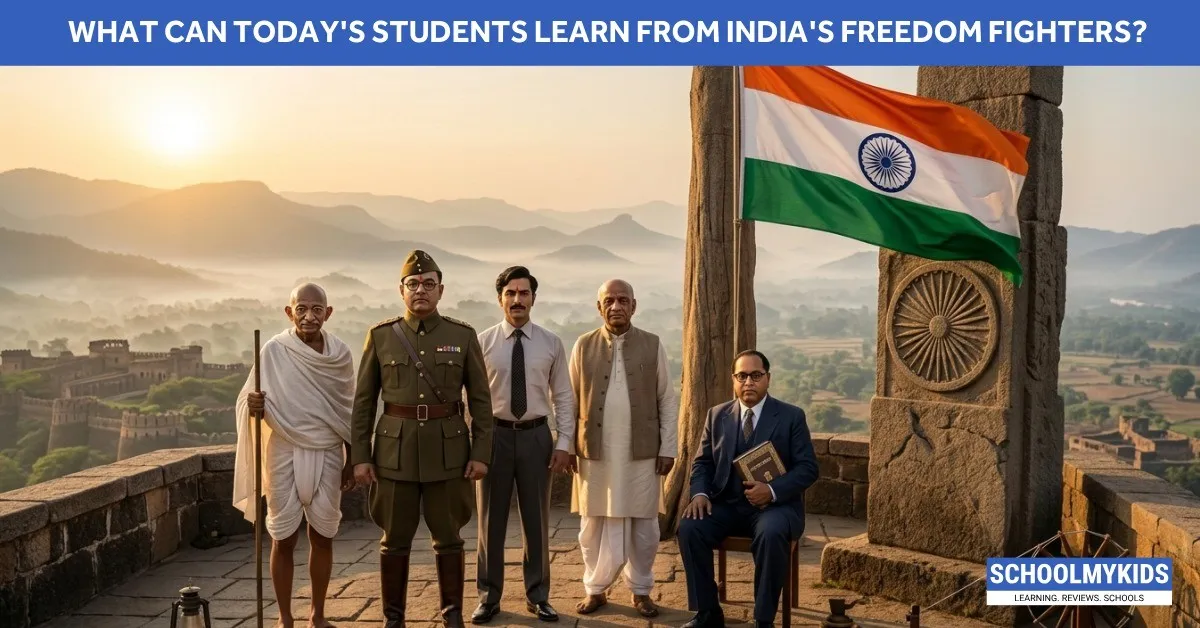
Independence Day is coming. When you think of independence, what comes to mind? Protests probably. Speeches. Marches. Most students learn about it that way in textbooks, which is fine, except it misses the point. India's freedom fighters weren't just historical names. They were people. Young people, many of them your age, who faced impossible situations and decided to do something about them anyway. That matters more than you'd think.
We're not studying this to romanticize the past or make history seem cool. We're looking at it because the problems they solved are problems you're solving right now too.
Pressure.
Figuring out what you believe in.
Standing up when it's uncomfortable.
Knowing when to push forward versus when to change direction.
These sound different from independence movements, but they're kind of the same underlying problem.
So what were the qualities that made these people different? We've narrowed it down to ten things. Not because these are the only ten that matter, but because these ten will change how you approach your life as a student, your relationships, and how you handle failure.
1. Courage Isn't About Not Being Afraid
People think brave people don't feel fear. They do. Gandhi felt it. Bhagat Singh felt it. Sardar Patel felt it. What happened was they decided that fear didn't matter more than what they were doing.
For you, that looks completely different. You're not planning independence movements. You're nervous about presenting in class. You want to stand by a friend, and it's uncomfortable. You're thinking about trying something where you might fail.
That nervousness? It's not telling you to stop. It's just there. The skill is doing the thing anyway.
In terms you can use:
Speaking up in class when you disagree with something
Trying out for sports or clubs when you might not make the cut
Choosing the harder class even though your GPA would be safer with the easier one
Standing by someone when your other friends think it's weird
2. Discipline Is Actually More Useful Than Motivation
Most people think motivation comes first and then you do the thing. That's backwards. Motivation is a feeling. It shows up sometimes and disappears other times. You can't build anything on something that unreliable.
Discipline is different. It's deciding something matters and then doing it whether you feel like it or not.
You need to understand this early because school loves making you think motivation is the problem. You're not motivated enough. You need to find your passion. Meanwhile, you're just sitting there trying to start studying, and it feels impossible.
The fix is building routines that don't require motivation.
What this means:
Study happens at the same time, in the same place, every single day
You don't negotiate with yourself about it
Projects get broken into actual daily work instead of panicked all-nighters
When you commit to something, you finish it even when interest drops
3. You Have to Actually Read and Think About Things
Freedom fighters didn't just take action. A lot of them read constantly. Swami Vivekananda read everything. He educated himself across multiple disciplines and traditions. Raja Ram Mohan Roy learned languages so he could access texts directly. These weren't people who took things at face value.
Information is everywhere for you. That makes things harder, not easier. You can find an answer to anything in thirty seconds. That doesn't mean you understand anything.
Reading deeply, following ideas through multiple sources, and understanding why something works or doesn't work instead of just accepting it is a different skill. One that takes time.
Doing this:
Pick books that aren't assigned
Learn about topics that have nothing to do with your immediate life
When you see something that interests you, don't just skim it
Read multiple perspectives on the same issue instead of one opinion
4. Patience Doesn't Mean Doing Nothing
The independence movement didn't happen fast. It took decades. People showed up, things happened, things got shut down, they regrouped, tried again. People who expected it to be quick gave up. The ones who saw results were the ones who stayed committed even when progress felt invisible.
This is relevant because you're living in a time where everything happens immediately or feels like it failed. You post something, and it either gets likes or it doesn't. You try hard in school and get a grade back pretty quickly. You apply for something and find out yes or no.
Many things don't work that way. Learning takes years. Skills take years. Building something that matters takes patience in a way that's hard to describe until you're doing it.
What this looks like:
Working toward something without needing constant proof you're progressing
Building a skill that won't fully develop for years and still showing up
Not jumping to a new goal just because one is taking longer than expected
Trusting that consistent work adds up
5. Changing Your Approach Isn't Giving Up
Freedom fighters tried different strategies. Nonviolent resistance worked sometimes. Underground organizing worked sometimes. Education initiatives worked sometimes. When something stopped working, they changed. They didn't keep doing the same thing just because they'd already started it.
People confuse consistency with stubbornness. There's a difference between quitting because something is hard and stopping because it's not working.
In your life:
A study method that isn't helping? Try something different
An activity that seemed cool but isn't? It's okay to leave
Your first approach to a problem didn't work? Change it without feeling like you failed
Someone gives you feedback that stings? Actually adjust based on it
6. Integrity Is About What You Do When Nobody's Watching
You can act right when everyone's looking. That's easy. The test is what you do alone, when there's no consequence, when you could get away with something.
Freedom fighters maintained their principles in prison, in isolation, when nobody would have known if they broke their own rules. That choice changes who you are as a person in a way that grades and accomplishments never will.
If you plagiarize on an assignment that nobody would catch, that's not just cheating the system. That's choosing to be a person who does that. That distinction matters.
Where this shows:
Being honest on work even when you could get away with something else
Keeping promises to people who can't enforce them
Acting according to your values because you have them, not because you might get caught
The way you behave when nobody is watching at all
7. Most Real Things Happen Because Groups Work Together
The independence movement succeeded because thousands of people worked on it. You know some names. The work was done by people whose names you've never heard. Freedom fighters understood that impact comes from building something collectively, not from being the smartest person doing a solo thing.
They shared knowledge instead of hoarding it. They trained others. They built networks. They didn't need to be the main character in the story.
For you:
Teamwork means lifting people up, not just dividing tasks
Sharing what you know makes you better, not worse
Building genuine connections with people matters more than collecting useful contacts
Being part of something larger than yourself changes how you feel about your work
8. Self-Education Is Something You Have to Do Yourself
Schools didn't teach the freedom fighters what they needed to know. So they found other ways. They sought out mentors. They read things that weren't assigned. They debated with people who disagreed with them. They didn't wait for permission to learn what mattered to them.
Ramakrishna Paramahamsa studied multiple spiritual traditions because he wanted to understand, not because a curriculum required it. Sri Aurobindo developed his ideas through self-directed study because the knowledge he needed was not available in formal institutions of the time.
Your school matters. It also isn't the whole thing. The things you're curious about? You might need to pursue those on your own, outside class, in your own time.
That's not avoiding your responsibilities. That's adding depth to your education.
The practice:
Pursue something you care about with dedication
Find people ahead of you in areas that interest you
Question what you're taught, respectfully
Build expertise in something you've chosen
9. Being Able to Explain Something Clearly Is a Superpower
Gandhi wrote letters that made sense to ordinary people. Vivekananda gave speeches that stayed with people. Sardar Patel could communicate complex political ideas in ways that connected with citizens. None of these were simplifying things so much that they became wrong. They were just explaining things clearly.
This skill beats being the smartest person in the room almost every time. If you can explain what you're thinking, what you understand, what you believe, clearly, in a way people follow, that opens more doors than intelligence does.
Building this:
Explain things to people who know less than you
Write simply without making things incorrect
Tell stories that show what you mean instead of just stating it
Pay attention to how people communicate well
10. You Need to Believe in Something That Isn't Just About You
Freedom fighters weren't just trying to become important people. They believed in something larger than themselves. That belief is what kept them going through difficult times.
You don't need to believe in the same things they did. You need to believe in something, though. An actual cause. A principle. Something that matters to you beyond your own success.
Finding what that is:
What problems upset you when you think about them
What would you do even if nobody would ever know
What do you think about in quiet moments
What would make the world feel more right to you
These qualities still show up in how students handle real pressure today. Exam stress, peer conflict, choosing harder paths over easier ones. The freedom fighters just lived them at a different scale.
Actually Using These Things
These ten qualities don't belong only to freedom fighters. They belong to anyone willing to develop them. Your school years are a good time to start precisely because the stakes feel smaller. You can fail at something, figure out what went wrong, and try again. Nobody's life is on the line.
You're not supposed to choose between doing well in school and learning this stuff. You're learning how to approach your education with these qualities. You're learning how to handle projects, relationships, failure, and uncertainty. That matters more than the grades. The grades come and go. How you are as a person when things are difficult stays with you.
The freedom fighters learned all this through struggle. You don't have to. You can learn it through deliberately paying attention and practicing. Start right now with whatever's in front of you.







Be the first one to comment on this story.