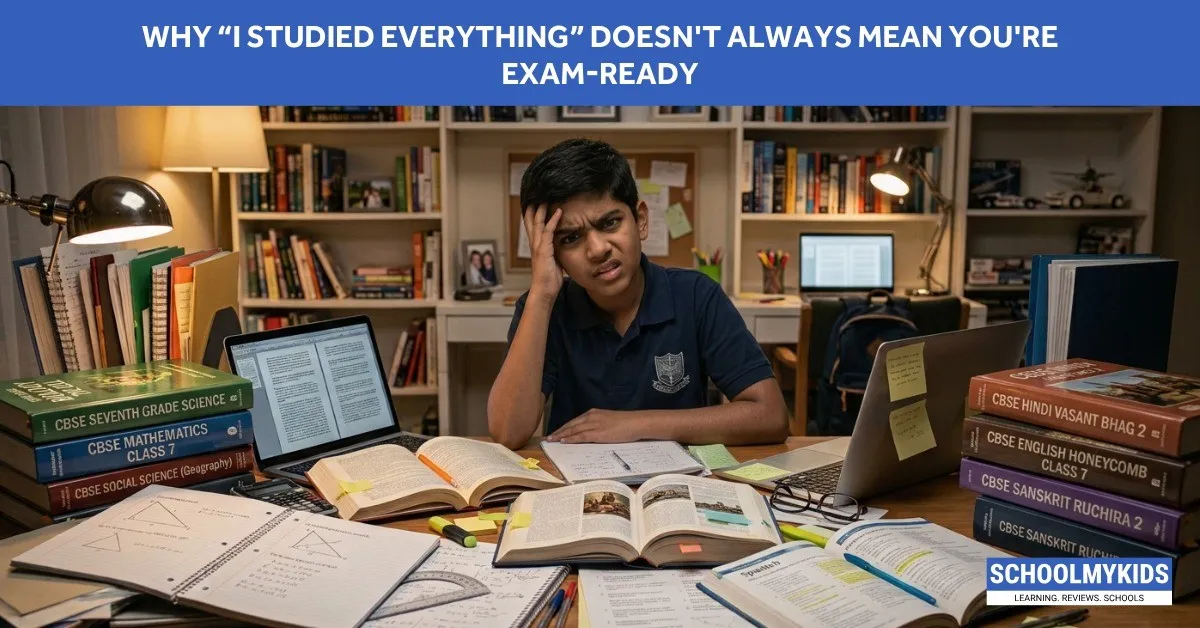
You spent three weeks going through every chapter. Made notes. Reread sections. Highlighted stuff. The day before the exam, you feel confident. Actually confident. “I got this.”
Exam day arrives. Question one. Your mind freezes. The thing you definitely studied. You can’t remember it. Not because it’s hard. Because it never actually went into your long-term memory. It felt familiar when you read it. That familiarity tricked your brain into thinking you knew it.
This isn’t unusual. This happens to almost everyone. And understanding why is the difference between panicking during the exam and actually being ready.
The Sneaky Thing Your Brain Does When You Read
Your brain has two different memory systems. One is immediate recognition. The other is actual retrieval.
When you read something, your brain goes, “Oh yes, I’ve seen this before.” That feeling of recognition feels exactly like understanding. It feels like knowledge. But it’s not.
Research from Washington University in St. Louis tracked students doing exactly this. Students studied prose passages. Felt confident they understood them. Then, when tested on free recall days or a week later without the material in front of them, they blanked. They scored way lower than they expected.
Students who repeatedly reread the material felt the most confident. But on the delayed tests they scored the worst (around 40 percent recalled versus 61 percent for students who practiced retrieval instead) (Roediger & Karpicke, 2006, Psychological Science).
Your brain is literally lying to you. And the lie feels like truth.
What Actually Happened During Your ‘Studying’
When you read chapter five, your brain processes the words. Creates patterns. Recognizes concepts when it sees them again. This creates what researchers call processing fluency (or the fluency illusion). The information flows smoothly. Easy to process.
Your brain mistakes this fluency for understanding. Easy to read = I understand it.
But understanding and recognition are completely different. You can recognize your friend in a photo without being able to describe them in detail. That’s the difference.
For exams, you need retrieval. You need to pull the information out of your memory without the textbook there helping you. Without the chapter there giving you context clues. Your brain needs to access it directly.
The Moment When Studying Wasn’t Actually Studying
If you reread, highlight, make notes, then reread again, you’re doing a version of study called “massed practice.” It feels productive because you keep seeing the same information. Feels like it’s sticking.
Actually, your brain is just getting better at recognizing that specific presentation of the information. The way it’s written in your textbook. The way you highlighted it.
Change the format. Put it in a question. Try to recall it without looking. Suddenly it’s gone.
This is why students say “I know this material” right up until they sit for the exam and realize they don’t actually know it. They know the material when they can see it. They don’t know it when they have to pull it out of memory.
The Real Test Of Whether You’re Ready
Let’s see how to actually know if you’re exam-ready. Not whether you’ve covered everything. Whether you can actually retrieve what you covered.
Take a chapter you studied. Close the book.
Write out everything you remember without looking. Don’t try to be perfect. Just write.
Now check how much you actually remembered versus how much was there.
Most students are shocked. They thought they knew most of it. Turns out the gap between what feels familiar and what they can actually write down is often large.
That gap is real. And that gap is what shows up on exam day.
Why Practice Tests Are The Only Real Metric
Taking an actual exam-format practice test is the only way to know if you’re ready. Not a self-check. Not rereading and feeling confident. An actual full-length exam under time pressure.
You take the practice test. You do worse than you expected. That failure sucks in the moment. But it’s actually the most valuable information you have. It shows you what you don’t actually know.
Then you go back and learn those specific weak areas. Not reread everything. Focus on what you couldn’t retrieve.
Take another practice test. You score higher because you actually learned the gaps. Not because it’s easier. Because you filled in what was missing.
That’s the actual path to exam readiness. Coverage → practice test → identify gaps → targeted learning → practice test again.
The Dunning-Kruger Thing (It’s Real, and It Applies To You)
There’s a psychological concept called the Dunning-Kruger effect (Kruger & Dunning, 1999). Essentially: People who don’t understand something often can’t recognize that they don’t understand it.
Why? Because understanding something is partly about knowing what you need to know to evaluate your own knowledge. If you haven’t learned something deeply, you don’t have the framework to recognize that you haven’t learned it.
So you feel confident. Genuinely confident. Because the parts of your brain that would tell you “wait, you don’t actually get this” aren’t developed enough yet.
This explains why students insist they studied everything and are shocked when they fail. They’re not lying. They genuinely believed they knew it because they didn’t know enough to recognize that they didn’t know it.
Key Takeaways
Recognition (seeing familiar info) is NOT retrieval (pulling it from memory)
Fluency illusion makes rereading feel like learning when it’s not
Students who reread most feel most confident but often score lowest
Coverage of syllabus doesn’t equal ability to retrieve from memory
Practice tests are the only real measure of exam readiness
Dunning-Kruger effect means unknowing students can’t recognize their own gaps
Actual exam readiness requires retrieving information without external cues
Identifying specific weak areas through practice tests matters more than general review
Frequently Asked Questions
Q1: I scored well on practice tests so I should be fine for the real exam, right?
Probably. But only if you took practice tests that were actually hard. And if they were in real exam format. If you took easier versions or had extra time, the real exam might surprise you.
Q2: How much should I cover before I take a practice test?
After covering 70-80 percent of the syllabus, you should take a full practice test. That test will show you what you don’t know. Then use that feedback to focus your remaining study time.
Q3: What if I score badly on practice tests but studied a lot?
That’s actually good information. It means your studying method isn’t working. You need to switch from recognition-based studying (rereading) to retrieval-based studying (practice problems, explaining concepts aloud, writing answers).
Q4: Can I feel ready for an exam without taking practice tests?
You can feel ready. But that feeling is probably an illusion of competence. The only way to actually know is to test yourself under exam conditions.
Q5: My teacher didn’t give us practice tests. What should I do?
Create your own. Use old exams if available. Use textbook questions in exam format. Or find exam papers online for similar subjects. The format matters. You need experience retrieving information without the textbook available.






Be the first one to comment on this story.