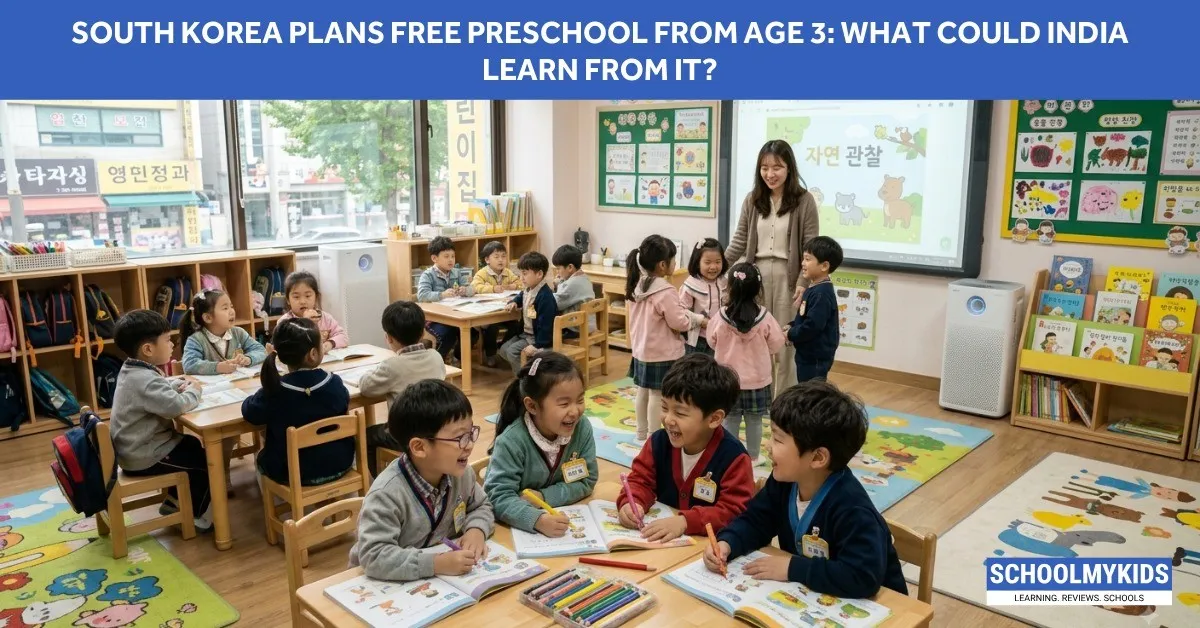
Last month, South Korea announced that from 2027, every child aged three through five will get free preschool and childcare. No means testing. No eligibility criteria. Just free. Everyone gets it.
They’re rolling it out gradually. Five-year-olds got free access starting July 2025. Four-year-olds joined in March 2026. By 2027, kids starting at age three.
The budget is real. Not theoretical. South Korea allocated 128.9 billion won (roughly 92.6 million dollars) just for the second half of 2025 to make the five-year-old phase happen. The government is also raising teacher-to-child ratios and consolidating the system to eliminate disparities between different types of institutions.
India has roughly 14 lakh Anganwadi centres. More than South Korea. But then something weird happened when officials looked at the data from June 2025. Over 10,868 Anganwadi centres operated for less than 20 percent of working days. Roughly 14 lakh centres supposedly exist, but many are not actually functioning at acceptable levels.
Nobody talked about copying South Korea's approach. Which is interesting because the gap between having a system and having a system that actually works is exactly what India's struggling with.
The South Korea Model In Actual Detail
South Korea's government basically said this: Raising kids costs money. Parents pay that money. The government could keep it that way. Or the government could pay. They decided to pay.
The system covers everything. Actual preschool education. Childcare throughout the day. Food. Materials. Teachers. Unified curriculum across public and private institutions.
They targeted 55 percent of kids using public childcare facilities by 2030. Currently sitting at 45.8 percent in 2025. The gap exists because private facilities still thrive, but the government's shifting the incentive structure toward public.
They also addressed something concrete: teacher-to-child ratios. They have set specific targets to improve teacher-to-child ratios, including further reductions for younger age groups by 2028. That’s specificity. Not "we'll improve quality somehow." Specific measurable changes.
The integration piece matters too. Kindergartens and daycare centers were separate systems run by different agencies, creating gaps. South Korea unified them under the education ministry. One system. One standard. One set of rules.
Parents pay basically nothing now for kids three to five. That changes the entire family economics. Suddenly mothers can enter the job market instead of staying home with kids. That's not just about kids. That's about economics.
What India Actually Has With Anganwadi Centers
The network is massive. 14 lakh centres across the country. Genuinely impressive infrastructure if it actually worked.
Each center serves 400 to 800 people in their radius. Centers provide nutrition supplements, health checkups, immunization, and preschool education. On paper, it covers everything South Korea covers.
But the reality. The 10,868 centers operating less than 20 percent of working days in June 2025. That's centers sitting locked most days. Kids showing up to empty facilities.
The infrastructure situation is real. Of the roughly 14 lakh Anganwadi centres, approximately 12.7 lakh have drinking water. 8.4 lakh have piped water connections. 10.6 lakh have functional toilets. 9.3 lakh have kitchen sheds. About 9 lakh have permanent electricity.
Translate that: Roughly a third of centres don't have permanent electricity. About a third don't have proper kitchen facilities. That matters when you're supposed to serve nutrition. The physical infrastructure just isn't there.
Tamil Nadu did an audit in 2025. Out of 18.49 lakh eligible children aged 3-6, only 8.18 lakh were actually served. Less than half the eligible kids were getting services. The gaps existed partly from poor record-keeping and partly from actual absences where centers had no workers.
Workers sometimes go missing. Replacement takes months. Beneficiary tracking is sloppy. External factors like weak community sensitization reduce participation. The system exists but doesn't function at scale consistently.
The Costs Actually Make Sense Though
South Korea is spending roughly the equivalent of what India allocates to Saksham Anganwadi and Poshan 2.0. India's budget for that program is approximately 21,960 crore rupees for 2025-26.
South Korea gets universal free access with that amount. India has universal infrastructure supposedly, but it barely functions for a third of eligible kids.
The difference isn't money. It's what the money actually accomplishes.
What India's Actually Doing Right And Wrong
Right: The Anganwadi network's reach is genuinely good. Spreading across villages where private preschools would never open because profit margins don't work in low-density areas. That's structural thinking.
Wrong: The quality and consistency. A center operating one day a week isn't a service. It's a building sitting empty most days.
Wrong: The integration. Different systems. Education ministry versus health ministry. Kindergartens separate from childcare. Creates confusion and gaps.
Wrong: The targeting. Supposed to be universal but coverage is actually patchy. Some areas have active centers. Others have nothing functional.
Wrong: The worker situation. Anganwadi workers are underpaid, undertrained, sometimes absent. The job is seen as low-status. You get what you pay for.
What Would Actually Work For India
Don't wholesale copy South Korea. Build on what exists but fix what's broken.
First, actually staff the Anganwadi centers. This means paying workers enough to do the job. Right now they're basically volunteers getting a stipend. If you want women to show up daily and provide quality early childhood education, pay them. The job requires training, patience, and consistency. That costs money.
Second, consolidate the system. Stop having different ministries running pieces. Everything goes under one system with one set of standards. Easier to manage. Easier to measure.
Third, upgrade infrastructure. Roughly 14 lakh centres are useless if a third don't have electricity or clean water. Fix the basic stuff first before expanding services.
Fourth, track actual enrollment and attendance. The gap between "14 lakh centres exist" and "how many kids actually participate weekly" is massive. Know the real number. Measure it. Report it.
Fifth, implement this regionally first. Not nationwide immediately. Pilot in three or four states. See what works. See what needs adjustment. Then scale.
Key Takeaways
South Korea mandates free preschool ages 3-5 by 2027 with a unified system and defined budgets
India has roughly 14 lakh Anganwadi centres covering infrastructure but only 8.18 lakh of 18.49 lakh eligible children in Tamil Nadu actually served
Over 10,868 Anganwadi centres operated less than 20 percent of working days as of June 2025
South Korea consolidated kindergartens and childcare under a single ministry; India has fragmented systems
Infrastructure gaps significant: only about 9 lakh of roughly 14 lakh centres have permanent electricity
South Korea allocates specific budget for teacher-to-child ratio improvements; India lacks specific measurable targets
Worker pay and training insufficient in Indian system compared to South Korea's professionalized approach
South Korea targets 55 percent public childcare utilization; India has infrastructure but poor utilization rates
Consolidation under a single system reduces disparities between public and private institutions in the South Korea model
India needs infrastructure upgrades and consistent staffing before meaningful expansion of services
Frequently Asked Questions About Free Preschool
Q1: If India made preschool free for all 3-5 year olds, how much would it cost?
Roughly the budget already allocated to ICDS if the money actually reached ground implementation. The cost isn't the barrier. Making existing centers function is.
Q2: Don't private preschools serve wealthy families in India?
Yes, that market exists. Free universal preschool doesn't kill it. Rich families still choose private for perceived quality. But it creates a floor. Everyone gets access. That's different from the current system where access depends on location and luck.
Q3: Why hasn't India fixed Anganwadi centers before now?
Governance complexity. Multiple ministries. Decentralized implementation. State government capacity varies. Federal systems are messy. Easier to announce programs than implement them at scale across 28 states with different capacity levels.
Q4: Would Indian teachers accept Anganwadi center jobs if paid better?
Probably yes. They'd need training. But pay matters. If it becomes an actual career path instead of a backup job, you'll attract committed people.
Q5: How long would it take India to implement something like South Korea's approach?
If serious: Five to seven years to roll out nationwide. South Korea had advantages of being small and having high government capacity. India needs to pilot, adjust, then scale. That takes time done right.




Be the first one to comment on this story.