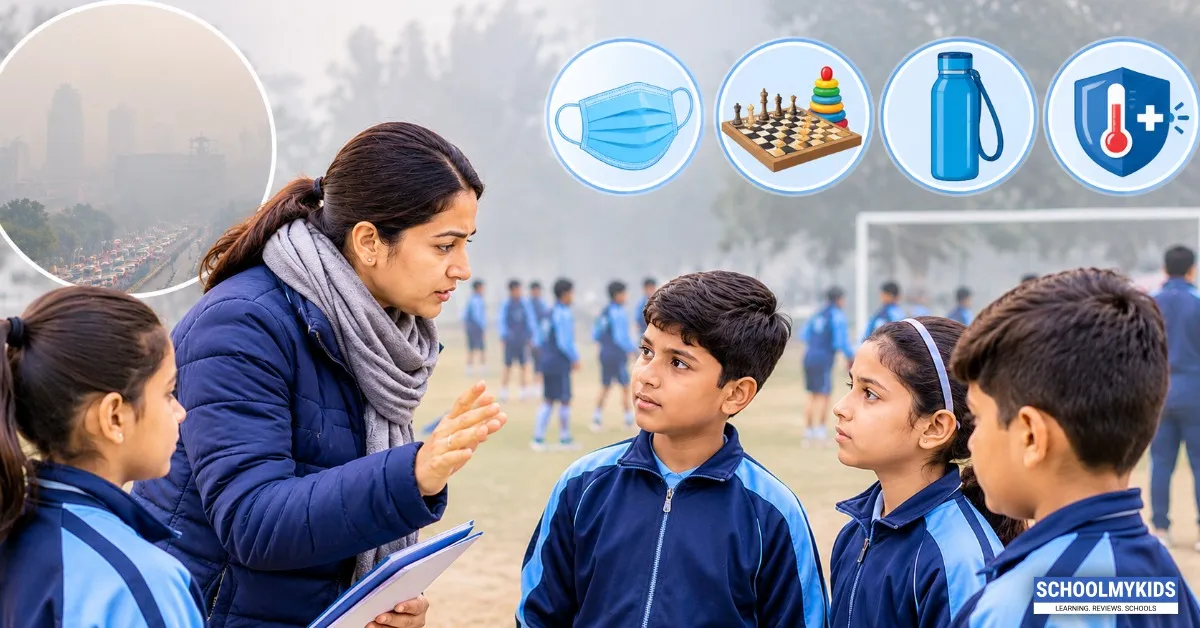
During November and December, schools in the NCR face a difficult situation. This is when annual sports day events, zonal trials, and inter-school tournaments are held. Air quality deteriorates to ‘poor’, ‘very poor’, and ‘severe’ categories during this time, and as a result, parents and teachers have many questions regarding the CAQM’s 2026 advisory on outdoor sports at schools, which are often searched on the internet.
Restricting outdoor sports on high-pollution days does not mean children must stop being active. Schools can and should move suitable physical activities indoors so students remain active while their exposure is reduced.
What CAQM Advisory No. 18 and GRAP Actually Say
Official records are clear. Following the Hon’ble Supreme Court's observations on 19 November 2025 with respect to protecting children from polluted winter air, and after seeking and considering the views of concerned stakeholders, the Commission for Air Quality Management (CAQM) issued Advisory No. 18 on 10 September 2026. In the advisory, the Governments of Delhi, Haryana, Rajasthan, and Uttar Pradesh were advised to ensure that no physical sports activities and competitions are scheduled during November and December 2026, keeping in view the air quality trends prevailing in the area where such events are scheduled to be organised. Already-scheduled events may be rescheduled and students should not be unduly disadvantaged.
It is clear that schools were not prohibited from all outdoor activities. In fact, already-scheduled events can be rescheduled, and governments were advised to ensure that students do not suffer for lack of alternative opportunities to take part in these activities.
School administrators and parents tend to get CAQM’s seasonal sports advisory confused with daily GRAP orders.
CAQM Advisory No. 18 relates to the scheduling and rescheduling of physical sports activities and competitions for the months of November and December 2026. GRAP stages, on the other hand, are activated or revised by CAQM based on air quality levels, forecasts and prevailing meteorological conditions. For example, the Press Information Bureau (PIB) release on the 17th of November 2026 stated that CAQM lifted GRAP Stage III restrictions after the AQI in Delhi improved to 204, and directed the continuation of Stage I and II restrictions.
Just lifting a GRAP stage doesn’t mean it is safe to resume all outdoor sports activities. Schools should still consult the active state education department’s circulars, the advisory of the CAQM, and the local air quality before deciding on outdoor activities.
Why Exercising Outdoors in Smog Affects Children’s Health
Now that we have explained the rules, it’s easier to understand why air quality and public health authorities are concerned about children’s health during outdoor physical activity.
According to the health guidance on air pollution by the National Centre for Disease Control (NCDC), children are at greater risk because their lungs and immune systems are still developing.
The Centre for Science and Environment (CSE) published a report on November 11, 2026, stating that the average PM2.5 concentration in Delhi during the week prior to Diwali 2026 was 236 µg/m³, as compared to 120 µg/m³ in 2025. These levels are citywide averages and do not pertain to any particular school. However, they demonstrate the need for schools to check the local air quality prior to permitting outdoor sports, in addition to consulting the calendar or time of day.
According to the health guidance of the NCDC, air pollution during physical activity can cause coughing and wheezing, and can also worsen existing asthma.
Safety Guide for NCR Schools
Traditionally, schools in the National Capital Region (NCR) of India have looked at a citywide average of the Air Quality Index (AQI) to determine school closures and restrictions. Because pollution levels in different neighbourhoods within NCR can vary greatly, a school in Delhi, for example, may record different pollution levels than a school in Gurugram or Noida.
Schools should check the latest AQI from the nearest CPCB/SAMEER monitoring station along with local forecasts and official alerts. A citywide average is useful but may not reflect conditions at every campus.
AQI Range | Recommended School Action |
|---|---|
0–50 (Good) | Normal outdoor activity for most students, subject to local conditions. |
51–100 (Satisfactory) | Children with asthma and respiratory conditions should reduce prolonged and strenuous outdoor activities. |
101–200 (Moderate) | Children with respiratory conditions should avoid prolonged and strenuous outdoor activities. |
201–300 (Poor) | Schools should restrict outdoor activities as a precautionary measure and move PE and sports indoors. |
301–400 (Very Poor) | Avoid outdoor physical activities, especially during morning and late evening hours. Keep vulnerable children indoors and limit activity levels. |
401–500 (Severe) | Avoid all outdoor physical activities. Keep vulnerable children indoors and keep activity levels low. |
The table incorporates the health advice given by the NCDC, along with the CPCB’s National AQI. It is meant to assist schools in understanding the precautions they should take for physical education and school sports, based on the current air quality. Note that it is not a separate order by the CAQM to restrict school activities based on the AQI.
Teachers can check the official SAMEER app or CPCB website for AQI, along with applicable CAQM and state education department orders, to take appropriate measures before morning assembly or first-period physical education.
Playbook for PE Teachers and Parents
Children must be guided to participate in age and skill-appropriate physical activities to improve and sustain their health and well-being.
For the PE Teacher
While air quality is better indoors, outdoor activities should still be limited and replaced with indoor activities such as badminton, table tennis, yoga, aerobics, dance, fitness circuits, and teaching sports rules, strategies, and nutrition. These activities will improve children’s engagement and interest in sports and games while teaching them about nutrition and sports strategies.
Maintain Confidential Health Records: With parent or guardian consent, keep only the information needed to support students during physical activities (relevant respiratory condition, activity restrictions, and emergency plan). Limit access to staff who need it.
Common Mistakes to Avoid: First, do not allow students to continue strenuous outdoor sports on high-pollution days simply because they are wearing masks. A properly fitted N95 or N99 mask may help reduce exposure during short periods outside, but it is not a substitute for moving activity indoors. Cloth masks are ineffective against fine particles. Schools and parents are advised to follow health advisories and take adequate steps to reduce children's exposure to polluted air rather than using masks as a substitute. Second, do not assume that a campus with lots of trees will not expose children to high levels of PM2.5.
No Attendance or Grade Penalties: Also, students should never be penalized for not participating in outdoor physical activity on bad-air days.
For Parents
Symptoms to Look for: Look for dry coughs, wheezing, difficulty breathing after climbing stairs, irritation in the eyes and throat, and fatigue and headaches in the evenings.
Follow Your Child’s Medical Plan: Children with asthma should follow their doctor’s instructions and keep prescribed medicines available. Parents should share the child’s asthma action plan and any activity restrictions with the school at the start of the winter season.
Frequently Asked Questions
1. Are there any restrictions on outdoor activities of schools in November and December 2026?
There is no legal order to ban all forms of physical activity. However, as per CAQM Advisory No. 18 (10 September 2026), governments in Delhi, Haryana, Rajasthan, and Uttar Pradesh were advised to ensure that no physical sports activities and competitions are scheduled during November and December 2026, keeping in view the air quality trends prevailing in the area where such events are scheduled to be organised. Already-scheduled events may be rescheduled and students should not be unduly disadvantaged. Live GRAP orders govern regular school routines.
2. What AQI level should schools use as a threshold to avoid outdoor physical activities?
Schools should take a cautious approach and move PE and sports activities to indoor facilities once the Air Quality Index (AQI) reaches the ‘Poor’ level (201–300). Schools should refrain from conducting outdoor activities when AQI is in the ‘Very Poor’ (301–400) and ‘Severe’ (401–500) categories.
3. Is it recommended for children to wear masks while playing outdoor sports in high pollution levels?
No. While wearing an N95 or N99 mask may help reduce exposure during short periods outside, masks should not be used to allow kids to participate in outdoor sports during Poor or Severe air quality days. Moving the activity indoors is safer.
4. How should kids stay physically active indoors during winter smog?
A range of physical activities can be done indoors and include yoga, bodyweight exercises and circuits, badminton, table tennis, dancing, and games that develop movement, strength, and coordination.
Conclusion
Kids in Delhi-NCR shouldn’t have to compromise their health to participate in winter sports, and shouldn’t have to give up physical activities just because of the smog. Families and schools should take steps to move activities indoors to protect kids’ respiratory health and continue staying fit and active.
Families looking for schools located in Delhi-NCR can use the SchoolMyKids school directory. To supplement indoor physical activities, get free printables and worksheets from SchoolMyKids.
References
Commission for Air Quality Management (CAQM): Advisory No. 18 — Rescheduling of Physical Sports Competitions Scheduled in November–December (10 September 2026).
Press Information Bureau (PIB), Government of India: CAQM Revokes GRAP Stage III in Delhi-NCR, Moves to GRAP Stage II as AQI Improves (17 November 2026).
National Centre for Disease Control (NCDC) & Ministry of Health and Family Welfare (MoHFW): Health Advisory on Air Pollution for Vulnerable Groups and School Children.
Central Pollution Control Board (CPCB): National Air Quality Index (AQI) Categories & SAMEER Live Air Quality Portal.
Centre for Science and Environment (CSE): Early-Winter Post-Diwali Air Pollution Analysis for Delhi-NCR (11 November 2026).